The company teaching medicine to run trials with fewer placebos - by giving every patient an AI twin.
Somewhere right now, a person is sitting in a clinic chair, sleeve rolled up, about to be randomized into the placebo arm of a trial. They will receive nothing useful for months. They volunteered anyway. Unlearn.AI looked at that chair and asked an uncomfortable question: what if the empty seat next to them could be filled by math instead of another patient?
Unlearn.AI is a San Francisco company with a deliberately contrarian name. Its product is the digital twin - and the first thing to know is what it is not. It is not a 3D avatar. It is not a chatbot wearing a lab coat. It is a statistical prediction: for every participant who enrolls in a trial, Unlearn generates a comprehensive, longitudinal forecast of how that exact person would most likely have progressed had they been handed the placebo.
Feed that forecast into the analysis and something quietly radical happens. You no longer need as many real human beings sitting in the control group, because you already have a credible, patient-by-patient model of the counterfactual. Unlearn folds this into two unglamorous-sounding inventions: PROCOVA, the statistical method, and TwinRCT, the trial design. Together they let sponsors cut control arms by up to a third without breaking randomization and without smuggling in bias.
The math is old-fashioned in the best way - it is prognostic covariate adjustment, a technique statisticians already trust - supercharged by machine-learning models trained on more than 300,000 patient histories and a million-plus interactions. The result is thirteen disease-specific Digital Twin Generators, each one a specialist that has, in effect, read every trial in its field and remembered how the placebo patients fared.
It is a tidy bit of judo. Rather than ask regulators to trust a black box, Unlearn handed them an old, respectable statistic wearing new, faster shoes.
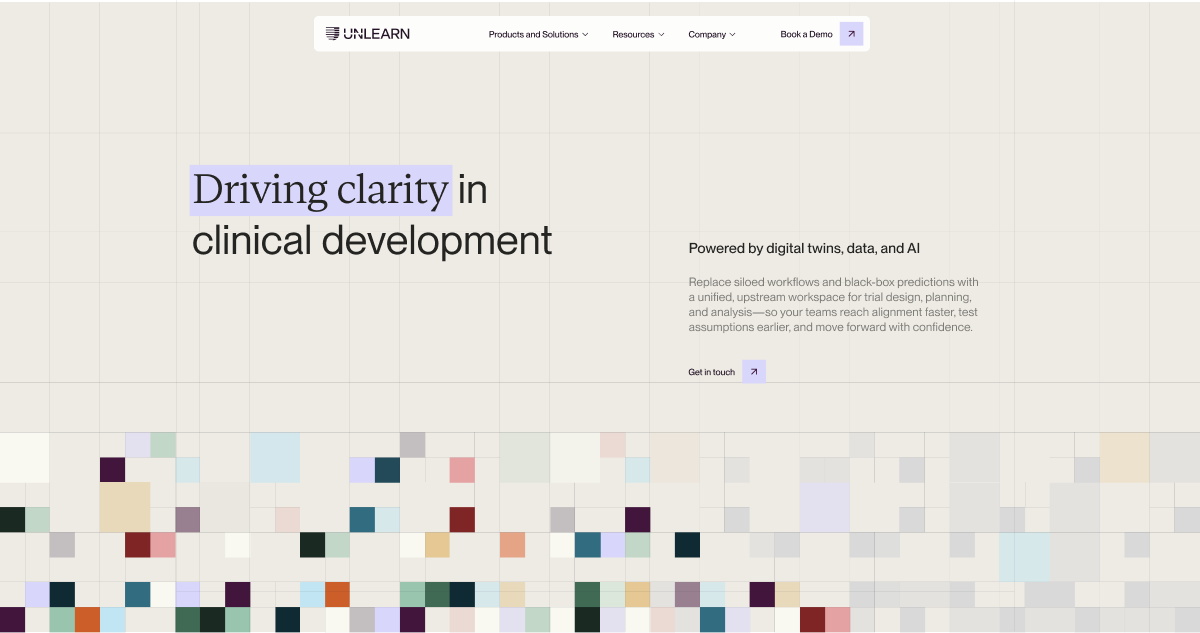
"Replace siloed workflows and black-box predictions with a unified, upstream workspace for trial design, planning, and analysis."
— Unlearn.AI, on what it actually sellsTrain a disease-specific model on hundreds of thousands of historical patient records.
For each enrollee, predict their full placebo trajectory - the arm they were never assigned to.
Randomize as normal, but with a smaller control group propped up by twin forecasts.
Use the prognostic score to sharpen the readout - more statistical power, fewer patients.
Unlearn's pitch lives or dies on a single trade: how much of the control arm can you replace before the science wobbles? The company reports reductions of roughly a third, with timeline savings to match. Bars below are illustrative of Unlearn's publicly stated figures.
SOURCE: Unlearn.AI public statements & press coverage. Figures approximate and trial-dependent.
Pharma and biotech sponsors design smaller, faster pivotal and Phase 2 trials - shifting more volunteers onto the candidate drug while keeping the statistics honest.
Teams get a prognostic score per patient and a regulator-reviewed adjustment method, instead of arguing about external control arms from scratch.
A reanalysis can surface signal hiding in noisy data - Unlearn famously revisited a Remynd trial and found efficacy that would otherwise have been missed.
The therapeutic sweet spot so far is neuroscience - Alzheimer's and ALS - where progression is brutal, trials are long, and every saved month is the difference between a drug arriving in time or not. From there the work has spread into immunology and beyond, with collaborators including Merck KGaA, AbbVie and Roche.
Charles Fisher, Aaron Smith and Jon Walsh met building motion sensors at Leap Motion - a startup chasing the augmented-reality wave. When that wave broke, the three physicists decided the more interesting hard problem was inside medicine, where the data was messy, the stakes were lives, and nobody had thought to apply their kind of modeling.
Today Steve Herne runs the company as CEO. The board reads like a crossover episode: Mira Murati, OpenAI's former CTO, sits alongside Ann Taylor, AstraZeneca's former chief medical officer - frontier AI shaking hands with the clinic.
Three Leap Motion alumni point physics at the clinical trial.
Multi-year deal to bring TwinRCT designs to late-stage immunology trials.
Insight Partners and 8VC back the digital-twin service.
The first time a regulator formally supports a machine-learning method to reduce pivotal-trial sample size; the FDA concurs it fits current guidance.
Altimeter Capital leads; total raised reaches roughly $130M.
Peer-reviewed work in Alzheimer's & Dementia: TRCI shows digital twins boosting trial efficiency.
8VC, DCVC, Mubadala Capital.
Insight Partners, 8VC, DCVC, Radical Ventures, Mubadala Capital.
Altimeter Capital, Radical Ventures, Wittington Ventures, Mubadala, Epic, Necessary VC.
Third-party trackers pegged Unlearn's valuation around $254M-$269M in early 2023; the Series C valuation is not public.
Return to that clinic chair. The volunteer with the rolled-up sleeve is still there - because trials still need real people, and they always will. But the seat beside them is changing. Where a second body once had to sit out the study on a sugar pill, there is now a forecast: a digital twin doing the unglamorous work of standing in for the placebo, so the next volunteer can get the real thing.
That is the whole, quiet ambition of Unlearn.AI. Not a robot doctor. Not a miracle drug. Just a stubborn insistence that medicine can be less wasteful with the people brave enough to enroll - and that the fastest way to a new treatment might be to need fewer of them in the dark. The grid of colored squares on their homepage was never decoration. Each square is a patient, and Unlearn is betting it can read them well enough to give the rest of us a few more years back.
Product explainers, talks, and digital-twin demos.
Founder talks on digital twins and the future of trials.