The patient had been seen. The doctor had made the rounds. Yet at Minnesota Oncology, the hospital charge could spend another 25 days making its way through the system. A paper census travelled with the physician, collecting codes and notes. Sometimes the sheet disappeared. Sometimes it simply failed to reach the right hands. The clinical encounter was over; its administrative afterlife was only beginning.
That is an unglamorous place to build a technology company. It is also pMD’s territory. The San Francisco business makes software for recording charges, communicating about patients and managing the work of getting paid. Its proposition starts with a familiar frustration: useful information exists, but the person who needs it cannot act on it yet.
- Capture the visit: pCharge records billable encounters on phones, tablets and computers.
- Connect the people: pChat brings secure messaging, voice and video into the workflow.
- Finish the job: pRevenue adds billing specialists and revenue cycle services.
Twenty days hiding in a handoff
Minnesota Oncology’s account offers a useful glimpse of the problem. Its office charges were working reasonably well. Hospital charges were the awkward exception, moving between clinicians, facilities and a central billing team. The practice needed a connection across systems that already existed.
In the case study pMD published in 2017, the group reported cutting hospital and surgical charge turnaround from about 25 days to five. Its rollout began in September 2016 and proceeded in four phases over four months. This was a company-published customer result, with all the limits that implies, rather than a promise for the next practice.
Charge turnaround, not time to insurance payment.
The distinction matters. A charge arriving sooner gives billing staff an earlier chance to work. It does not mean an insurer has paid. The improvement begins with making the encounter visible.
The index card had a second job
A smaller customer reveals another part of the story. North Shore Cardiopulmonary Associates, a three-physician practice, had used a pen and three-by-five-inch index cards to collect patient charge information. Its problem included administrative expense, inaccurate reporting and lost reimbursement.
According to pMD’s 2015 case study, North Shore first inventoried technology its doctors already understood. It then adopted pMD and kept recording inpatient information on paper for the first month, creating a practical comparison between old and new methods. The practice reported an annual revenue increase of $67,000 per physician.
That historical figure is an account from a customer, rather than an independently established return. The method is easier to borrow than the number: use familiar equipment, retain a comparison long enough to spot differences, and measure a result the practice actually cares about.
The phone is only half the product
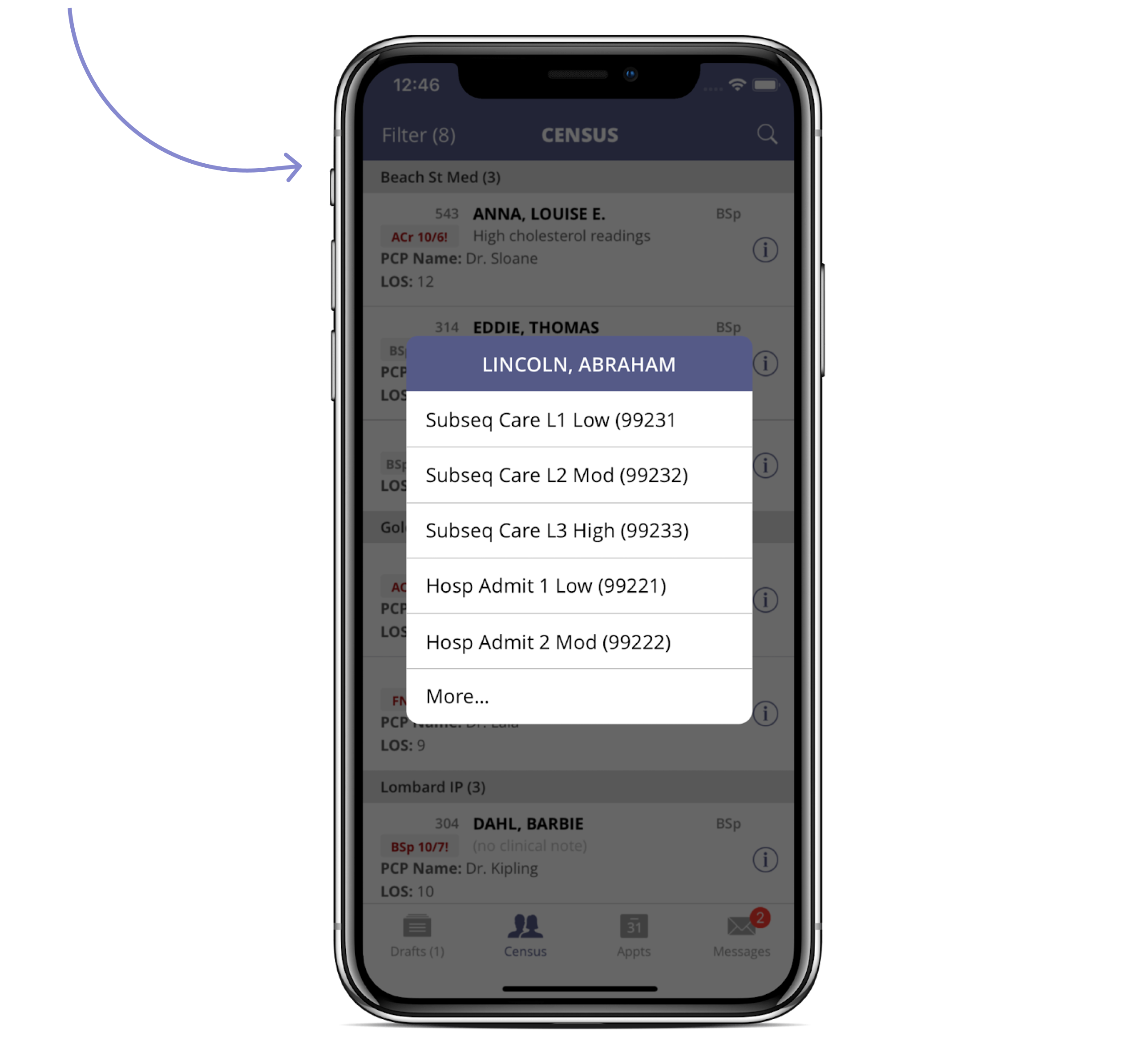
Today, pCharge lets clinicians record charges at the point of care. pMD says its Instant Capture feature can record a charge in two taps, in under two seconds. The mobile application also captures charges offline. Those details address the conditions of rounds: limited time, movement between rooms and imperfect connectivity.
pChat handles another handoff: the conversation. It offers encrypted messaging, voice and video, including communication with patients and colleagues outside the same organization. Its listed price is $10 per user per month, with patient contacts included and no setup fees or long-term contracts.
A practice can buy communication without buying outsourced billing. pChat itself cannot bill patients. For broader financial work, pRevenue combines software with medical billing and revenue cycle specialists. Its offering includes AI-assisted demographics and insurance verification. pDemographics processes uploaded facesheets, turning information on a document into verified patient details.
pMD sits in a market that includes charge capture vendors such as MDTech and Ingenious Med. Mobile entry alone gives buyers little reason to stop comparing. The more revealing question is how software, interfaces and the people doing billing fit together.
The people answering the phone
pSuite makes that service component explicit. Its tiers cover in-house support around the clock, workflow consultation, integrations and account management. Premier comes with pCharge; Ultimate is reserved for pRevenue. pMD says it does not charge clients for creating, testing and maintaining its interfaces with other systems.
“How else can we help?”The question pMD says its employees ask customers.
Implementation therefore belongs in the buying decision alongside the subscription. A practice needs agreement about the systems exchanging information, the tasks staff retain and the measures that show progress. Even a short interaction on a phone depends on preparation elsewhere.

The founder’s route into that work was personal. Philippe d’Offay told university students that he initially wanted to avoid the medical industry and began in consulting. His mother’s illness changed his assessment of where he could help. He also described learning to recruit colleagues who wanted responsibility and a stake in decisions.
pMD’s published history reaches back to the PalmPilot. Its current account of engineering emphasizes direct contact with customers, making feedback part of the job. The device changed; the need to understand the clinician’s working day remained.
Trust also depends on how the information is protected. In October 2026, pMD announced completion of its annual SOC 2 Type II and HIPAA audits, conducted by Linford & Company LLP. The SOC 2 assessment covered controls over a twelve-month period. For a practice evaluating the company, that announcement belongs beside the workflow discussion: the same records that need to move quickly also need careful handling.
Who fixes the rejected claim?
In March 2026, pMD argued that AI-assisted billing still requires human oversight, workflow improvement and persistent denial follow-up. That argument serves its commercial interests, but it also gives buyers a concrete question: when a claim is denied, whose staff corrects it, resubmits it and follows through?
Faster entry will have limited value if documentation remains incomplete or responsibility ends at an alert. A practice whose existing systems already handle these tasks well has less reason to add another tool. For everyone comparing options, pMD’s story suggests a useful place to start: follow one encounter from bedside to payment, and find the first place it waits.
Keep exploring
Visit pMD · Explore pCharge · News & insights