Before Piyush Goel founded a software company, he qualified as a chartered accountant. It is a useful detail to keep in mind when he talks about artificial intelligence. There are plenty of people willing to explain what a new system can do. Goel keeps returning to a less glamorous question: what happens to the business when somebody actually uses it?
His career has taken him from accountancy into information systems, from founding Beyond Key in 2005 to moving to Chicago in 2017. Along the way, the company has built software, expanded into cloud and data services, and pursued AI. The vocabulary has changed considerably. His recurring interests - simplicity, client involvement and the practical work of running a company - have proved rather less fashionable, and rather more durable.
The accountant keeps studying
Goel’s education did not stop with his qualification from the Institute of Chartered Accountants of India. He added a diploma in information systems from the same institution, followed by an honours qualification in systems management at the National Institute of Information Technology. Later came an executive programme on artificial intelligence and business strategy at MIT Sloan.
That sequence matters because it crosses the boundary that technology businesses spend much of their time negotiating. A client has a commercial problem. A developer has technical possibilities. Getting the two to meet requires somebody willing to understand both languages, including the awkward bits that tend to disappear from a sales presentation.
Goel’s advice to aspiring founders reflects this education. He tells them to learn financial management, planning, marketing and customer relations alongside the technical work. He also recommends hiring people whose abilities fill the founder’s gaps. For somebody running a software business, it is a pleasantly unromantic account of entrepreneurship: learn how the company works, then find colleagues who know things you do not.
A retailer, a recession, a company
Beyond Key’s early work included building a digital platform for an online retailer. Its twentieth-anniversary account traces the business back to that project. The detail gives a practical starting point to a company now associated with a broad menu of enterprise services. There was a retailer with work to get done before there was a catalogue of capabilities to describe.
Founded in 2005, the business soon encountered the 2008-09 recession. Goel has recalled getting through that period and earning Microsoft Gold Partner status during the company’s early years. These are milestones with different meanings: one concerns surviving a difficult market; the other concerns developing technical credentials. A services company needs customers to believe in both its competence and its ability to remain around.
By November 2022, he was describing a business that had worked with more than 500 companies. That was his account at the time, rather than a live customer count. The same period’s expansion covered Indianapolis, Chicago, Pune, Hyderabad and Indore. The enterprise had travelled some distance from its first retail platform, while still selling help with the troublesome details of business operations.
Chicago was a personal move
International expansion became a change of address for Goel himself. In 2017, he moved to Chicago and established Beyond Technologies LLC as the group’s global headquarters. The following year, the company announced a Chicago office. Dates like these can look tidy on a timeline. In a founder’s career, they mark the point at which an overseas market becomes somewhere one lives.
The move also sits alongside his involvement in the Entrepreneurs’ Organization in Chicago and Indore. He has been an angel investor and a mentor to startups, and his public biography has included membership of the Economic Club of Chicago. His professional world extends beyond managing one company to spending time around other people trying to build and run businesses.
There is a connection between those networks and the counsel he gives younger founders. He encourages them to seek mentors, listen to customers and remain flexible about how they pursue their goals. His own route required several kinds of education and a move across continents. The pattern suggests a founder comfortable adding to his toolkit rather than insisting the original one should be sufficient.
The client gets a say
In Goel’s account of Beyond Key’s working methods, the customer remains involved during development. Feedback shapes revisions; requirements are particular to the organisation. The principle sounds modest, until one considers how much enterprise software must accommodate: existing processes, established habits and people who still have ordinary work to finish while a new system arrives.
His 2023 description of the commercial model was similarly concrete. Clients paid for customised services and solutions on a project basis. He emphasised continuity of project staff, domain knowledge and a choice of onshore, offshore and nearshore arrangements. These are details of delivery rather than theatrical claims about invention. Customers, after all, may prefer seeing the same colleague on Monday to meeting a fresh visionary every week.
In 2024, he described a growth plan built around expanding services, strengthening client relationships and investing in talent and innovation. AI, cloud computing and analytics formed part of that plan. He also stressed adoption, data quality and alignment with business goals. The ambition was to expand the company while keeping its work attached to something a customer could recognise as useful.
By March 2025, his discussion of data consulting began with fragmented systems and information that businesses struggled to use. He described understanding the client’s data environment before improving architecture and analytics. His proposed measures of success included delivery, adoption, smoother processes and fewer operational bottlenecks. A dashboard can be handsome; the queue of unfinished work still deserves attention.
- UnderstandFind the business problem.
- ConnectMake data and systems work together.
- ObserveCheck adoption and results.
The carnival has a purpose
At Beyond Key’s Heartbeats 2023 celebration in Indore, the agenda included carnival stalls, games, singing, dancing and recognition for long-serving employees. Families and children joined the event. A company gathering with more than 15 stalls offers a different picture of enterprise technology from the usual diagram of interconnected rectangles.
Goel used his address to talk about the team’s geographic spread, including employees from more than 15 Indian states and colleagues in the United States, Canada and Japan. He also spoke about volunteers working with children in Machala, a village near Indore. That part of the company’s activity drew a personal response: he described the initiative as close to him and thanked the volunteers.
His emphasis on people also appears in less festive arrangements. Beyond Key describes renewing training subscriptions so employees can keep learning as technology changes. Its workplace recognition has included Great Place to Work certification. The practical question underneath these programmes is familiar from his client work: how do people acquire the knowledge to use the systems being introduced around them?
“Our people are the foundation of our success”
Piyush Goel
There are external markers of the company’s progress, too. Beyond Key received an Inc. Power Partner award in 2024, with Goel listed as its leader. It has also received Stevie and Titan awards. These belong to the organisation and its colleagues, rather than serving as decorations for the founder alone. The annual celebration’s recognition of long service makes that distinction visible.
When the software starts taking action
Goel’s AI discussions have grown more operational as the technology has developed. In 2023, he described using AI to support employees and free their time for work requiring creativity and judgement. He also discussed training, access controls, encryption and security reviews. His interest in automation was accompanied by an interest in the conditions under which people could trust it.
He has carried that discussion into public writing. His Times of India contributions have covered AI in business intelligence and the relationship between digital transformation and customer experience. A YourStory article examined personalised interactions through intelligent document processing. These topics reveal a consistent curiosity about what happens between information arriving in an organisation and someone deciding what to do with it.
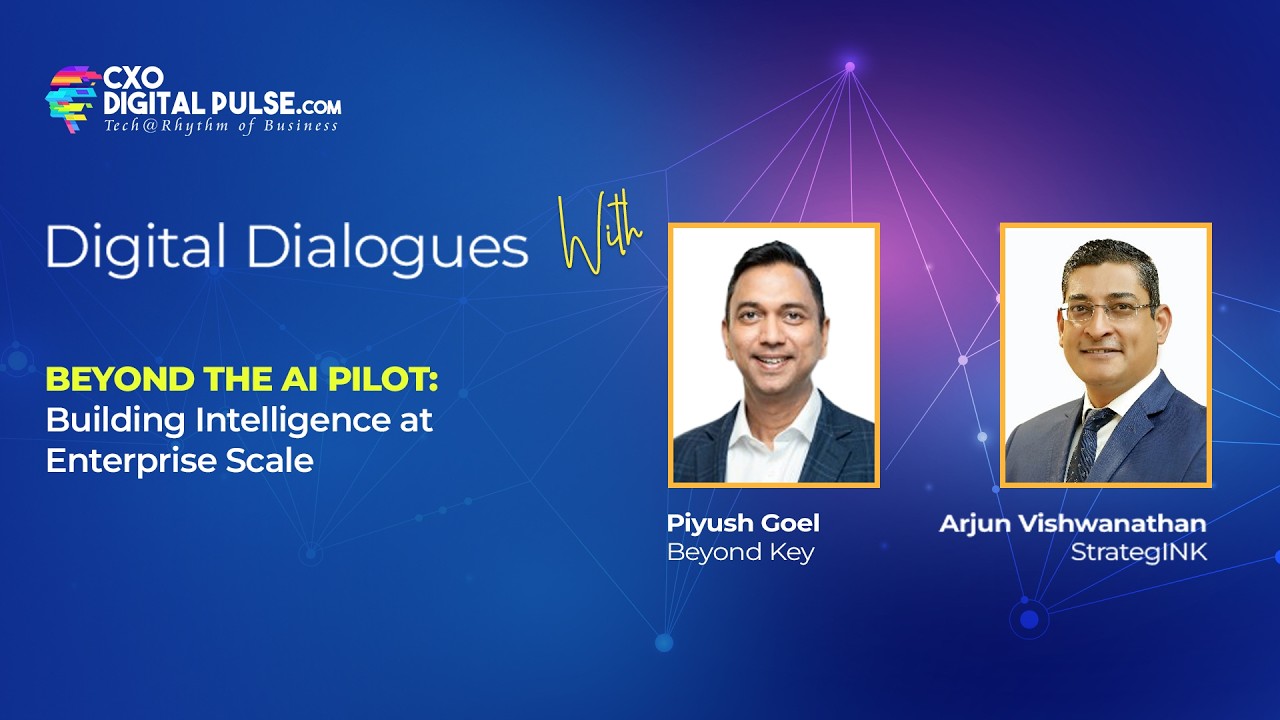
In September 2026, he described enterprise AI as a matter of operating models, ownership and measurable outcomes. His examples included procurement agents checking requisitions and supplier information. He argued for gradually increasing autonomy, defining permissions, recording actions and assigning responsibility. The more software can do, in this account, the more carefully somebody must decide what it should be allowed to do.
His changing view of leadership was especially revealing. Speed had become less impressive to him as a measure of performance. He placed more weight on learning, experimentation and helping people make sound decisions while answers were still emerging. That is a demanding position for a technology founder: sell the possibilities, while asking colleagues and customers to examine the surrounding business with equal care.
Room for another question
Away from work, Goel plays tennis and golf, reads, enjoys philosophical thinking and spends time with friends and family. Those interests give the public portrait some welcome space beyond software. A reading habit also fits the visible course of his education: one qualification followed by another, with a later return to the classroom for AI and strategy.
The question running through his career is what complexity is worth keeping. Some of it is unavoidable: different markets, legacy systems, unfamiliar technology, teams spread across countries. Some of it merely makes work harder. Goel has built his company around helping clients tell the difference. For a founder who began in accountancy and kept studying, usefulness remains a perfectly respectable ambition.
Continue the conversation
- Beyond Key
- Piyush Goel on LinkedIn
- The career interview
- The early company story
- Chicago office announcement
- Client work and growth
- Data and delivery
- Heartbeats in Indore
- The people behind the work
- Twenty years of Beyond Key
- 2024 Inc. Power Partner recognition
- AI and the software workforce
- The 2023 business interview
- Enterprise AI in 2026
- Writing at YourStory
- AI and business intelligence
- Digital transformation and customer experience
- Watch Digital Dialogues on YouTube