Ryan Fukushima once spent months chasing a deal and emerged with a phrase worth keeping: “pilot purgatory.” Anyone who has watched an enthusiastic business conversation acquire its sixth follow-up meeting will recognize the place. There is plenty of activity. A decision remains tantalizingly out of reach. The calendar fills up with evidence that everyone is interested.
Fukushima has described the episode publicly, including his own mistake in pursuing it without a clear strategy. That willingness to discuss an unproductive stretch makes a useful entrance to his career. The executive titles are straightforward enough. The education behind them is more interesting: learning how a technically impressive idea becomes a business, and how easily the people building it can confuse excitement with commitment.
Today he leads Data & Apps at Tempus AI. He is also a co-founder and director of Pathos. Earlier came engineering, an MBA, and venture investing. Look closely at those changes of role and a recurring question appears. What has to happen between believing that something should exist and getting an organization to make it work?
Before the pitch, the backend
Fukushima’s technical work included designing and implementing backend systems for Cisco and VMware. He earned an engineering degree at California Polytechnic State University, San Luis Obispo, and an MBA at the University of Michigan’s Ross School of Business, where he was a Zell Scholar. Engineering and business supplied two different ways of examining an enterprise: the machinery underneath it and the decisions that justify building the machinery.
He then worked at Hyde Park Venture Partners, concentrating on enterprise investments in the Midwest. At Lightbank, he became an entrepreneur-in-residence and vice president. Those jobs placed him close to the early decisions that determine a company’s direction: which problem deserves attention, who might buy a solution, and whether the team can deliver what it proposes.
There is a particular tension in that progression. Investing rewards a persuasive account of what a company might become. Operating requires arranging the people, systems, and agreements that allow it to become anything at all. A slide can contain a very elegant business. Monday morning tends to require a few more details.
- 2014Lightbank
Investor & entrepreneur-in-residence - 2015Tempus
Chief operating officer - 2024Nasdaq
Tempus begins trading as TEM - 2026Data & Apps
CEO at Tempus AI
A company cannot run on a presentation
Fukushima became Tempus’s chief operating officer in September 2015. The date matters because it puts him near the beginning of the business, long before the public-market milestone that would later provide an easy shorthand for its growth. His assignment stretched across the years when an organization was still establishing how its work would be done.
On June 14, 2024, Tempus began trading on Nasdaq under TEM. Its offering had been priced at $37 a share, with 11.1 million shares offered and expected gross proceeds of $410.7 million before fees and expenses. These are company figures, rather than a personal scorecard for Fukushima. They describe the scale of the institution he had helped operate.
The bell-ringing ceremony belongs to a specific morning. The operating tenure occupies most of the preceding decade. Putting the two beside each other changes the emphasis of the story. Public markets offer a memorable photograph; building a company involves years of decisions that rarely arrive with photographers. Hiring, product priorities, and commercial agreements have to accumulate into something that can withstand scrutiny.
Nearly nine years after Fukushima became COO.
The customer has a different calendar
In a March 2025 essay about customer interviews, Fukushima recalled presenting a sophisticated platform and receiving polite interest without the urgency his team expected. The builders could see the future they wanted to create. The people across the table had existing problems and existing ways of getting through the week.
He described a change in the conversation: asking about current difficulties and how customers were handling them, rather than asking them to imagine an ideal product. The adjustment sounds modest. It requires giving up the pleasure of explaining one’s invention long enough to hear something inconvenient about its reception.
His account places the turning point in understanding a recognizable problem. That gives the episode its wider relevance. A customer does not need to share a founder’s entire theory of the future to decide that a particular piece of work is worth paying for. The first agreement can be considerably smaller than the original ambition.
“Innovation without context is just novelty.”
Ryan Fukushima, on customer discovery
When the impressive résumé gets in the way
Fukushima has also written about overvaluing experience when hiring. In his account, people with distinguished backgrounds brought approaches that fitted an established business better than the category his team was trying to create. Colleagues without the same industry history proved more effective at learning their way through unfamiliar work.
His opening admission was unusually direct: “I prioritized experience over potential.” It is a useful sentence because the subject is himself. A hiring retrospective becomes less useful when every failure belongs to the recruits and every success belongs to the person who selected them.
The episode raises a practical distinction between credentials and fit. Experience can shorten the route through a familiar problem. An unfamiliar problem may require someone willing to question the route. For a leader, the difficult part is deciding which kind of task is actually in front of the team. The candidate’s previous employer cannot answer that question.
The handshake and the screen
Another part of his operating career is visible in a photograph from 2024. Fukushima stands at the left, shaking hands with SoftBank’s Masayoshi Son. Eric Lefkofsky, Tempus’s founder and chief executive, appears on a screen beside them. It is a company-expansion picture with an unusually tidy arrangement of physical and remote attendance.
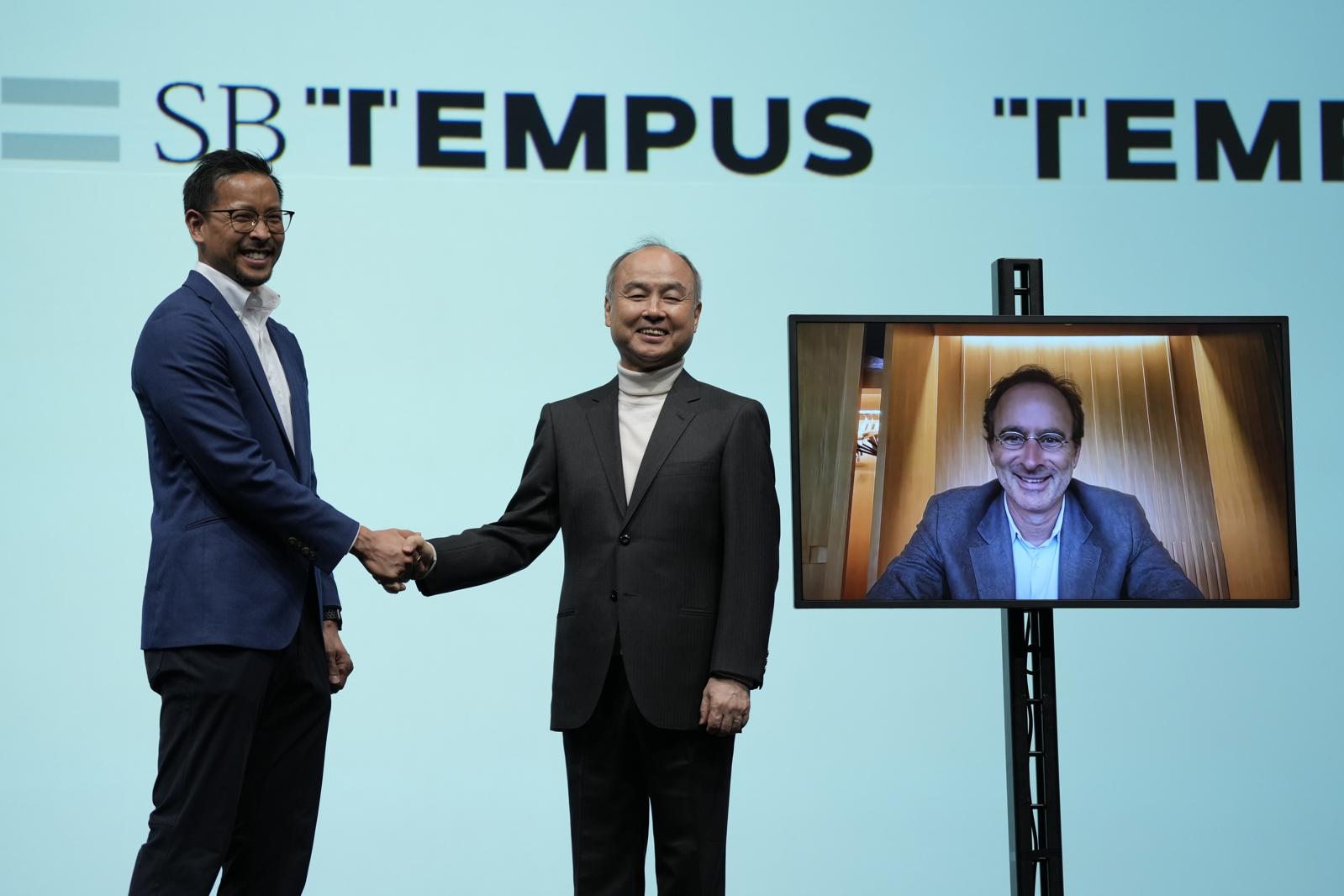
SoftBank announced the SB TEMPUS joint venture on June 27, 2024. Its announcement listed Fukushima and Hidebumi Kitahara as representative directors, with a planned equal investment of 15 billion yen from each partner. The structure put a concrete international responsibility beside Fukushima’s Chicago-based career.
A joint venture is a different test from a sales presentation. The parties must agree how an organization will be owned and governed. The announcement specified a fifty-fifty investment ratio. That detail brings the photograph back down to business: behind the handshake sits an agreement about who contributes, who participates, and how the new enterprise is constituted.
A second company, and a different seat
Alongside his Tempus work, Fukushima co-founded Pathos with Lefkofsky. He served as its interim CEO. The overlap adds a second kind of company-building responsibility to his résumé, one that eventually included deciding how his own position would change.
On May 8, 2025, Pathos announced Iker Huerga as chief executive and a board member. Fukushima moved into an advisory role and remained on the board. Those are different jobs with different relationships to everyday decisions. The transition preserved his connection to the company while assigning executive leadership to someone else.
Founder stories often move briskly from creation to expansion, treating the founder’s continuing authority as part of the scenery. Here, a documented handover deserves its own space. Starting an organization and holding its chief executive title indefinitely are separate choices. Fukushima’s career includes the decision to remain involved from another seat.
The handover also offers a concrete answer to a question that follows executives across expanding businesses: where can their involvement be useful now? An advisory role and a board seat preserve a relationship while changing its terms. The announcement makes that change visible. For a reader following Fukushima through older interviews and newer biographies, it is an important point on the timeline. A title records a responsibility at a particular moment. Following the changes in that responsibility tells considerably more about a career than collecting the titles together.
The operator opens a notebook
In early 2025, Fukushima began experimenting more deliberately with public writing. He reported eighteen posts in nine weeks, more than 200,000 impressions, and over 5,000 new followers. The figures were his own account of the experiment. What interests him enough to publish is at least as revealing as the audience totals.
He writes about decisions that can look embarrassingly ordinary beside an ambitious technology business: selecting colleagues, understanding buyers, designing an agreement. The stalled pilot appears again in that context. His emphasis on shared measures of success, committed internal champions, and a workable pricing arrangement gives the story something more substantial than a complaint about slow negotiations.
Public writing also changes the form of an operating lesson. Inside a company, a mistake produces another meeting or a revised plan. Outside it, the same episode must become intelligible to someone who never attended the meeting. That requires choosing what was distinctive about the problem and what another builder might recognize.
Fukushima’s current title, CEO of Data & Apps, returns the story to an operating assignment. Tempus’s overall chief executive remains Lefkofsky. The distinction locates Fukushima’s responsibility within a larger organization, after years in which his work has included investing, building, international governance, and handing over a chief executive role.
The career becomes easier to understand when those changes receive as much attention as the milestones. He has been the engineer behind a system, the investor examining a business, the operator responsible for delivery, and the founder who stays on the board after a leadership transition. His public accounts suggest an ongoing education in choosing the right question for each seat. Occasionally, the tuition appears as several months of meetings.
Follow the questions
More from Fukushima and the organizations in his story.
- Ryan Fukushima on LinkedIn ↗
- His newsletter ↗
- His engineering and investing background ↗
- The public-writing experiment ↗
- His hiring retrospective ↗
- The Tempus IPO announcement ↗
- The Customer Interview Paradox ↗
- His account of a stalled pilot ↗
- Tempus AI ↗ · Pathos ↗
- The SB TEMPUS announcement ↗
- Pathos leadership announcement ↗