A scanned claim form is a peculiar sort of progress. The paper has become a file. It can travel by email, sit in a database, appear on a screen. Yet somebody may still have to read it and type its contents into another system. The document has moved into the digital age; the employee is doing the same old work.
That was the problem described in Beyond Key’s work for Breg, the American orthopedic bracing company. Clinics received hundreds of patient details and claim forms. Employees entered the records manually. Beyond Key, already working on claims management and business intelligence for Breg, proposed optical character recognition: read printed text from scans and turn it into digital characters.
It is a modest scene with a large implication. Buying software and improving work are separate events. Between them lies a collection of awkward transfers, exceptions, and habits. Beyond Key has built a business around that territory.
- It builds and connects enterprise software, with a substantial Microsoft practice.
- Its customer work runs from claims processing to technician training and cloud analytics.
- It sells tailored services alongside products for search, procurement, and nonprofits.
- The useful buying question: which piece of work will become easier to finish?
The scan was only half the job
Breg’s problem began at the handoff. Capturing a document did not make its contents available to the claims workflow. Beyond Key’s account describes a relationship spanning more than six years at the time of publication, including a claims management system and BI dashboards. OCR extended that work into the incoming paperwork.
The distinction matters. An OCR demonstration can show text appearing on a screen. A useful implementation has to deliver that text somewhere an employee can act on it. The company’s separate insurance-enrollment case explicitly pairs OCR extraction with human verification. Automation, in that account, has room for a person checking the result.
Read these cases as descriptions of the work performed. Their stated goals include less manual entry, fewer errors, and faster processing. A buyer can use them to identify a similar problem, then set a baseline for their own project. Count the forms, minutes, corrections, and exceptions. Otherwise, “efficiency” becomes a very elegant word for something nobody measured.
- CaptureScanned forms
- ExtractOCR reads text
- VerifyHuman review
- UseClaims workflow
A software company with an accountant at the beginning
Piyush Goel founded Beyond Key in 2005. His leadership biography lists qualifications in chartered accountancy and information systems. It also dates his move to Chicago to 2017, when he established Beyond Technologies LLC as the group’s global headquarters. The combination is an amusing one: a founder trained to reconcile accounts now leads a company often asked to reconcile systems.

The company’s twentieth-anniversary account traces its early work to a digital platform for an online retailer. Its Szul case gives that sort of assignment texture. The jeweler had a basic website and wanted richer online selling capabilities, marketplace connections, and payment integrations. Beyond Key describes continued technology upgrades over a relationship of more than a decade.
That is an instructive origin for an enterprise consultancy. A retailer’s website does not become finished because somebody announces a launch. Payment methods change. Sales channels change. The next request arrives. Today, Beyond Key combines a Chicago headquarters with delivery operations in India, including Indore, Pune, and Hyderabad, and an Australian presence.

The classroom behind the audio equipment
QSC supplies professional audio and video systems. The equipment requires people who know how to install, operate, demonstrate, and service it. A product can be beautifully engineered and still depend on the competence of the person who meets it in the field.
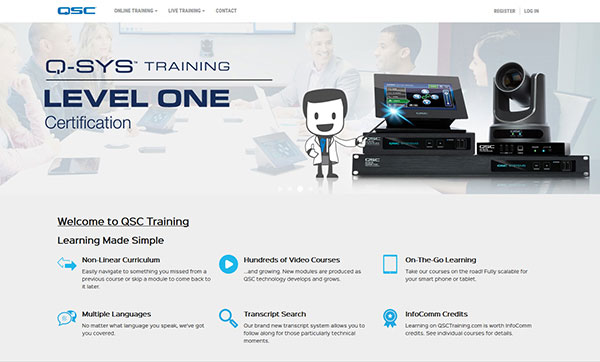
Beyond Key’s QSC case describes migrating a traditional, non-automated learning management system into a Moodle-based platform for online and classroom training. The assignment was to make the training environment interactive and automated. Here, the software supports the knowledge surrounding the hardware.
This explains something about Beyond Key’s breadth. It works in healthcare, insurance, manufacturing, education, logistics, retail, and nonprofits. Those are different industries, but their software problems can share a shape: information exists, people need it, and the route between the two is inconvenient. A learning platform, a claims workflow, and a dashboard serve different users while demanding similar attention to the handoff.
“A decade-long relationship built on trust, innovation, and a shared vision.”
Claudé E. Zamboni, former QSC CIO, in a company-published testimonial
The answer is somewhere in SharePoint
Beyond Key’s Microsoft work includes SharePoint intranets, Microsoft 365, Power Apps, Power Automate, Dynamics 365, Business Central, and Power BI. These tools occupy the practical interior of an organization: employee information, approvals, sales records, financial operations, and reporting. The company helps configure, extend, migrate, and connect them.
AIKA 365 brings a product to one familiar irritation within that interior. An employee needs an answer, and the answer lives in a SharePoint document whose name the employee cannot remember. The knowledge agent accepts natural-language questions, retrieves information, generates summaries, and supplies clickable references. Its product page describes retrieval-augmented generation, commonly shortened to RAG.
The references deserve attention. They give a user a route from the generated answer back to the underlying material. For a buyer, that suggests a practical demonstration: ask a real workplace question, open the cited document, and check whether it supports the response. Then try an ambiguous question. A fluent sentence is a pleasant beginning; an answer that can be checked is more useful.
Search also depends on the organization doing some housekeeping. As a buying consideration, old policies, conflicting instructions, and poorly managed access deserve scrutiny before a rollout. A knowledge agent works with the material it can retrieve. The person responsible for that material remains part of the project.
Bring one ordinary question to the demo. Ask for the answer, open the reference, and have the employee who does the work judge whether it helps.
Three platforms, plenty of plumbing
The same practical work continues in Beyond Key’s data services. A published logistics case describes a US provider needing integration across sources, data processing and warehousing, and usable analytics. A financial-services case describes legacy systems restricting access to enterprise information and a proposed move to Snowflake. Both begin with access and organization, before the attractive charts arrive.
Snowflake lists Beyond Key in its partner directory at Select tier. Beyond Key announced Registered Databricks Consulting Partner status in September 2025 and Featured Microsoft Fabric Partner status in January 2026. Its practice covers data architecture, migrations, pipelines, dashboards, and support across these environments.
The market position is a combination of Microsoft enterprise applications and work across modern data platforms. Alternatives include specialist implementation partners, data consultancies, larger systems integrators, and internal engineering teams. Beyond Key’s range makes it worth considering when a job crosses several of those boundaries. Buyers should still examine the assigned team and a relevant project example.
Moving data to a cloud platform does not settle what the business means by a customer, an active policy, or a completed order. Those definitions have to survive the journey. The copyable lesson from these assignments is to agree on the decision a report should support, then work backward through the information it needs.
Buy the handoff, budget for the next one
Beyond Key sells consulting, custom development, implementations, staff augmentation, and ongoing support. Alongside that service business sit packaged offerings: Beyond Intranet’s workplace tools, AIKA 365, ProcureKey for sourcing, and Right Cause for nonprofit operations. A customer can buy specialist work, a product, or a combination.
Its Microsoft marketplace intranet offer describes pricing tailored to organizational size and requirements, with a one-time setup fee and optional post-production support. Beyond Intranet’s license terms also describe subscriptions and additional charges for requested features or changes. For a prospective buyer, setup, software access, cloud consumption, and support belong in the same budget conversation.
The fit is strongest where an existing workflow needs adaptation or integration. If a standard product already handles the task comfortably, commissioning custom work can add ownership without enough benefit. A proposal should identify who maintains the result, who checks exceptions, and how employees will learn to use it.
Beyond Key’s March 2026 Sydney announcement adds local customer engagement to that delivery model. Its reported SOC 2 Type II compliance and ISO 27001:2022 certification offer further subjects for procurement review, including the scope of the work they cover. These details belong beside the demo, rather than beneath a pile of adjectives.
Return to the claim form. The revealing question was what happened after it became a scan. That is also a useful way to assess Beyond Key: follow a piece of work through the organization, find the point where somebody starts copying, searching, or waiting, and ask the company to show how it would change that particular moment.
Follow the work
Explore Beyond Key, its customer projects, newsroom, and technology blog. Try the product pages for AIKA 365, ProcureKey, and Right Cause.