Peter Stern was standing on a tarmac in Yuma, Arizona, a few days before Christmas in 1990, laughing at somebody else’s engineering. A Huey helicopter had an apparatus on its nose that reminded him of a kitchen oven. Copper pipes bulged around it. Four ungainly cones pointed forward. His own team’s laser system was the size of a shoebox. Naturally, he preferred the shoebox.
He recounts the scene with the confidence of a young engineer who has finished his work and found time to inspect the competition. The resemblance to a household appliance was funny. The assignment was serious: help helicopters detect obstacles under difficult conditions. Over the following tests, he recalls, his team’s LiDAR system did what they had hoped.
Three decades later, Stern was arguing for a much smaller version of the same underlying idea. Between those two points came an online brokerage, collaborative email, and a company whose familiar product was a very short web address. His career makes several turns. His questions have become increasingly direct.
Does the thing work? Who needs it? Will anyone buy it? A respectable demonstration gets you through the first question. There are still two waiting outside.
Helicopters → online trading → shared inboxes → short links → light on a chip.
Two seconds on Wall Street
Stern graduated from Carnegie Mellon in 1989, studying electrical engineering and public policy. His early working years involved military research and sensing systems. By 1996, he had helped found Datek Online, taking his engineering into a business where time was both measurable and valuable.
In his 2026 recollection of Datek’s first customer order, a user bought 300 shares of COMS roughly two seconds after placing the order on the website. Stern emphasizes the absence of a human trader from the ordinary transaction. He remembers a business designed to give customers fast execution and free real-time quotes, rather than profit from an informational advantage over them.
The company grew into the fourth-largest online brokerage in the United States. Datek merged with Ameritrade in 2002. The financial story was substantial; the product proposition could still be expressed without a diagram. People wanted access to trading and information that had previously been harder to obtain.
It is tempting to look backward from a successful company and make the path look tidy. Stern’s later writing resists that temptation. He remembers young people handling situations beyond their experience, alongside colleagues whose contribution he still wants to acknowledge. The surviving story has taken him longer to organize than the original company took to grow.
- 1989Carnegie Mellon graduate
- 1996Datek Online co-founder
- 2011Bitly CEO
- 2020Joins Voyant full-time
- 2026Still asking who will buy
The business at the other end of a link
After Datek came Zenbe, which Stern built with fellow Carnegie Mellon graduate Alan Chung. Its products included Zenbe Mail, Shareflow and Lists for the iPhone. The setting had moved from markets to messages and collaboration. People still had something cumbersome to get through, and software offered a way to make it easier.
Facebook acquired Zenbe in 2010. In May 2011, Stern became Bitly’s CEO, succeeding John Borthwick. Bitly was already established. Stern arrived to run a service whose usefulness was immediately visible: take an unwieldy address, make it short, and let someone share it.
There was a less visible business inside those little links. They could show what people clicked, when they clicked, and how attention moved. A service that helped distribute information could also help businesses understand its reception. Stern’s task was to develop the commercial possibilities of something many people treated as a convenient utility.
“We get a sense of what the Internet cares about.”
Peter Stern, 2012
The context made that task urgent. Twitter was introducing its own link handling, raising questions about the future of independent shorteners. Bitly’s familiar place in people’s routines did not guarantee a permanent business. Stern was working on custom domains, business products and the value of the activity passing through the service.
In July 2012, Bitly raised $15 million in a round led by Khosla Ventures. Stern said the company was already bringing in millions of dollars annually, while needing resources to support its plans. Business customers would remain the source of revenue. Advertising was not his proposed answer.
The consumer product also expanded into organizing and discovering links. Some established users disliked the changes to their workflow. Stern defended the broader direction, reporting 200,000 new registrations over the preceding month. Here was a familiar product problem: the next audience and the existing audience did not necessarily want the same experience.
He left Bitly in March 2013. His speaker biography later that year described a team that had tripled and revenue that had grown almost tenfold during his tenure. Those figures belong to that period, when the company was trying to turn widespread familiarity into a business that could support itself.
Funding round led by Khosla Ventures during Stern’s time as CEO.
A FAMILIAR TOOL, A COMMERCIAL QUESTIONSharing a link → observing clicks → helping businesses understand attention.
Back to the light
Voyant Photonics brought Stern back to sensing. Its founders, Christopher Phare and Steven Miller, had worked with Columbia physicist Michal Lipson. Their research involved silicon photonics: using the semiconductor manufacturing ecosystem to build structures that manipulate light. The possibility was a smaller, less costly way for machines to perceive their surroundings.
Stern had been advising the company before joining full-time as president in April 2020. He later became CEO. The move joined practical experience from his early career with the work of helping a young company reach customers. An optical invention needed money, manufacturing and a reason to leave the laboratory.

There was little room for an abstract discussion in December 2021. Voyant was running out of money. Stern had gone much of the year without a salary, and staff had accepted pay cuts. An investment finally came together as the holidays approached. The $15.4 million financing allowed the company to continue and pay its people. Even an experienced operator could reach the end of the runway.
In January 2022, Voyant’s investor LDV Capital announced the round and the availability of developer kits. The work was moving into customers’ hands. Stern discussed applications across robotics, industrial automation and other settings where equipment needed information about its environment. The market extended beyond the attention surrounding autonomous cars.
His technical writing makes the appeal concrete. He describes playing with an iPad’s LiDAR to measure rooms and furniture, then distinguishes that experience from the requirements of industrial sensing. In another piece, he considers how simulation can help engineers assess a design before committing it to fabrication. The interest lies in what a device can do under particular conditions.
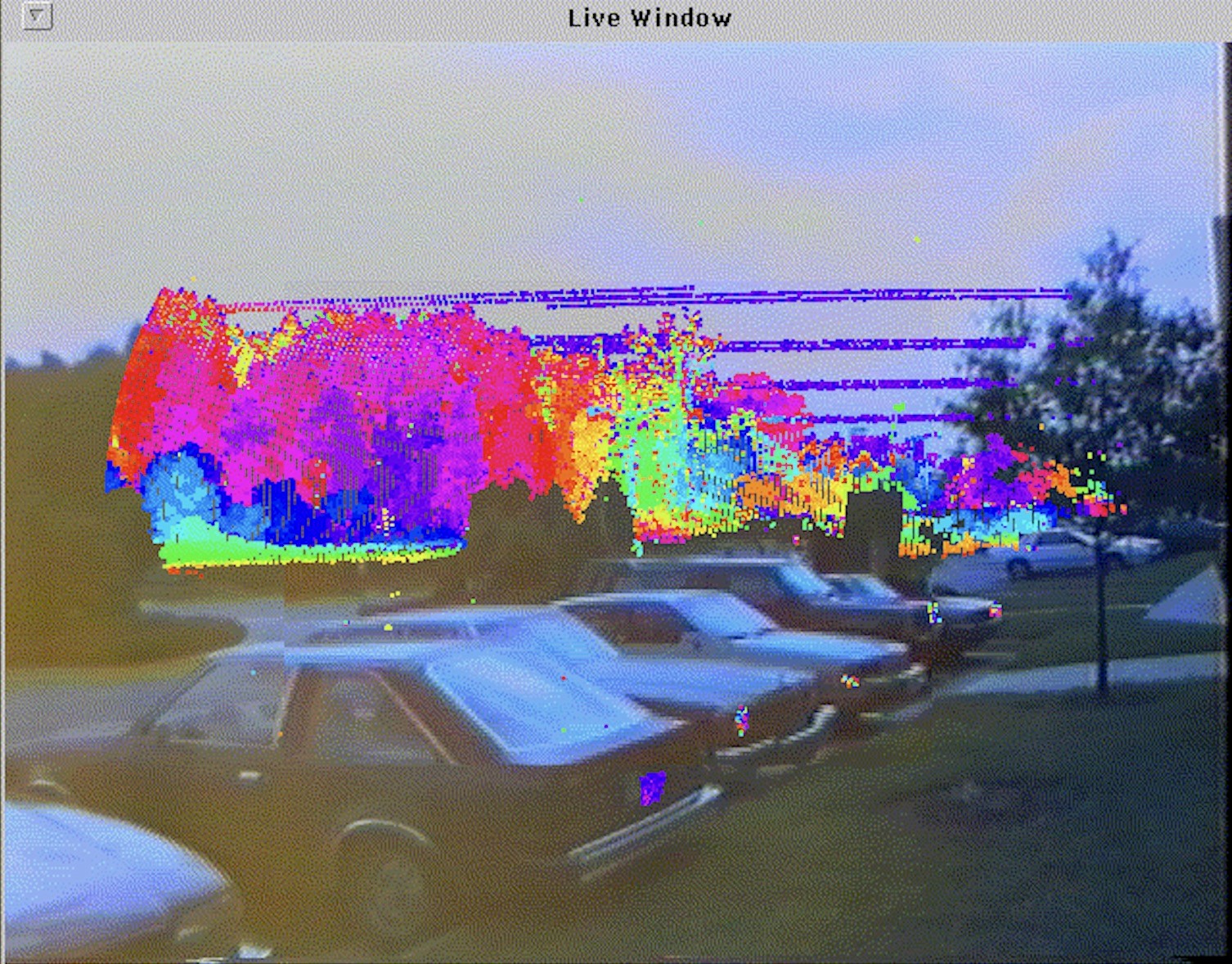
Field work has its less solemn moments. In a public post about preparing Voyant devices for Las Vegas, Stern described police wondering why colleagues kept driving a course around a parking lot. His advice for discouraging further questions was wonderfully unglamorous.
“Nothing shuts down curiosity faster than saying ‘Environmental testing.’”
Peter Stern, field-testing post
Columbia recognized his contribution to commercializing the technology when he received the Bayh-Dole Coalition’s American Innovator Award in 2023. The useful continuity with Yuma is easy to see: a machine, an unfamiliar environment, and engineers trying to give it information it could otherwise miss.
The mayonnaise school of management
Stern’s account of his first post-college mentor concerns another kind of precision. Brian Cyr, an Air Force officer who offered him a job, taught him to write directly. Stern’s younger self had expected military officers to resemble action-film characters. Cyr, he recalls, was about as threatening as mayonnaise.
The lesson outlasted the joke. Eliminate unnecessary words. Prefer active language. Tell the reader what matters. In an essay published on his site in 2025, Stern describes applying those rules to pitch decks, resumes and marketing documents. He ends by thanking Cyr for mentorship he had not fully appreciated at the time.
His customer advice has a similar impatience with decorative language. In a January 2026 essay, he challenges conference-panel encouragement to launch a startup. Technical competence can produce an elegant answer to a question nobody urgently needs answered. He asks founders to identify the person with a problem, a budget, and a reason to act.
That view has accompanied years of mentoring and investment. Stern helped establish and run Carnegie Mellon’s Open Field Entrepreneurs Fund. Its early program paired financing for recent alumni with mentoring and practical support. At a 2011 campus visit, he put his preference plainly:
“Business success favors simplicity.”
Peter Stern, Carnegie Mellon, 2011
The advice is easier to hear alongside the mistakes. In his customer-discovery writing, Stern admits that ideas which looked convincing in his own conference rooms failed when tested. He argues for finding that out early. The engineer’s pride in making something work has to coexist with the willingness to stop making it.
The book still on the plane
Stern now works through Manhattan Distance, his New York advisory and investment practice. His writing continues across technology and the practical business of starting companies. Away from that work, his biography lists cooking, hardware, code and time outdoors. The habit of experimenting appears to travel well.
There is also Broken Trades, his manuscript about Datek and Island. In July 2026, he shared its acknowledgements, explaining that the book advances during selected long flights and around Datek’s anniversary. An engineer can help make a stock trade happen in seconds and still spend decades trying to finish the explanation.
The unfinished book is a fitting companion to this career. Stern keeps returning to earlier work with another question, another test, another edit. The shoebox on the helicopter once looked elegant. Elegance was a beginning. Someone still had to take it outside.