Pedro Waengertner once wanted to become an advertising copywriter. Creative director looked like the summit. Then technology intervened, with the bad manners of an opportunity that has arrived before the career plan is ready. He had been taking equipment apart since childhood and learning BASIC on a TK-95. Video games held his attention, too. The things he enjoyed were beginning to resemble an industry.
He joined the business then known as Conectt as its third team member, after its two founders had already come together. For a while, he felt the peculiar frustration of working in a promising field while believing his proper career lay elsewhere. Looking back, he described judging his prospects by the rules of an existing game while a new one was opening. Advertising had given him one picture of success. The internet was quietly redrawing it.
His education supplied both vocabularies. He studied advertising at the Pontifical Catholic University of Rio Grande do Sul, graduating in 1998, then completed a marketing specialization at ESPM in 2001. The combination matters: his professional life would keep returning to the meeting point between what technology permits and what customers actually want. A clever mechanism still needs somebody willing to use it.
A sales trip with unusually permanent consequences
In 2003, a discussion about who would handle Conectt’s sales brought him from Porto Alegre to São Paulo. He volunteered, packed his car and drove. His affectionate description was “São Paulo Dream.” The practical complications included getting lost while visiting clients, armed with a printed street guide. A grand strategy can have a surprisingly modest beginning: somebody has to go and sell.
The city became his base. Technology services taught him about competing for business, while teaching gave him another way to work through the subject. At ESPM, his MBA classes covered marketing and digital business. His university biography also records Zuppa, the online restaurant reservation business he founded. Software, selling, classrooms, restaurant tables: his experience accumulated across places where a good concept eventually has to survive an actual customer.
Education extended beyond the campus. In 2018, he curated Steps, an ACE partnership with meuSucesso.com. Its four classes covered diagnosis, product, distribution and management, with different specialists teaching each part. Waengertner handled the live question session. It is an instructive arrangement: the curriculum passed through several hands, and the curator’s job included listening after everyone else had finished talking.
When the founders mark the mentor’s homework
With Mike Ajnsztajn, he co-founded Aceleratech in 2012. The name promised acceleration, a proposition with considerable appeal to entrepreneurs who have discovered how slowly other people answer emails. It became ACE in 2016. The business expanded from helping young companies to working with established ones, and its later structure gave those different needs their own homes.
Mentoring also forced a revision in his own approach. He has described arriving with advice drawn from corporate experience, only for founders to test it and return with disappointing results. Experience could suggest a question; it could not guarantee the answer. His account of becoming more Socratic is appealing precisely because he includes himself among the people still learning.
That distinction gives his public work its tension. He writes books offering methods, yet makes room for entrepreneurs whose circumstances defeat a familiar prescription. A method can organize an experiment. The customer retains the privilege of spoiling it. For an investor who also teaches, accepting that division of authority is part of the work.
- 2012Aceleratech
Accelerate & invest - 2016ACE
A broader remit - 2023ACE Ventures
A holding for several businesses
Innovation, with the furniture removed
His first book, A estratégia da inovação radical, appeared in 2018. Its subject was the practical distance between a traditional company and the management habits associated with Silicon Valley. Organizational design, agile management, investment decisions and partnerships all figured in the argument. Innovation needed to become a business capability. Giving it an office of its own was an insufficient architectural solution.
ACE’s explanation of the book sets out six principles. Teams need an organization that allows them to work differently; management needs agility; existing businesses need to confront their own possible obsolescence. Add an investor’s approach to risk, collaboration with partners and attention to the customer, and the supposedly mysterious subject begins to look like a series of decisions. Some are uncomfortable. None can be delegated to the wallpaper.
His corporate work made that discomfort tangible. He described employees greeting permission to experiment with suspicion. Leaders needed preparation, too: an unfinished presentation should not automatically trigger a polished answer from the most senior person present. The manager’s role could involve helping a team investigate. An executive accustomed to solving everything in the room might find that a demanding assignment.
There was evidence behind his impatience with appearances. An ACE mapping exercise reported in 2019 counted 138 corporate programs connecting with startups. Roughly 60 percent had initially fallen short of their goals. Waengertner questioned initiatives built chiefly around how innovative the company would look. The problem, in his telling, was how much useful work that positioning could leave undone.
“O cliente no centro da equação”
The customer at the center of the equation.One of Waengertner’s six principles of radical innovation
Three books, and a queue of different questions
Transformação radical followed in 2020, written with Sulivan Santiago and Victor Navarrete. The conversations behind it had begun in January 2019, prompted by questions about applying innovation in practice. Methods tried at ACE Cortex became material for the book, alongside cases and tools. The collaboration moved the argument from general principles toward the work of implementation.
Its publisher describes exercises, assessments and downloadable canvases intended for teams to use. The focus ranges from managing ideas to executing projects. Across the two books, Waengertner’s recurring concern is what an organization can actually do repeatedly. Inspiration has an attractive opening night; a company also needs something workable for the following Tuesday.
Then a different audience intervened. After speaking at Sebrae’s Feira do Empreendedor, he found people waiting with questions that reached beyond the startup world. Those conversations helped inspire his third book, Contra a corrente. Published in 2024, it addresses people trying to get a business idea into motion, including the difficulty of organizing their own work once there is no boss to assign it.
The publisher’s description emphasizes aligning the venture with personal values, planning concrete steps and dealing with the uncertainties of beginning. That changes the scale of the conversation. A person considering a first business may need a realistic next move before they need an investment thesis. Waengertner’s audience had widened, and his writing followed it.
He has also cautioned that many businesses do not fit venture capital. A consultancy, for example, may finance itself through customers. That is a useful position for a venture investor to express publicly. It gives the business model a vote in the choice of financing, rather than making a funding round the compulsory ending of every entrepreneurial story.
A bigger name, and a door facing Brazil
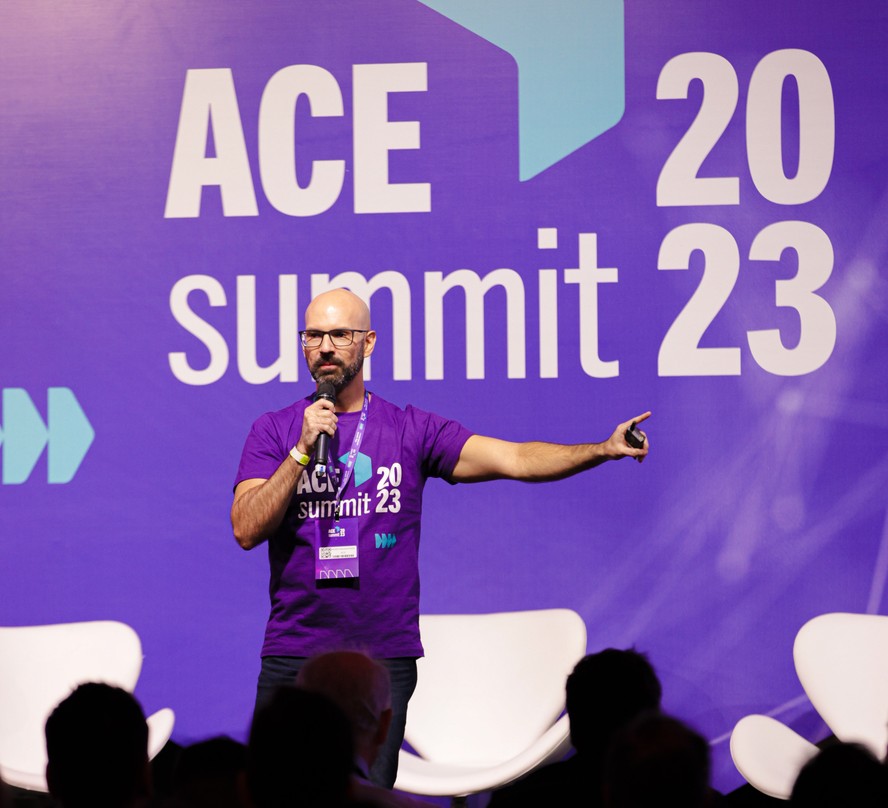
The ACE Summit in May 2023 put the company’s changing shape onstage. Waengertner introduced the ACE Ventures name and announced ACE Outlier Capital, a corporate venture capital operation. He explained that the broader name would help people understand the range of activities. International recognition was part of the reasoning, too: Americans had already used the name in conversations with the business.
The organization’s own chronology records ACE Cortex in 2018, Future Dojo in 2021, and ACE Advisors and the Summit in 2023. Investment, corporate projects, education and transactions had become connected parts of the same professional world. For Waengertner, the company itself offered a continuing opportunity to apply the changes he discussed with other executives.
By its August 2026 Investor’s Day report, ACE described more than 180 investments across nine investment vehicles. The same report placed corporate growth work, technology M&A and community alongside venture capital. Waengertner opened the event and joined a discussion about Brazil’s next VC cycle. The numbers belong to the organization; his role is to help decide where that organization goes next.
One current direction turns the usual international expansion story around. In February 2026, ACE and gener8tor outlined an initiative to bring overseas startups into Brazil, initially focused on agriculture and sustainability. Waengertner’s case was that Brazil offers sophisticated demand and room for growth. Alongside partner Mateus Quelhas, the team was working on routes that could include operations, commercial partnerships or technology adoption.
The ambition is consistent with the one in his ESPM biography: placing Brazil on the global innovation map. Helping foreign companies find customers there makes that proposition concrete. Brazil becomes somewhere to build a market, as well as somewhere entrepreneurs begin before looking abroad. The direction of the invitation matters.
The microphone stays open
His Growthaholics podcast keeps the conversation moving between founders, investors and corporate leaders. A 2025 episode carried his ACE Summit closing talk about a new roadmap for founders, addressing how AI changes product, marketing, pricing and team structure. In September 2026, the show was discussing data center infrastructure with Equinix Brazil president Victor Arnaud. The questions change as the businesses change.
Recognition has followed, including a place in the Brazilian Marketing Academy’s Hall of Fame. Yet the more revealing part of this career is its succession of revised assumptions: the aspiring copywriter entering technology, the teacher taking questions, the mentor learning to hold his answers more lightly. Waengertner has made a profession of helping people move. His own story suggests that movement requires leaving a few cherished instructions behind.