Julio Vasconcellos’s first business ambition concerned his shoes. As a child, he watched his father arrive home in a suit and decided that he would rather go to work in sneakers. Years later, telling the story at TEDxPortoAlegre, he described the wish behind the wardrobe: control over his own destiny. It was a modest dress code attached to a demanding plan.
His father was a diplomat. Vasconcellos grew up in Brasília and spent stretches of childhood abroad, moving between Brazil and other countries. The adult career would involve more crossings: Philadelphia, New York, Stanford, Rio, San Francisco. The recurring question was how to build something of his own. Finding the right place to do it would take several attempts.
An education in asking
He studied finance and marketing at Wharton, graduating summa cum laude, then joined Monitor Group in New York. There he became the firm’s youngest project manager globally. Consulting gave him a place inside other people’s business problems. He also helped develop a business plan for an internal venture that became Monitor’s business analytics and research group. Even before founding his own company, he was finding ways to get close to a beginning.
In 2005, he went west for an MBA at Stanford. He worked with startups in digital media and mobile, helped launch an education software company and co-created iinnovate, an interview series about entrepreneurship and innovation. Before he had a large company to run, he had questions for people who did. The interviewer's chair would remain a recurring seat in his career.
Stanford ended in 2007. His subsequent work included Kanjoya, formerly Experience Project. Then Brazil began to look like somewhere he could build. Facebook was recruiting him to help grow its presence there, in a market where Orkut was still part of everyday internet life. At the same time, he and Alex Tabor were preparing a venture of their own. For a while, Vasconcellos tried doing both.
The apartment gets crowded
Peixe Urbano launched in March 2010. Vasconcellos, Tabor and Emerson Andrade were bringing the group-buying model to Brazilian local commerce. Restaurants and other businesses could offer discounts online; customers could discover something nearby and pass the offer along. The proposition drew on two familiar pleasures: finding a bargain and telling a friend about it. The technology gave those habits a commercial meeting place.
At first, persuading businesses to participate required considerably more than putting up a website. Vasconcellos later recalled that only one in ten of the merchants he visited agreed. That ratio supplies a useful corrective to the story’s subsequent speed. Nine doors could close before the offer list gained another entry. The early company depended on people doing the unglamorous work of explaining an unfamiliar service to someone with a business to run.
The service caught on. Within nine months, Peixe Urbano had five million registered users. By 2011, the company was expanding beyond Brazil, beginning with Argentina. Vasconcellos had become Facebook’s first employee in Brazil, but the demands of Peixe Urbano made the double life untenable. He chose the startup operating out of Tabor’s apartment in Botafogo. A comfortable answer to the career question would have been understandable. He wanted the uncertainty of his own answer.
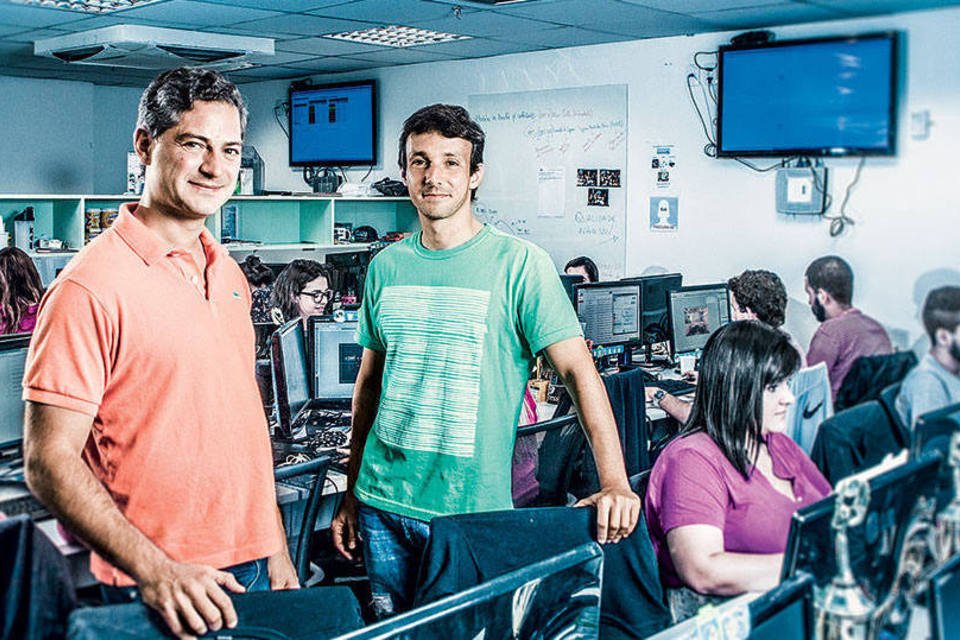
The business eventually reached six countries, 1,200 employees and more than $100 million in revenue. Those figures help explain why Peixe Urbano became such a conspicuous chapter in Brazilian technology. They also describe a substantial managerial burden. A company that large needs recruiting, coordination and discipline across markets, alongside whatever made the first offer attractive. Success had produced a much larger job.
Different measures of expansion, not a valuation or a sale price.
When the expansion bill arrived
The growth attracted imitators. By 2011, Peixe Urbano faced roughly 2,000 competitors, some with names that seemed to have been assembled from the same aquarium. The rush into daily deals was followed by a reckoning. In 2012, with the model under pressure, the company dismissed hundreds of employees and sold office equipment to help pay its bills. Desks have a way of becoming less symbolic when they need to be sold.
Baidu acquired control in 2014. The price was undisclosed. In 2015, Vasconcellos handed the chief executive’s role to Tabor and remained involved through the board. The sequence resists a tidy triumphal ending: enormous growth, a difficult contraction, a buyer, a change of role. All of those events belong to the same company. Leaving out the middle would make the ending much harder to understand.
He later described a feeling that the mission remained unfinished. An acquisition had happened; the durable business he had imagined remained an ambition. That helps explain why his next move involved the work of starting again. A completed transaction can settle ownership without settling what the founder hoped to accomplish. Vasconcellos still liked the early stage, when a small team could turn an idea into something people might use.
A recommendation from someone you know
After a spell as an entrepreneur-in-residence at Benchmark, he co-founded Prefer with Scott Belsky. The idea concerned the independent professionals people rely on: an accountant, a housekeeper, someone whose work creates an ongoing relationship. Prefer would connect customers and professionals through trusted referrals. A recommendation already carried value in ordinary life. The company would try to give that exchange a useful home online.
Benchmark led the initial financing, with Homebrew among the investors. The ambition extended beyond discovery: helping professionals handle customer acquisition, scheduling and payments would let them spend more time on their actual work. A good accountant does not necessarily want a second career in marketing. Prefer was addressing the small business that sits behind an independent professional’s service, including the tasks customers rarely see.
The company began in 2016 and publicly launched in May 2017. Its initial market was New York. This time, the geographic choice was deliberately narrow. Vasconcellos had learned to take expansion seriously, and wanted the product to work in one dense market before taking it elsewhere. In March 2018, the team numbered ten. He was candid that engagement had yet to reach the level he wanted.
“O produto que funciona bem para mil pessoas, não é o mesmo que funciona bem para 1 milhão”
Julio Vasconcellos · 2018A product that works for a thousand people is different from one that works for a million. Translation from Portuguese.
Prefer closed its operation in early 2019. By June, Vasconcellos was returning to Brazil to concentrate on investing. The shutdown is essential to the story because it prevents the second beginning from becoming a convenient moral about experience guaranteeing results. Knowing more changes the decisions available to a founder. It does not oblige customers to develop the habits a new product needs.
His later account of Prefer included a shift in his own preferences. He still liked scrappy founders who tested ideas and iterated. Working with Belsky had increased his appreciation for craftsmanship, design and the quality of the experience. Speed remained useful; so did care. The interesting change was his willingness to give craft more weight after having built a company around it. Experience had revised an instinct.
Back on the other side of the table
Investing had already been running alongside the operating career. He held founding roles at Graph Ventures and Canary; Atlantico became his principal chapter in 2019. These were related pursuits with different responsibilities. Building a product asks whether people will use it. Investing asks which people and companies deserve capital, and what support will help them do the work. Past operating experience supplies examples. It still leaves plenty of room for error.
At Atlantico, he became founder and managing partner of a firm investing in Latin American technology businesses. The firm describes a team of founders and operators backing companies with early evidence of product-market fit. It is an approach that makes his history relevant beyond a biography. The founder sitting opposite him may be choosing a market, hiring a team or wondering whether an encouraging result is enough to justify expansion.
- 2010Peixe Urbano launches in Brazil
- 2014Baidu acquires control
- 2016A new beginning with Prefer
- 2019The Atlantico chapter begins
His public work increasingly includes explaining how he sees the region. Atlantico publishes a recurring digital transformation report, and Vasconcellos writes at The Atlantico Pub. The operating career has become part of a broader conversation about where technology businesses can grow. He now has to persuade readers and investors as well as founders. The early merchant visits have acquired different surroundings.
Still asking the next question
The interviewer's chair has returned, too. With Atlantico colleague Victor Ramos, he created Atrás do Retorno, a series of conversations with investors. Discussing that project in 2025, he reflected on how experienced investors step back and place a business within a wider historical and industry context. The subject had changed since Stanford’s iinnovate. The practice of learning through someone else’s account remained.
Those discussions also reached beyond investment technique. He asked about raising children and reflected on the importance of example: what people see you do can matter more than what you tell them. It is an apt question for someone whose childhood career plan began by watching a parent come home from work. The suit had made an impression. So had the possibility of choosing another working life.
In September 2026, he published an argument that Latin America’s next $100 billion company would be built around AI. He pointed toward applications, local knowledge and distribution as places where regional businesses could compete. That is his forecast, with the future still available to disagree. It follows a career spent watching imported technologies meet local conditions, sometimes with extraordinary uptake and sometimes with much less accommodating results.
The sneakers were an achievable part of the plan. The harder ambition was the freedom to build something, accept what happened, and decide what to try next. Vasconcellos’s career contains an expanding company, an acquisition, another startup and a return to Brazil. Today, at Atlantico, the question travels with him into other people’s beginnings: what would it take for this one to last?
Follow the conversation
Writing, interviews and the work in progress.
Read The Atlantico Pub ↗Meet the Atlantico team ↗Julio on LinkedIn ↗Julio on X ↗Watch: the founder-to-investor conversation with K Fund ↗Listen: company building and investing on 20VC ↗Listen: the 2018 Prefer conversation, in Portuguese ↗Read: his 2019 return to Brazil ↗Read: Peixe Urbano’s change of course ↗