A spreadsheet is wonderfully accommodating. Give it a sufficiently handsome assumption and it will arrange the future to your liking. Fabien Mendez discovered the limits of this hospitality when Loggi, the delivery business he co-founded in São Paulo, began moving into national deliveries in 2016. The business plan had worked. The business was proving considerably less agreeable.
Years later, recalling that expansion, he said the spreadsheet had accepted everything. Reality had been more complicated. It is an unusually useful detail in the life of a founder associated with a billion-dollar company: the number that looks inevitable in retrospect once sat inside a plan its authors did not fully understand.
Mendez's career has repeatedly returned to that gap between a promising system and the people who must make it work. First came an unsuccessful attempt to transport passengers. Then came Loggi, founded with Arthur Debert in 2013. In 2023 he co-founded Sanctu, taking the language of platforms and networks into the Amazon. That venture would bring its own encounter with an uncooperative assumption.
The motorcycles were already there
He was born on the French Riviera and spent part of his adolescence in Spain. His education took him through Sciences Po in Paris and Fundação Getulio Vargas in São Paulo. He studied finance and strategy; his early professional life included mergers and acquisitions work at BNP Paribas and EY. The eventual logistics founder had learned to examine businesses before trying to build one.
GoJames, founded in 2012, was an attempt at an app-based passenger transport service before Uber entered Brazil. It failed. Mendez has described it as an “epic fail,” a phrase admirably resistant to the more flattering vocabulary founders sometimes apply to a company that runs out of road.
The next opportunity was visible from the pavement. Walking along São Paulo's Avenida Nove de Julho, he counted the passing motorcycle couriers. Here was an existing workforce, an existing need and a city whose traffic made the connection between them expensive and awkward. He saw room for technology to organise that connection.
That observation matters because it puts the couriers before the app. Loggi would enter a working economy, with habits, regulations and customers already in place. The task was to make a service easier to request, price and follow. The motorcycles needed no introduction to São Paulo. A more convenient way to hire them did.
A partnership tested over cachaça
Arthur Debert supplied the other half of the founding partnership. A mutual acquaintance introduced the technology specialist to the French businessman. Debert wanted Mendez to have someone assess his technical competence. He also proposed a less formal examination: go to a bar, drink cachaça, eat sausage and find out whether they could stand one another's company.
They left an unsatisfactory first venue for a boteco and stayed until closing. Two days later, they agreed to become partners. The courtship was practical. A co-founder can pass every professional test and still make Tuesday afternoon unbearable. Debert's extra round of diligence had the virtue of acknowledging this.
By September 2014, Loggi had secured R$10 million from Monashees Capital and Qualcomm Ventures. Mendez explained that he wanted complementary kinds of help: strategic knowledge from one investor and technological knowledge from the other. Money arrived with an expectation that the people behind it would know something useful.
The early service connected customers and couriers through computers or smartphones. A customer could specify the route and the collection and delivery instructions, then receive an immediate price estimate. Such conveniences look ordinary once established. Their value is easier to appreciate when the alternative requires several phone calls and a generous tolerance for uncertainty.
When the map got larger
Loggi's initial business centred on quick, local deliveries for offices. E-commerce offered a much larger map. It also changed the nature of the work. A local courier marketplace and a national parcel network share a destination, but they require different machinery to reach it.
By 2016, the company was expanding into deliveries across Brazil. That was the period behind Mendez's rueful account of the business plan. Routing a motorcycle through one city was giving way to coordinating journeys, facilities and handovers across a country. Each extra connection offered another place for a neat assumption to come undone.
The investment story became more conspicuous in 2019. A $150 million round took Loggi to unicorn status, the startup shorthand for a valuation of at least $1 billion. In September that year, Mendez said he wanted the company to serve every Brazilian municipality and deliver more cheaply than Correios, the postal operator.
The ambition was about access as much as speed. An online seller's reach depends partly on the delivery network available to it. A buyer's choice depends on whether an order can arrive at an acceptable price. Mendez's wager was that improving those connections could make room for more commerce.
The figures give a sense of what followed. A December 2020 podcast description put Loggi at more than 300,000 daily deliveries. A July 2022 profile described 400,000 daily deliveries across 3,600 municipalities. These are snapshots from different dates, rather than a promise about what the business would do forever. They show how far the operation had travelled from office errands.
“Queremos entregar mais barato do que os Correios.”Fabien Mendez, 2019
“We want to deliver more cheaply than Correios.”
The people inside the network
The simplicity of ordering a delivery can conceal the number of people needed to complete it. In 2016, Mendez described motorcycle couriers as customers too. That was a revealing way to talk about a marketplace: attracting people to place orders would accomplish little if the people carrying them found the arrangement unworkable.
The employment model nevertheless brought questions. In a 2021 interview, he defended the autonomy of couriers operating as individual microentrepreneurs. A representative of a couriers' association offered a more divided account: preferences differed between groups of riders. Mendez also acknowledged that protests over working conditions were legitimate. The public debate complicated the appealing picture of an app efficiently matching two willing parties.
Even the product interface carried an operating philosophy. In the early service, customers could enter the complete route and explain whom a courier should speak to. Those small instructions reduced the distance between a customer’s intention and a rider’s next action. They also made clear that software depended on local knowledge: a name at reception, the right collection point, an understandable request. The interface had to carry enough of that knowledge for another person to act on it.
Then the corporate structure changed. In August 2022, Mendez left the CEO position for the board, with CFO Thibaud Lecuyer taking over. Loggi simultaneously announced a reduction of roughly 540 employees, about 15 percent of its workforce, as it sought greater operational efficiency. The company he had helped create had reached a stage where expansion and retrenchment belonged in the same history.
That transition prevents the story from ending conveniently at the valuation. A funding round is a dated event. Running a network is a continuing obligation.
A farm without a land purchase
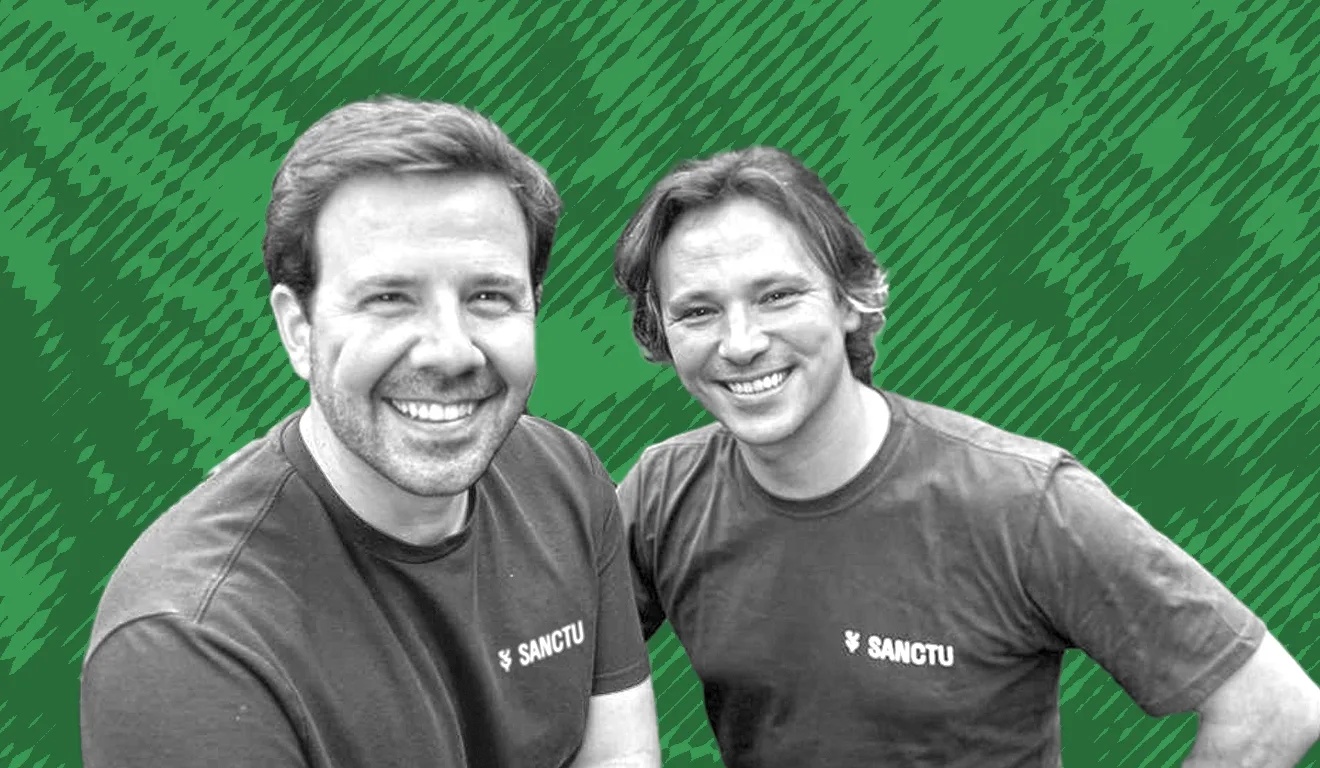
In 2023, Mendez co-founded Sanctu with Henrique Dantas, a former BCG climate and sustainability executive. The setting changed from delivery routes to small farms in the Amazon. The familiar element was the attempt to coordinate activities that were difficult for individual participants to organise alone.
Sanctu's proposed partnership brought together farm planning, finance, technical assistance and sales. Farmers contributed land, labour, cattle and experience. The company helped organise a productive system combining livestock, trees and forest restoration. Its website presented separate steps for the project, financing, assistance and selling the resulting products.
This was an ambitious collection of responsibilities for one business. Financing a change in land use, helping someone carry it out and finding a market for the output are distinct jobs. The proposition depended on making them work together, so that a family could earn more while restoring part of its property.
By June 2025, the stated target was 50,000 farms by 2034. Canary and Monashees had backed the venture. Mendez's pitch paired forest regeneration with household income, making prosperity central to the proposal. A farmer being asked to change years of practice would have practical questions long before anyone admired the slide about scale.
THE SANCTU PROPOSITION
An explanation of the proposed model, not a record of achieved scale.
The ten-year question
On July 3, 2026, Dantas announced that he and Mendez had decided to stop scaling Sanctu. He reported R$30 million raised in 2024 and work with ten families on roughly 1,000 hectares. The obstacle, he wrote, was the fit between the offer and what families wanted: a ten-year commitment and daily work under a rotational grazing protocol attracted too few participants. He said infrastructure and cattle had been donated to the first families.
The distance between ten participating families and a target of 50,000 is sobering. More revealing is the reason Dantas gave. A system can offer an attractive projected income and still ask for a commitment people are unwilling to make. Ten years occupies a different place in a household's life than it does along the horizontal axis of a presentation.
Read alongside Loggi's early national expansion, the episode gives Mendez's story an unusual continuity. In both cases, coordinating a large system meant encountering details the initial plan had treated too lightly. The outcomes differed. The need to revise an assumption did not.
There is something useful about keeping all these chapters together: the failed passenger service, the motorcycles, the late-night co-founder test, the national delivery network and the farms. Success can make a founder's earlier decisions look preordained. Mendez's route through Brazil offers a less tidy and more interesting account. There were people to persuade at every stage. Their answers determined how far the plan could go.
Follow the routes
- Mendez on LinkedIn ↗
- Loggi: the company’s history ↗
- Sanctu: the proposed partnership ↗
- Watch: Sanctu’s mission film ↗
- Listen: Mendez on Like a Boss ↗
- Read: the 2022 CEO transition ↗
- Read: the June 2025 Sanctu interview ↗
- Read: Dantas’s July 2026 update ↗
- Read: the Loggi founding partnership ↗
- Read: the national-expansion interview ↗