On a work flight, Mariana Dias asked a flight attendant for a napkin. She wanted somewhere to draw an idea for improving recruitment. The paper was disposable; the career decision that followed was rather less so. She had a job at Ambev, a business degree, and a problem that kept following her around. People were being hired, people were leaving, and the process between the two seemed to offer plenty of room for improvement.
The napkin belongs to the origin story of Gupy, the company she cofounded in 2015. Yet the interesting thing about Dias is how often the story requires a second draft. A corporate career became a startup. A recruiting product became a broader people-management business. An acquisition that looked straightforward required a rethink. She has repeatedly had to decide which part of an idea deserves loyalty and which part needs crossing out.
The security she meant to keep
Dias’s early ambition was a corporate career. She studied business administration at the University of São Paulo, spent time on an exchange at the College of Mount Saint Vincent, and worked at Unilever before joining Ambev’s trainee program in 2011. She was interested in sales. Human resources did not initially strike her as the obvious destination.
The appeal of an established employer was easy to explain. Her father’s working life had shown her what running a business could demand. Her grandfather was a bricklayer; her father began as an office boy at a real-estate business and eventually became its owner. Advancement had brought opportunity, but also instability. A salary, paid holidays, and Brazil’s thirteenth-month payment had their attractions.
Her own earlier experiments were smaller and more cheerful. She sold jewelry at school. During an exchange, she taught samba to earn extra money. Those are entrepreneurial episodes, certainly, although selling a few things between classes is a different proposition from surrendering a reliable income. Childhood enterprise does not oblige anyone to spend adulthood explaining a cash-flow forecast.
Inside Ambev, HR became absorbing. Factory operations gave her a place to examine how people decisions affected a business. She went on to oversee HR products for the company’s Latin American factories. Recruitment supplied a particularly persistent question: if employees left soon after arriving, what had happened before they were hired?
She wanted a better match between vacancies and candidates. The work was operational, fragmented, and insufficiently supported by technology. Improving it for one employer was a possible project. Improving it for many employers was a possible company. That change in scale explains the leap more convincingly than a lifelong declaration of entrepreneurial destiny.
“No dia que fui convidada para virar sócia da Ambev decidi fundar uma startup.”
Mariana Dias · “The day I was invited to become an Ambev partner, I decided to found a startup.” Translation from Portuguese.
Four founders, one expensive yes
Gupy had four founders: Dias, Bruna Guimarães, Guilherme Dias, and Robson Ventura. Guimarães was a fellow Ambev professional; Guilherme is Mariana’s brother. Their backgrounds brought together experience of people operations, business, and technology. Dias’s later studies in entrepreneurship and innovation at Stanford added another strand to a career already moving away from its original itinerary.
The personal financing was unglamorous. Dias sold her car. The founders planned for a period of two to three years without earnings. Leaving a large company meant giving up the machinery that makes ordinary working life predictable: a pay date, an established structure, other departments to call. The arithmetic had to work before the rhetoric could be much use.
Her account of the first sale is a good corrective to the polished launch story. The platform was not ready. She sold using a presentation of slides. A customer was interested enough to want the solution across Latin America. For a new business, that is encouragement with a deadline attached. Once someone wants to use the thing, the attractive diagrams acquire obligations.
The financial danger was real, too. Dias has recalled that an investment proposal from Canary arrived at a moment when the alternative might have been bankruptcy. The later funding announcements can make the early company look safely inevitable. Her recollection gives the story back its uncertainty. A business that eventually attracts substantial capital still has to survive the period before anyone agrees it deserves some.
Gupy’s investment round, led by SoftBank and Riverwood. Funding for the business, with years of building already behind it.
That round created room for expansion. It also changed the kinds of decisions on Dias’s desk. Software for recruitment could lead toward the rest of an employee’s experience: arriving, learning, developing, receiving feedback. Pursuing that larger business would involve other companies, other teams, and customers with habits of their own.
The competitor had a point
In 2022, Gupy acquired Kenoby, its recruiting rival. The initial integration plan was brisk: close the acquired platform within six months and bring the operation into Gupy. Dias later acknowledged the assumption behind it. Founders tend to believe their own product is better. Ownership of the other product does not automatically cure the condition.
Kenoby customers used features that Gupy lacked. Some liked those features very much. The integration therefore required listening to the acquired team and preserving useful capabilities, rather than simply moving everyone across. The timetable expanded to about a year. Dias described the experience as an exercise in intellectual humility.
Useful Kenoby features stayed. The timetable changed.
There is something revealing about choosing to tell this story publicly. Acquisition announcements ordinarily favor the vocabulary of addition: more customers, more capabilities, more opportunity. Dias supplied the subtraction, too: less certainty about the original plan. The admission gives a reader a more useful view of leadership than another account of a transaction going exactly as intended.
Gupy’s product range continued to broaden. It had bought Nidu in 2021, moving into corporate education, and acquired Pulses in 2023, extending its work in engagement and performance. The progression followed a recognizable argument: the employee’s experience carries on after the offer letter, while the software supporting it has often been divided into separate boxes.
Bringing those businesses together had consequences inside Gupy. In August 2023, the company announced an 8.5 percent reduction in staff as it integrated solutions and reorganized teams across functions. The people-management company faced its own difficult people decisions. Expansion made the organization itself part of the work Dias had to redesign.
Twenty seats at breakfast
After the 2022 funding round, women entrepreneurs began contacting Dias for advice. She and Guimarães responded with an invitation to Sunday breakfast at their home. There were twenty places. They filled within hours. The gathering gave founders somewhere to compare the questions that a funding announcement leaves out.
They drank Moscatel, and the name stuck: Máfia do Moscatel. The joke was deliberate, a reply to the male networks built around poker. Breakfast is a modest institutional technology. It gets people into the same room, provides a reason to stay, and makes asking a difficult question slightly less ceremonial.
The community grew beyond that first gathering. By October 2025, it included more than ninety women. It organized mentoring, exchanges, and events, with a summit focused on founders in the AI era. Dias and Guimarães remained involved in selecting members. The group sought founders whose businesses had traction, so that participants would recognize the practical problems being discussed.
This work fits alongside Dias’s angel investing in women-founded startups and her role on Endeavor Brasil’s board. External recognition followed, including the World Economic Forum’s Young Global Leaders program in 2023 and Forbes Brasil’s The Founders list in 2025. The breakfast story supplies a more intimate measure of what she did with her experience: she made herself available to people confronting similar decisions.
“Somos poucas, mas não estamos sozinhas.”
Mariana Dias · “We are few, but we are not alone.” Translation from Portuguese.
The organization chart gets another occupant
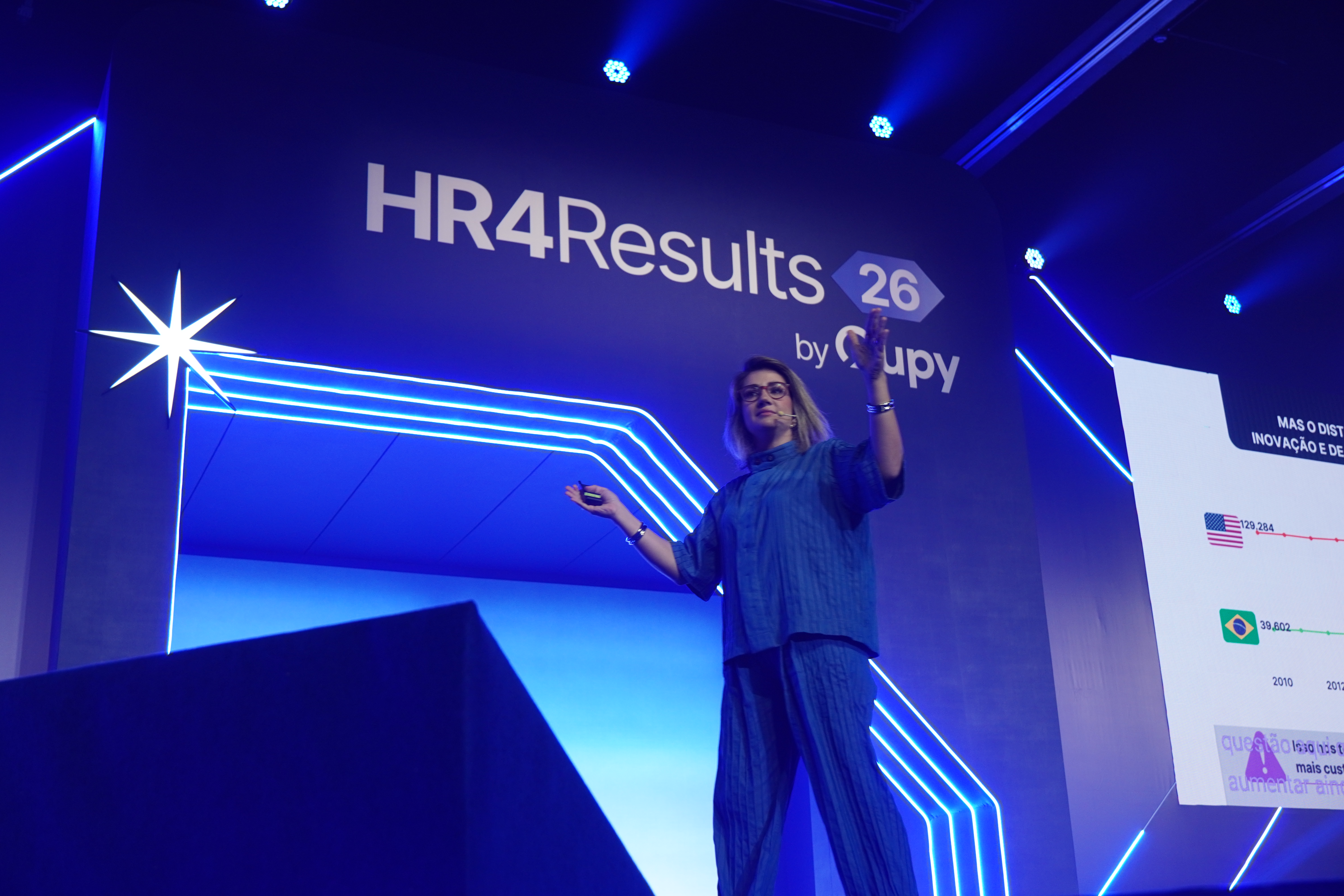
By 2026, Dias’s public discussion had moved toward a fresh organizational question. As AI agents take on work, who directs them, develops them, and decides how they fit beside people? At HR4Results in March, she discussed the idea of human and autonomous resources. Even the name of the department was becoming available for revision.
Her argument puts responsibility across people, technology, and business strategy. Training a team to use a tool is one task. Changing how an organization operates is another. The distinction matters for a founder whose company sells technology into those decisions. A new interface can be adopted faster than a company can work out what it wants the interface to accomplish.
In an August 2026 conversation, she described recruiting through WhatsApp, with an agent talking to a candidate. The ambition returns to the irritation behind the original business: a process should be easier to move through. But she also argued that access to AI alone would do little to distinguish one organization from another. The choices leaders make with it would matter.
Her own career offers a practical way to read that argument. She learned the recruiting problem by working inside it. She learned something about acquisitions by revising one. She helped other founders compare their experience rather than leaving each to rediscover the same difficulties. Learning, in this account, has dates, customers, and occasionally a guest list.
The napkin remains an appealing beginning because it is so small. What followed required four founders, investors, acquired teams, and a willingness to reopen decisions. Dias could draw a first version in flight. Building Gupy meant accepting that other people would have things to write in the margins.
Keep the conversation going
Gupy · The company profile · Dias on LinkedIn · Instagram · Máfia do Moscatel
Watch · The 2026 ForbesCast conversation Watch · Dias’s career interview with Exame Listen · Like a Boss, 2019 Read · The Kenoby integration conversation Read · How Máfia do Moscatel began Read · From Ambev to Gupy Explore · Articles by Mariana Dias