The form was intended for Portugal. The enquiries were coming from Brazil. Somewhere between a language setting and a prospective customer clicking submit, Factorial had acquired a question it could no longer leave to its European business: what would it take to serve a country that was already asking to buy? Renan Conde would help answer it. A form is an unglamorous beginning for an international expansion. It does, however, have one advantage over a beautifully prepared strategy presentation. Someone on the other end has actually raised a hand.
Conde’s account of those early enquiries places demand before the grand entrance. Factorial, the Barcelona software company, was developing its Portuguese market when Brazilian interest began appearing. The language travelled more easily than the product’s assumptions. A system for managing employees still had to accommodate local rules, local habits and the people who would use it. Speaking Portuguese was a start. Understanding a Brazilian HR department was the job.
Seven years away, then a hundred colleagues
In 2022, Conde returned to Brazil after seven years living and working for the European market. By March 2023, he was writing about taking the local operation from zero to 100 employees in less than a year. That is a pleasing number for a headline and a demanding number for a manager. Each new colleague needs an explanation of how the place works. While the explanation is being delivered, the place is changing.
His explanation began with culture and its adaptation to Brazil. He wanted people to understand the company’s aims and behaviours, while accepting that processes were still being made and revised. Communication had to cross job titles and borders. Market research came alongside that work, followed by deciding which experience levels the business needed and how careers could develop. He presented these as recurring checks. Hiring a team was only the first pass through the list.
Employees in less than a year, in Conde’s March 2023 account of the Brazilian launch.
There was a modest literary clue at the end of his account: a recommendation of Reed Hastings and Erin Meyer’s No Rules Rules. A manager explaining a rapidly expanding organisation had chosen a book about culture and the freedom to work differently. Even the reading list had operational consequences.
A career spent crossing markets
Before Factorial, Conde worked across banking, insurance, corporate benefits and property technology. His career includes Itaú, Icatu Seguros, Coface, Green-Acres and Casafari. Factorial’s biography describes a business administration graduate with more than a decade in international business development. It also records an Insurope Business Achievement Goal award at a conference in Leipzig. These are commercial credentials, acquired in businesses where persuading a customer usually requires understanding an institution as well as an individual.
He joined Factorial in 2020, when the company had about 60 people. His early work included opening Portugal and helping develop markets including Italy, Germany, the Netherlands and the United Kingdom. The route to Brazil passed through several versions of the same practical problem: a product can cross a frontier in an instant, while trust, a team and a useful sales conversation take considerably longer.
He subsequently held responsibility for Brazil and the United States, then the Americas. In a November 2022 interview, he described Factorial’s proposition for smaller businesses as bringing time management, talent and employee documents into a shared platform. The ambition was to make software available to employers whose size had previously made elaborate systems hard to justify. His position put him close to both the promise made in a sale and the work required to fulfil it.
The spreadsheet has a formidable distribution network
In his early discussion of Brazil, Conde identified Excel as competition. It is a revealing choice. A spreadsheet rarely needs to win a procurement process. It is already on the computer, already familiar and usually already holding something indispensable. An HR software seller has to persuade a business to change a routine that may be awkward but remains reassuringly legible to the person maintaining it.
Conde’s September 2022 writing approached that routine from the employee’s side. He described younger professionals arriving with expectations shaped by digital tools, then encountering paper, printers, manual tasks and meetings that produced still more manual tasks. His argument was that automation and centralisation could help people contribute and feel heard. In that account, a software purchase has consequences beyond the person signing the contract. It changes what colleagues spend an ordinary working day doing.
The appeal is easy to understand without awarding technology magical powers. Time spent chasing a document is time unavailable for a useful conversation. A system may make the chase shorter. Whether the conversation happens still depends on the people using it. That distinction runs through Conde’s later remarks, even as the product becomes more complicated and the vocabulary moves from digitalisation to artificial intelligence.
When the org chart started getting in the way
By 2024, the Brazilian operation needed a different arrangement. Sales reported to Conde, while customer experience and onboarding answered through separate structures in Barcelona. The customers were local; the lines of responsibility went in several directions. Taking over as CEO for Brazil brought the authority to organise those functions around shared goals. A sale, the customer’s first steps and the ongoing relationship could finally be managed as parts of one local business.
His team also narrowed its target to companies with roughly 50 to 350 employees. The previous flow of thousands of monthly leads included many businesses outside a useful fit. Conversion rose from 13% to 32%, according to the figures he gave in December 2024. The operation reached breakeven that September, two months ahead of schedule. Those measures describe a change in the quality of growth, as well as its pace.
Reported conversion rates around the local restructuring. Scale: 0-40%.
The administrative detail is the interesting part. Aligning teams and choosing customers sounds less exciting than announcing another market. Yet these decisions determine whether an expansion produces a business that customers can use. The org chart, that dependable supplier of boxes and arrows, had become part of the product experience.
Taking the work backstage
In September 2024, Conde shared a visit to Rock in Rio Academy, organised by HSM and Provoke.Club. With colleagues from Pessoas em Foco by Factorial, he explored the operations behind the event and discussed work with Rock World. His account thanked a long list of teammates. The setting offered a cheerful change from the usual software backdrop: a festival, with all the staffing and coordination that have to work before an audience can enjoy itself.
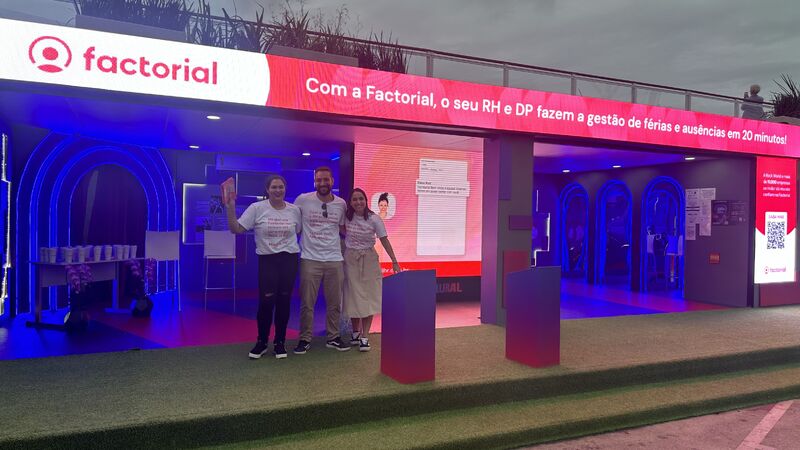
There is a useful connection between that visit and his business. Events make the scale of people management visible. The finished experience depends on many roles, working at different times, with a common deadline. A software platform sells the less photogenic portion of that coordination. In a festival photograph, the bright signage gets its moment; somewhere behind it, a schedule is earning its keep.
The audience member becomes a speaker
Conde announced that he would speak at Web Summit Rio in April 2025 on the changing C-suite. In the announcement, he remembered attending Web Summit in Lisbon years earlier and never imagining that he would eventually be onstage. It is a small, specific reversal in a career otherwise told through countries and responsibilities: the person watching the conversation was now being invited to contribute to it.
His public appearances have covered digital HR, recruitment, careers and the changing workplace. A Band interview paired him with Joana Treptow and Juliene Salvan; a Growthaholics episode brought him into conversation with Pedro Waengertner and Milena Fonseca. These discussions extend his work beyond explaining a product. They place him among people trying to describe how employers and employees are revising their expectations of one another.
In his own later reflections, he remembered wanting, when younger, to work for a company that made a positive difference to people’s lives. He also described learning from his team and Factorial’s founders, and finding colleagues who became part of his personal circle. The aspiration is broad. The evidence he chooses is intimate by business standards: customer feedback, people he has helped develop, and people who continue to teach him.
The second version of growth
A 2025 conversation about his career described a preference for curious recruits and a CEO who facilitates execution rather than trying to become every department’s expert. That sits comfortably with the recommendations on his professional profile. Colleagues describe patience in teaching sales and encouragement in the early Brazilian office. Their recollections give his emphasis on developing people a recognisable workplace setting.
Looking back on 2025, Conde reported positive EBITDA for Brazil and put consistency at the centre of his explanation. He credited a clearer customer focus, attention to customer experience and product development. He also emphasised difficult decisions and a team prepared to adjust its course. The account makes room for the uncelebrated parts of management: revisiting assumptions, changing priorities and doing the work again.
“Consistência gera crescimento sustentável.”
Renan Conde, reflecting on 2025
“Consistency generates sustainable growth.”
In February 2026, the reported results were 56% revenue growth and 67% growth in Brazil’s customer base for the preceding year. The next ambition was to triple the operation. Conde also acknowledged that earlier rapid hiring had cost the business some process and culture. By then, the Brazilian team worked remotely, with periodic in-person meetings, and local autonomy supported decisions suited to its own workforce. The growth target remained a plan, carrying lessons from the first expansion.
Who gets the last word?
By May 2026, Conde was describing a product that had moved beyond its initial emphasis on time clocks, employee portals and document signatures. AI was being integrated across modules, with tools for reports and performance assessments. His boundary was explicit: “a decisão tem que ser humana”. The decision has to be human. Software can offer a suggestion; the employer still has to decide what to do with it.
His writing about 2026 similarly calls for HR professionals to interpret between technology and people, with greater attention to governance and measurement. It is a fitting next problem for an executive whose career has involved translating a company’s offering into several local markets. A useful answer must make sense to the person receiving it. The Brazilian form supplied an early signal. The ongoing work is to keep listening after the enquiry becomes a customer.