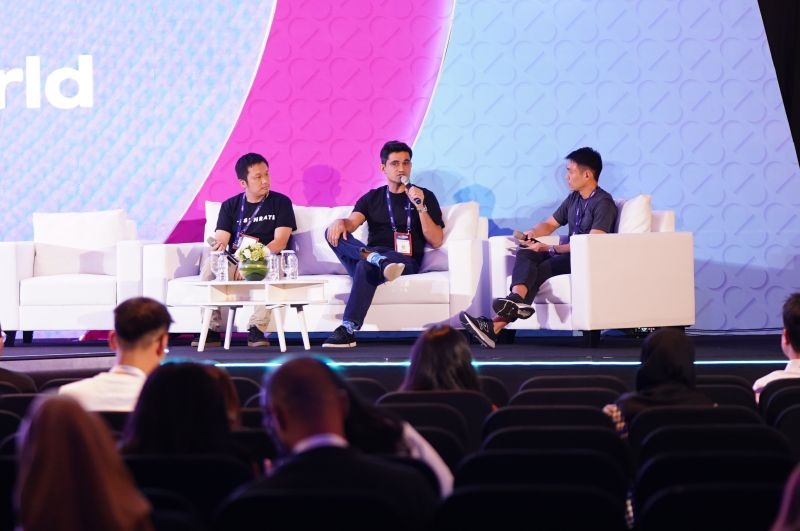
There are three white chairs on a stage in Jakarta. Paul Meng sits on the left, wearing a SUNRATE T-shirt. Beside him is Abheek Anand of Peak XV Partners; on the right, Tech in Asia founder Willis Wee. It is October 2023, and the conversation concerns investment. The photograph catches something useful about Meng’s working life: a founder, a financier and a moderator, discussing the business behind the money that businesses move.
Payments make an unlikely subject for a personal story. The satisfying outcome is usually that nothing particularly interesting happens. A supplier receives the money. A balance makes sense. Someone gets to close a spreadsheet. Meng has spent the years since co-founding SUNRATE in 2016 building a company around those expectations. His route to that work began with computer science and passed through banks in North America and Asia.
A programmer in the bank
Meng graduated from the University of Waterloo, majoring in Computer Science and Information Systems. Before SUNRATE, he accumulated more than 15 years of experience in risk management and corporate finance. His employers included Canadian Imperial Bank of Commerce, Royal Bank of Scotland and Citibank. His qualifications include the CFA charter and certification as an anti-money-laundering specialist.
The combination gives his career an unusual grammar. Software has to perform a task; finance has to account for what the task does. A payment can be correctly formatted and still require a decision about the beneficiary, the currency or the permission to proceed. Meng’s responsibilities at SUNRATE bring these concerns together: strategic management, risk and compliance, and relationships with financial institutions.
Those duties help explain the kind of founder story that follows. The continuity runs through his professional responsibilities. Meng moved from working within financial institutions to building a business that depends on their cooperation. His technical education and professional qualifications remain relevant to the same set of operational questions.
A small business at the other end
When SUNRATE announced its Series D-2 funding round in July 2023, Meng described the beginning in deliberately modest terms. The company had set out to improve the payments experience for small and medium-sized businesses. The release connected that ambition with secure transactions, customer service and clearer costs. It also named treasury tools, TreasuryOS and RiskOS, alongside international payments, collections and commercial cards.
“the modest goal of bettering the payments experience”
Paul Meng, describing SUNRATE’s beginnings, 2023
A smaller company can have an international problem without having an international finance department. That is the practical attraction of Meng’s original ambition. The business owner wants to serve a customer or pay a supplier; the payment system brings its own vocabulary and requirements to the conversation. Good service begins with taking those requirements seriously while making them manageable.
In a February 2024 interview, Meng placed SUNRATE firmly in business-to-business payments and emerging Asia. The company’s focus included Greater China and Southeast Asia. He also described an eventual IPO as a long-term capital-market goal. That was an ambition, expressed at a particular point in the company’s life. It gives the story a direction without supplying an ending.
Three chairs in Jakarta
The stage photograph belongs to the Tech in Asia Conference held on October 18 and 19, 2023. Meng joined Anand, Peak XV’s managing director, for a fireside discussion moderated by Wee. The session’s title, Behind the Investment, suited the moment. Peak XV had led the extended Series D round, with participation from Prosperity7 Ventures and SoftBank Ventures Asia.
Investment relationships also appear in Meng’s own public account of attending the Prosperity7 Majlis in Beijing in 2024. He described presenting SUNRATE and meeting stakeholders at a gathering of more than 350 attendees. This is a less cinematic founder anecdote than a midnight invention, but a useful one. Part of the job is explaining a complicated business to people whose support may help it expand.
The two appearances show different versions of that work: a public conversation on a conference stage, and a portfolio-company gathering with investors and industry leaders. In each, Meng was representing the business he had helped create. The scene gives a clear picture of a founder’s public calendar and the relationships occupying it.
Permission has a price
In August 2025, the expansion story acquired a specific price: RMB 315 million, or USD 43.8 million. SUNRATE announced that it had acquired all of Transfar Pay, a unit of Shenzhen-listed Transfar Group, and secured a payment business licence in China. The transaction had received approval from the relevant Chinese regulatory authorities.
Meng’s explanation emphasised the company’s global licensing framework and compliant operations. The deal makes that responsibility tangible. A network may appear borderless from a customer’s dashboard, while the company running it must work through permissions in individual markets. Acquiring a licensed business was one route SUNRATE took to extend that network.
Acquisition of 100% of Transfar Pay, followed by SUNRATE’s announcement of a China payment business licence.
In April 2026, SUNRATE signed with Hong Kong’s Office for Attracting Strategic Enterprises. Meng described Hong Kong as a key base in the global strategy. The company planned to strengthen payments and treasury work there while exploring compliant innovation in blockchain and Web3 digital finance. These were plans for further development. The language of permission remained beside the language of possibility.
Global work, local desks
Another part of the expansion had a more ordinary address. On March 31, 2026, SUNRATE opened an expanded Kuala Lumpur office at Menara Binjai. The larger workspace supported operations, customer experience, product development and global business support. Meng described Malaysia as an important market and a key part of the company’s strategy.
There is something reassuringly physical about the detail. Global software still requires people working in particular rooms. The Malaysian team’s responsibilities covered work that customers encounter directly and work they may never see. A larger office is a modest piece of a larger story, but it makes the operating side of expansion visible.
The April 29 announcement of a Bank Negara Malaysia Class B licence added another piece. Granted under the Money Services Business Act 2011, the approval enabled regulated money remittance services in Malaysia. The company described Kuala Lumpur as a Shared Services Centre supporting its global network. In Meng’s account, the regulatory approval and the operating centre worked together. Geography supplied both a market and a place to do the work.
The payment behind the holiday
Travel offers a particularly clear example of the businesses Meng is trying to serve. A booking has a consumer on one side and a collection of commercial relationships behind it. Airlines, hotels, agencies and other suppliers all belong to the payment picture. For a payments founder, the holiday starts to look rather like a set of accounts payable wearing sunglasses.
At Phocuswright Europe in Barcelona on June 15, 2026, SUNRATE announced an enhanced collaboration with Sabre. The work extended beyond commercial card issuance to international payments, foreign exchange and global collection services. The stated purpose was to help travel businesses manage more of the payment lifecycle through the relationship.
Meng’s explanation centred on travel’s international character and the payment challenges accompanying it. This is a concrete application of the original smaller-business ambition: a company may need several financial functions around the same commercial activity. Bringing them together is an operating proposition. Its usefulness depends on the work a travel business can actually complete.
Autonomy meets the audit trail
The next chapter arrived at SuperAI in Singapore. On June 10, 2026, SUNRATE unveiled Sunrate.AI, describing a system of specialised agents for chat, onboarding, payments, compliance and foreign exchange. The announcement proposed coordinating payment workflows rather than treating every action as a separate task. It also described approvals, human review and audit trails within the architecture.
For Meng, this puts a new technology inside an old area of responsibility. An automated decision still has consequences for a business’s money. The launch framed AI as a way to handle complexity, with operational controls around its use.
Five agents. Different jobs.
Select a function to see its place in the payment workflow.
Document verification, beneficial-owner validation and account activation.
In July 2026, SUNRATE and Mastercard released a joint white paper on agentic global payments. It identified 16 payment-lifecycle pain points and 13 AI use cases, including reconciliation, routing and compliance screening. The report also addressed governance, transparency and accountability. A business delegating decisions needs to understand who authorised an action and how to review what followed. The audit trail belongs in the same conversation as the ambition.
Meng also joined the 2026 Money Awards jury for Payments. That role places him among those assessing other companies’ responses to problems he encounters in his own work. Clear customer needs, execution and tangible impact were among the stated criteria. They offer a sensible way to read his career, too.
By September, SUNRATE had announced its inclusion in Singapore’s Most Innovative Companies 2026, a Tech in Asia and Statista ranking. Meng again framed innovation around problems faced by businesses operating across borders. The thread back to 2016 is easy to follow. The machinery has grown more elaborate; the customer still needs to pay someone. For a founder working in payments, an uneventful transfer remains a satisfying finish.