Patrick Grady hired his first employee in March 2000. In the history of software companies, this qualifies as arriving at the party just as somebody notices the smoke. He had spent months preparing a business plan for a service that would coordinate the small transactions of working life. The market was about to provide a considerably less cooperative demonstration of coordination.
His proposed assistant would understand a person’s circumstances and help get things done. Travel was an opening: flights, hotels, cars, dinner, the company rules that governed them. Behind each apparently simple purchase sat a collection of systems that did not conveniently talk to one another. Grady wanted to make them cooperate.
A quarter of a century later, he leads TetraScience, working on the organization of scientific data for AI. The setting has changed. The recurring irritation is recognizable. People own expensive software, possess valuable information, and still spend their days joining the pieces together.
A business plan before twenty
Grady grew up in the New York suburbs and attended Pace University. In his account of those years, an interview for a Wall Street summer internship precipitated his departure from college in 1987, before his twentieth birthday. He was fascinated by Michael Milken’s approach to capital markets and began looking for another market whose financing machinery could be rearranged.
Venture capital caught his attention. His proposed change was to connect individual investors with entrepreneurial businesses more directly, reducing the layers through which their money passed. He wrote a hundred-page plan. The ambition was expansive; the initial equipment was admirably compact. A small investment bank gave him a desk and a telephone.
He began building an angel network, assembling prospective investors on one side and business plans on the other. Advisers warned him that the model would become difficult as it grew. A nineteen-year-old with a hundred-page plan is not always the ideal audience for a warning.
As the venture developed, regulatory constraints complicated his attempt to scale it. He found himself devoting time to the machinery around investing rather than the entrepreneurs he wanted to help. One enduring relationship came from that period: venture capitalist Burt McMurchy, whom Grady called his “Yoda.” They had first met while competing on a deal.
The apprenticeship that ended in a shutdown
McMurchy’s advice was practical. Before advising people who ran companies, Grady should run one. He took charge of Borealis, a Nevada sales-force automation business with roughly fifty employees and dwindling cash. He later described the first week as a reckoning with how little he had understood from the investor’s chair.
The company closed after about fifteen months. His account gives the episode an uncomfortable place in the career: the operating apprenticeship ended in a shutdown, and the education stayed with him. Almost immediately afterward, he began working on the business plan that became Rearden Commerce.
He credited the earlier General Magic team as an influence on the personal-assistant idea. He and investor Charlie Bass had also discussed a future of mobile, distributed work. The question was already taking shape: what would a worker need when the office stopped being a single place?
How much of a working day disappears into making separate systems cooperate?
One employee, too many passwords
In the summer of 1999, Grady spent time on Cisco’s campus studying its self-service working environment. Employees could reach travel, dining, conferencing, and other applications through a portal. Each application had a purpose. Together, in his assessment, they imposed a growing burden of logins and disconnected tasks.
He wanted an assistant that knew the employee and could apply company policy while a purchase was being made. Travel supplied a demanding test because time, location, availability, and cancellations all mattered. A useful assistant had to understand a situation, then carry an action through it.
The company was incorporated in November 1999, before that first hire the following March. Grady drew on technical advisers as he developed the approach. In the early years, he said, the business survived from payroll to payroll; he put in $3 million of his own money alongside outside funding.
Distribution eventually made the idea less solitary. American Express became a partner, signing an agreement in 2006 and beginning to sell the product in earnest in early 2007. A company attempting to change how people bought services had found a route through an organization that already helped them buy.
- 1999Business incorporated
- 2000First employee hired
- 2006American Express agreement
- 2016Grady leaves Deem’s leadership
A billion dollars does not buy back time
By January 2013, Rearden Commerce had grown to about five hundred employees. A September 2011 financing had valued it at $1 billion, following acquisitions including Ketera Network and Homerun.com. It was the sort of figure that could make the preceding struggle look tidier than it had felt.
Grady treated the valuation as validation, but resisted the assumption that it required an immediate march toward an IPO. His stated measure of progress was whether users, merchants, and partners gained value. He admired Jeff Bezos’s willingness to think beyond short reporting cycles. Patience was central to the argument, though patience financed by investors always comes with negotiations attached.
Later in 2013, with the business renamed Deem, he was candid about the calendar. He acknowledged that he could have started in 2007 or 2008 and arrived at much the same point. The early start had bought years of work that a later entrant might have avoided. Being early can look wonderfully like foresight from a distance; closer up, it has a payroll.
“Now it’s a game of execution.”
Patrick Grady, 2013
His original scenario had involved a business traveler arriving at JFK and receiving recommendations informed by identity, location, and destination. By 2013, he believed the necessary pieces were assembled. The phrase “personal assistant” had acquired a substantial amount of infrastructure underneath it.
In 2015, Deem connected 34,000 corporate clients with 100,000 merchants and forty travel-management partners. Its founder explained the broadening ambition through an Amazon comparison: travel had served as Deem’s starting category, much as books had for Amazon. Expense management and purchasing belonged in the same larger proposition.
Yet the expansive version did not settle the company’s future. Grady stepped down in April 2016. Under John Rizzo, Deem pursued a narrower strategy. That turn belongs in the story alongside the valuation. An ambitious platform can produce useful products and still require a substantial reconsideration of its scope.
A second company, a different starting point
Grady first met Spin Wang and TetraScience’s other founders at the Harvard Innovation Lab in May 2017. Their business involved connected laboratory equipment and applications. His developing view was that fragmented experimental data presented the more consequential problem.
In spring 2019, Wang returned with a difficult situation: the company was short of money and needed to change direction. Wang and fellow founder Salvatore Savo visited Grady in San Francisco for three days. They chose to rebuild within the existing company rather than abandon its legal and capital structure. A $1.5 million seed round followed in May.
The resulting business put the data layer at its center. Grady and Wang’s account emphasizes a neutral intermediary, able to work with the businesses producing and consuming experimental information. The old concern with systems cooperating had acquired another setting, with a more specific starting problem.
Series B announced, co-led by Insight Partners and Alkeon Capital.
A financing milestone following the 2019 rebuild.With the 2021 Series B, Grady’s transition to CEO was finalized. The financing was also an exercise in choosing companions: he described seeking investors with relevant expertise, experience across funding stages, and patience for the company’s intended course.
His account of the fundraising contains a pleasing detail for anyone who has endured a persuasive slide show. He said he did not make a pitch deck. Instead, investors received operating results and the board-approved plan of record. That plan ran to 107 slides. Apparently even the refusal to make a presentation can require a presentation.
The argument continues
The directness predates the companies. Grady recalls family dinners organized around debate, with his father assigning him the weaker side. In first grade, persistent questioning earned him repeated blackboard-writing punishments. He says they changed little. A person can get a remarkable amount of practice disagreeing before acquiring a job title.
His later self-assessment is less triumphant. He recognizes that people have sometimes experienced his manner as overly aggressive, and credits his wife, Alexis, with helping soften it. The admission adds something to the founder’s familiar praise of first principles: an argument can be carefully reasoned and still land badly.
In October 2025, he began sharing that voice through Unvarnished, his Substack about AI, company building, intelligent agents, and geopolitics. By July 2026, his writing was pressing a question about ownership: as organizations adopt external AI models, how do they retain control of the data and working knowledge that make them distinctive?
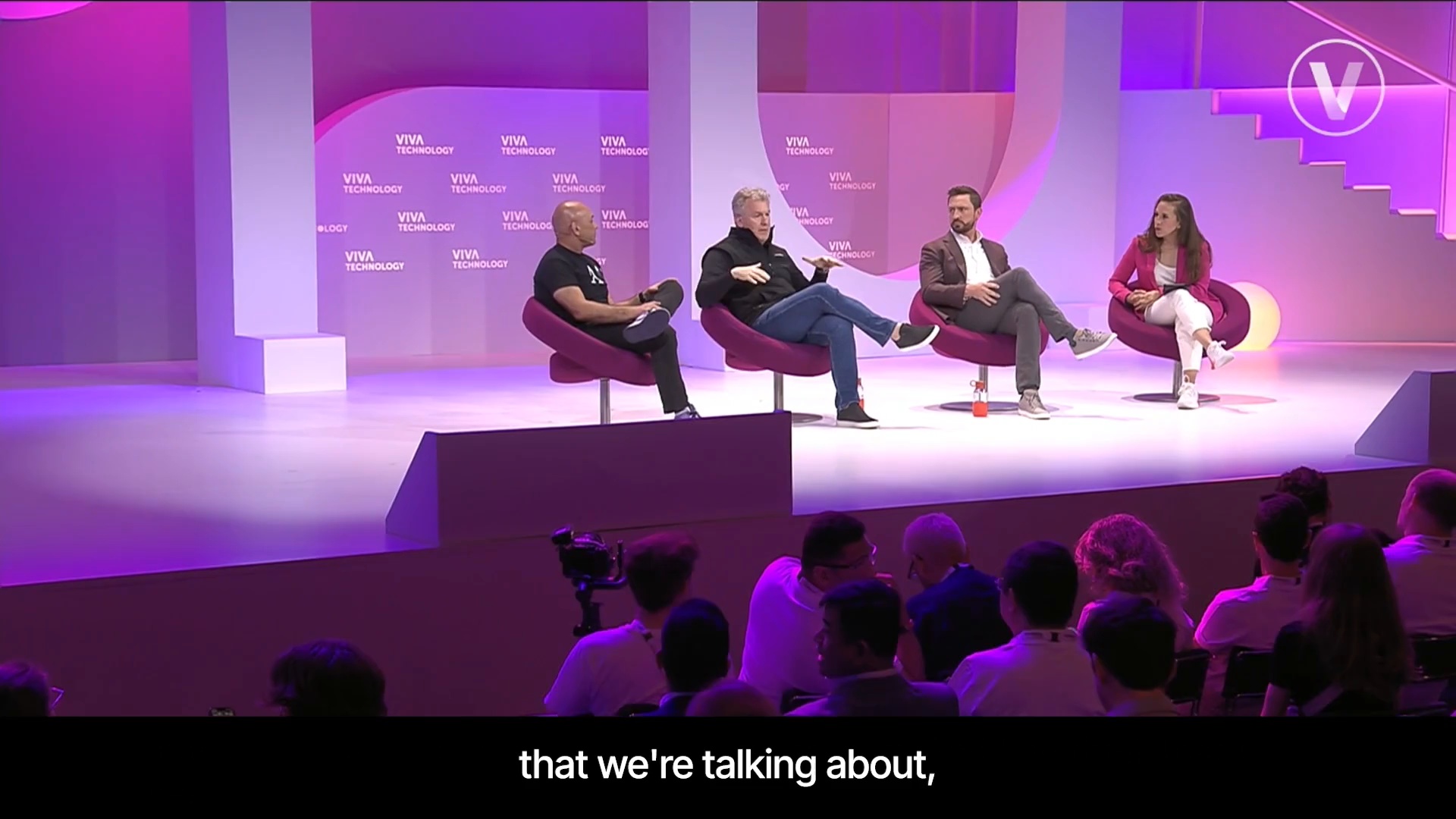
Onstage at VivaTech in 2025, he had also stressed collaboration between organizations with different expertise. The long-time advocate of entrepreneurial independence was arguing for the practical necessity of working together. It fits the thread running through his career: individual effort keeps encountering problems that require an arrangement among many participants.
Grady’s story gives being early its proper complications. There are borrowed ideas, painstaking connections, a closed company, a costly build, and another chance to reconsider where to begin. The enduring question is quite ordinary. Why does getting something done still require so much work around the work? He has spent much of his career trying to make the answer shorter.