In November 2024, UMB Fund Services replaced a transfer-agency system that had been in place for more than twenty years. The interesting part was what disappeared alongside it. Several ancillary systems, accumulated over the years, could be retired too. A software conversion had become an opportunity to subtract.
- Software that keeps investor ownership records in order.
- Built for financial institutions, from transfer agents to 529 administrators.
- The useful test: how many surrounding workarounds can disappear?
The replacement came from Envision Financial Systems. Its specialty is investor recordkeeping: maintaining the account-level information that tells an investment business who owns which shares, what happened to those shares, and what must happen next. The work sits behind statements, distributions, transactions and customer-service answers. You generally encounter its output rather than its name.
That obscurity makes Envision worth examining. A new investment product can look simple from the sales desk while introducing awkward exceptions downstairs. Someone has to keep the records straight. Envision sells that someone a system.
02A daily accrual changes the plan
The origin begins with a specific assignment. At Analytic Investment Management, Satnam Gambhir needed to accommodate daily-accrual funds in its shareholder accounting. A Tennessee procurement document recounts how his review of outside systems found a market dominated by legacy mainframe applications. Analytic chose client-server technology and relational databases instead, completing its next-generation system in 1993.
Gambhir already knew Tim Kan, the architect of real-time quotation feeds at Stockmate Financial. They had met in 1988 through their employers. By October 1994, Gambhir, Kan and investor Alan Lewis had founded Envision. The company's own history remembers lunch meetings in a Newport Beach park. Its name expressed the founders' dissatisfaction with mainframes and their belief in a different technological future.
The instructive detail is the sequence: an operating requirement exposed an architectural constraint. The founders did not need to invent a new reason for funds to keep records. They needed a different way to do a job that funds already had.


03Less software around the software
UMB makes that idea tangible. Envision announced the completed conversion on November 19, 2024. UMB's transfer-agency business needed to handle mutual funds and alternatives, including interval and tender-offer funds. Moving its records also allowed it to simplify the collection of surrounding applications. The announcement describes a changed operating model, rather than publishing a measured savings figure.
A buyer evaluating that result should ask a surprisingly useful question: which extra systems can actually go away? A faster core may leave the same manual handoffs intact. Retiring adjacent tools suggests that responsibilities have moved into the main workflow, where they can be controlled together.
Envision occupies a specialist corner of financial technology. Its customers include transfer agents, fund sponsors, broker-dealers and college-savings administrators. SS&C offers competing transfer-agency and subaccounting capabilities, including APIs and hosted services. Envision's pitch rests on configurable, real-time recordkeeping across different products. Openness alone is no longer an exclusive claim.
“We’re excited to replace a system that had been in place for more than 20 years.”UMA WILSON · UMB · NOVEMBER 2024
04One record, several ways to work
The commercial model follows a core-plus design. A central recordkeeping system supports additional modules for document workflows, branded investor portals, reconciliation and correspondence. Broker-dealers can license the software, use hosted SaaS, and add operational services such as fund-data management and trade reconciliation. Buying software and handing over daily processing are separate choices.
FundKeeper addresses a particularly untidy corner: mutual fund accounts held directly at different fund companies. It brings those positions into a consolidated environment, giving investors and advisers one portal and consolidated statements. It works with clearing and IRA-custody services. The appeal is fewer scattered records and contact points for the brokerage back office.
The 529 business shows the value of knowing a narrow problem well. Contribution limits, beneficiary information and age-based portfolio changes all require their own handling. Envision says its system was developed with administrators who understood those daily details. Its homepage lists 38 college-savings and ABLE plans across 25 states' 529 programs.
Partnerships extend the reach. In November 2022, BetaNXT announced an integrated brokerage and mutual-fund subaccounting offering with Envision under one relationship and support structure. The partnership launched with AssetMark. Customers had wanted a hybrid service arrangement that the available alternatives had not satisfied. Integration was part of the product being purchased.
adviser portals
OWNERSHIP RECORD
connected systems
05The calendar gets complicated
Alternative investments put this design under pressure. A system accustomed to ordinary fund activity must also accommodate tender offers, repurchases, capital commitments and trading calendars that differ by product. In January 2026, Envision introduced AltsKeeper, bundling its alternative and semi-liquid investment capabilities into one configurable operating environment.
The company estimated that the number of alternative and semi-liquid products on its platform had doubled in three years. AltsKeeper supports interval funds, tender-offer funds, REITs and BDCs, with subscription processing, document tracking and configurable liquidity events. The practical target is the patchwork of spreadsheets and separate tools that can appear as product variety grows.
March brought ETFKeeper. Its scope includes ETF share creation, redemptions, dividends, splits and capital-stock reporting, with connections to fund accounting and custodians. Different mechanics, familiar argument: extend the recordkeeping environment without multiplying systems.
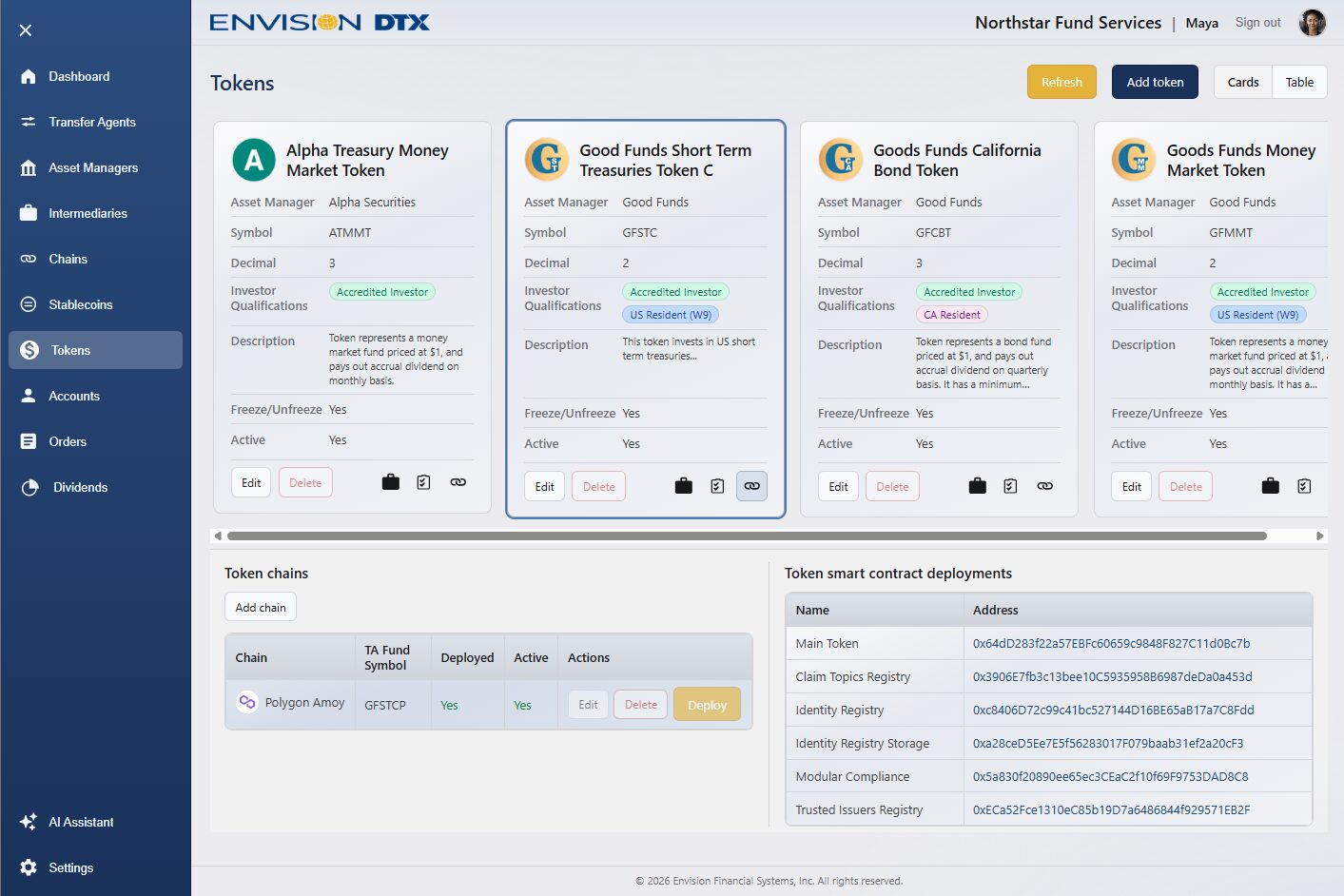
The newer Envision DTX platform takes that argument into tokenized funds. Its proposed architecture keeps the transfer agent as the authoritative recordkeeper while connecting blockchain activity to existing servicing workflows. The dashboard looks contemporary; the underlying concern is old-fashioned and essential. Two representations of ownership must agree.
06Count the handoffs
There is a useful lesson here for anyone buying enterprise software. Inventory the workarounds before comparing feature lists. Identify which team owns each exception, where information is re-entered, and which calendar or eligibility rule sends work into a spreadsheet. Those questions make a migration proposal concrete enough to challenge.
This approach depends on a firm's willingness to redesign its operating work. It becomes less convincing if every old side process survives, if surrounding systems cannot exchange reliable data, or if the buyer expects recordkeeping software to replace investment judgment. FundKeeper itself depends on complementary clearing and custody arrangements. The boundary matters.
Envision's March 2026 announcement said its technology supported more than $8.5 trillion of investor assets. That is the scale of the records its clients service, not money sitting on Envision's balance sheet. The more revealing unit may be smaller: one account, one exception, one fewer place to type the same information. Multiply that across an investment business and the back office starts to move.
Follow the records
Explore Envision, FundKeeper, AltsKeeper, ETFKeeper and DTX.
LinkedIn · X · News & videos · Watch: automating investor relations