A missing attachment is rarely dramatic. Neither is an approval waiting in the wrong inbox, a meeting whose decision never reaches the right system, or the polite third email asking whether anything has happened. Yet this is how modern work often loses an afternoon: not in catastrophe, but in the small spaces between useful tools. Karrtik Rao has built his public career in those spaces. At Moxo, where he has been identified as Head of Solutions, the object of his attention is not merely the message, the file, the form, or the video call. It is the journey between them.
That makes Rao a curious sort of enterprise-software protagonist. The usual software story begins with invention. His begins with inconvenience. A client wants to know what comes next. An employee needs a document. A manager needs to approve an exception. Everyone has an application, and still someone must chase someone else. Rao's work asks why the process cannot do more of its own explaining.
His public record is spare, but unusually coherent. In 2020, he appeared in the launch of RaiConnect, a virtual-branch service built by Raiffeisen Bank International with Moxtra, as Moxo was then known. In 2022, he wrote about digital collaboration for financial advisers, joined a podcast discussion about law-practice software, and demonstrated Moxo Flows on the Finovate stage. The industries changed. The operational puzzle did not.
A branch with no front door
A physical bank branch has a choreography so familiar that it becomes invisible. There is a door, a desk, a queue, a person who knows which form belongs where. Move the branch onto a phone and all that tacit structure vanishes. A screen can be more convenient than a building, but it is less forgiving of ambiguity. Nobody wants to wander through six tabs looking for the digital equivalent of the right desk.
RaiConnect was intended to give premium clients of Raiffeisen's network banks a virtual branch for timely service. At launch, the app was available across several European markets, with more planned. Rao's description of the project was revealing. He did not sell mobility as novelty. He framed it as translation: the job was to carry the quality of an in-branch experience into a mobile-first world.
“For today’s consumers, on-demand, digital experiences are no longer perks - they are expectations.”Karrtik Rao, during the RaiConnect launch
Translation is harder than digitization. Digitization can put a form on a screen. Translation asks what the form was doing in the larger encounter, who helps when it is confusing, where the signed copy goes, and how the client learns that the next step has begun. Rao's preferred phrase at the time was “OneStop.” The capitalization was corporate, but the instinct was humane: do not make a client reconstruct the organization chart simply to get served.
Seven minutes on the seam
Two years later, Rao walked onto the FinovateFall stage in New York wearing the unofficial uniform of the software demonstration: dark jacket, open collar, laptop waiting behind a lectern. A live demo is a peculiar theatrical form. The audience is invited to admire the future while every presenter privately negotiates with Wi-Fi, timing, and fate.
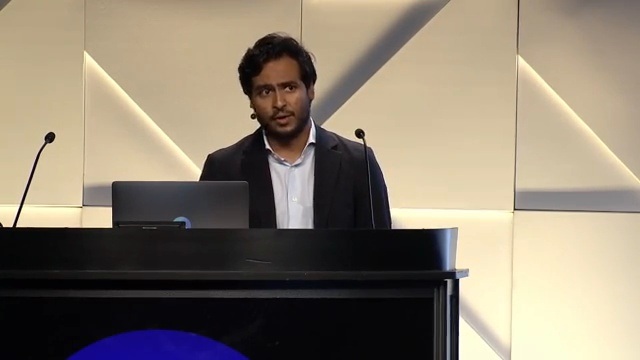
Rao's presentation followed a fictional financial-advisory client through a process. The particulars were deliberately ordinary: a form, a file request, an approval, a task. There was messaging when conversation was needed and a meeting when live contact made sense. Third-party services could enter the workflow without sending the client on a tour of unrelated windows. None of these objects was exotic. The arrangement was the point.
A feature can perform perfectly while the customer journey fails between features. The document arrives, but the reviewer is not alerted. The approval occurs, but the client cannot see progress. The meeting ends, but its result never changes the task. In software, as in farce, doors are easy; entrances and exits require timing. Rao was demonstrating the timing.
The demonstration also moved between a desktop workspace and a phone. That small change of screen carried a larger argument. Employees and clients do not necessarily encounter the same process in the same place, or need to see the same amount of it. Coherence does not require identical views. It requires each participant to receive the right context, the right action, and a reliable sense of progress. The workflow supplies the common spine while the interface minds its audience.
His title, Head of Solutions, suited the performance. Solutions work lives between the product a company has built and the problem a customer can describe. It requires technical fluency, operational patience, and a tolerance for edge cases. The glamorous question is what the product can do. The useful question is what must happen next.
The adviser’s invisible stage crew
Rao made the same case in a 2022 essay for the wealth-management industry. Advisers, he argued, could configure and automate workflows, manage client processes, share documents securely, meet by video, annotate material, record conferences, and track tasks. The inventory reads like the contents of a well-stocked digital office. His conclusion went beyond efficiency: better access and better service could support client loyalty.
This is the less mechanical side of workflow software. Clients do not cherish a workflow because it has conditional logic. They cherish not having to repeat themselves. They appreciate knowing who has the file. They enjoy being asked for a signature once. Efficiency earns its keep when it resembles consideration.
The best workflow behaves like good stage crew: the right object appears in the right hand at the right moment, and nobody applauds the person who moved it.The operating idea behind Rao’s public work
There is also a limit hidden inside the promise. Service cannot be reduced to routing. The important moments often involve judgment: a complicated case, an exception, a worried client, a decision for which a human must remain accountable. Moxo's current language places AI agents, connected systems, and people inside the same process. That is a newer vocabulary for the division of labor Rao was already showing in 2022. Let software carry the context and the chase. Keep people where judgment and relationship belong.
One problem, many professions
The financial adviser was not Rao's only example. In January 2022, he joined an episode of Adventures in Legal Tech devoted to law-practice management software. The conversation ranged across case workflows, useful performance measures, data, payments, lead management, and the daily work of lawyers and staff. Law and wealth management have different rituals, but both produce dense client relationships, consequential documents, deadlines, and decisions. Both punish a careless handoff.
This helps explain the breadth of Moxo's later positioning. The company began in 2012 around mobile collaboration and evolved toward client-interaction workflows, then broader business-process orchestration. Rao's public appearances sit along that change. He has been less a herald of one industry than an interpreter of a recurring pattern: work crosses departments, companies, and systems, while the person waiting for an answer experiences only delay.
Strategic business solutions at Moxtra; RaiConnect translates premium branch service to mobile.
A legal-tech roundtable examines case management, data, payments, and client workflows.
A wealth-tech essay links coordinated digital service with adviser productivity and retention.
As Head of Solutions, Rao demonstrates Moxo Flows at FinovateFall.
The WealthTech & Investing Summit lists him among its speakers.
The modest ambition
Rao does not maintain the kind of public mythology that turns an executive into a lifestyle genre. His LinkedIn presence is largely professional, sharing Moxo partnerships, customer stories, and hiring notices. The restraint fits the work. Solutions operators are usually measured by whether other people can proceed.
That does not make the ambition small. Coordination is one of business's stubborn taxes. Every status request consumes attention. Every lost document lowers trust. Every invisible dependency turns a simple process into a scavenger hunt. To remove those irritations at scale is to change the texture of a working day, even if nobody writes a sonnet about the approval arriving on time.
The strongest thread through Rao's work is clarity. Show the client the next action. Give the employee the surrounding context. Connect the system that holds the record. Use a meeting when conversation helps and automation when repetition does not. These are not thrilling instructions. Neither is “mind the gap,” and yet it has saved a great many shoes.
Enterprise software often announces itself with a grand noun: platform, transformation, intelligence, orchestration. Rao's story is clearer in verbs. Request. Review. Decide. Sign. Finish. The achievement is not that the verbs exist. It is that one can lead cleanly to the next, with fewer people stopping to ask where the work went. When that happens, the machinery has not vanished. It has simply learned some manners.