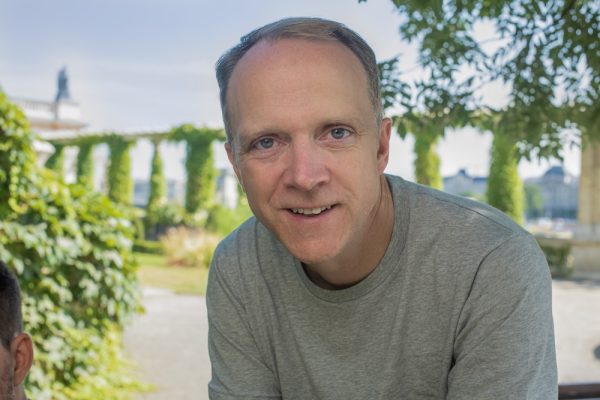
Profile
The Conversation He Couldn't Stop Thinking About
At Twilio, Mark Gilbert spent years watching companies extract intelligence from their own communications. The patterns that emerged fascinated him: there was a vast gap between what was being said in business conversations and what was being captured, analyzed, and acted upon. The insight that stuck - the one he couldn't let go of - was that financial advisors were sitting inside some of the most valuable conversations in the economy and walking away with handwritten notes they'd spend an hour transcribing.
That frustration became Zocks. Not a note-taker dressed up in AI branding, but a platform designed to sit inside the workflow of a financial advisor and eliminate the administrative overhead that had ballooned alongside regulatory complexity. Meeting transcription with speaker attribution. Automatic form-filling for account opening and compliance documents. Personalized client emails drafted and ready to send. The administrative tax on advisors - sometimes ten or more hours a week - converted back into time with clients.
"When you're focusing, that means you're ignoring other things. And that's probably the hardest part of leadership - is to just let certain things go knowing that you've made a bet on what matters most."- Mark Gilbert, Co-Founder & CEO, Zocks
Gilbert came to this with a specific pedigree. He studied Electrical Engineering at the University of Waterloo - a program that produced a generation of Canadian tech founders who ended up running things in Silicon Valley. He moved through engineering and product leadership roles at Microsoft before joining Hearsay Systems as CTO in 2017, then VP of Product Management at Twilio. Each stop added a layer: how enterprises buy software, how compliance intersects with communications, how to move fast at scale without breaking what customers trust you to protect.
The early Zocks pitch was grounded in specificity. Financial advisors weren't incidentally underserved by technology - they were underserved by design. Most software built for wealth management was designed for compliance officers or portfolio analysts, not the person actually sitting across from a client. Gilbert made a bet on the advisor's daily experience. The bet paid quickly.
He launched an early adopter program in late 2023 with a target of 25 firms. Within six months, 250 people had signed up. When Zocks deployed at Carson Financial Group across their full RIA network, the rollout finished in under six weeks - the fastest enterprise software deployment Carson had ever seen. The product was working. The market was ready. The question was whether the technology would keep up.
"This just saved me an hour from this single meeting, Mark."- Zocks early adopter, after testing a single meeting. Gilbert later said it made his week - for many days.
It did - faster than expected. What Gilbert initially mapped as a two-to-three year technical timeline compressed to nine months as large language models accelerated sharply in late 2022. Zocks moved with them. The platform wasn't just riding the LLM wave; it was using the capability to build something structurally hard to replicate: deep integration with the workflows, compliance requirements, and CRM systems that financial advisors already lived inside. Salesforce, Wealthbox, HubSpot, Redtail. The connective tissue that made Zocks sticky wasn't the AI - it was the understanding of how advisors actually work.
By March 2025, Zocks closed a $13.8M Series A. By January 2026, a $45M Series B co-led by Lightspeed Venture Partners and QED Investors, bringing total funding to $65M. The company now serves more than 5,000 firms including Ameritas, Kestra Financial, Osaic, and Cambridge Investment Research. It holds a 4.8-star rating on G2 and ranks first in value and momentum in its category.
Gilbert runs the company with what he describes as strategic focus as a discipline - not as a preference but as a practice. Remaining flexible enough to respond to advisor feedback within days rather than months. Conducting regular check-ins with every customer personally. Staying close to the evidence. When the product was still rough around the edges and an early user reported saving an hour from a single meeting, Gilbert asked about the formatting issues. The response: "Don't worry, this is still so much faster than what I'm doing today." He shipped it. The lesson stayed.
In April 2026, he was appointed to the Board of Directors at RFG Advisory, which simultaneously made a strategic investment in Zocks as part of the Series B. The board seat reflects both validation and acceleration - a distribution partner becoming a governance partner. Gilbert continues to operate Zocks from 548 Market Street in San Francisco, one of the more storied addresses in tech, with 140 people building what he now describes as not just a system of work for advisors, but a system of insight.
The idea is that Zocks eventually knows enough about an advisor's clients - their patterns, their concerns, their life events surfaced across hundreds of conversations - that it can prompt the advisor to reach out before the client thinks to call. Anticipatory service at scale. The thing advisors can't do manually because they're too busy filling out forms. Which, if the product works, they no longer are.