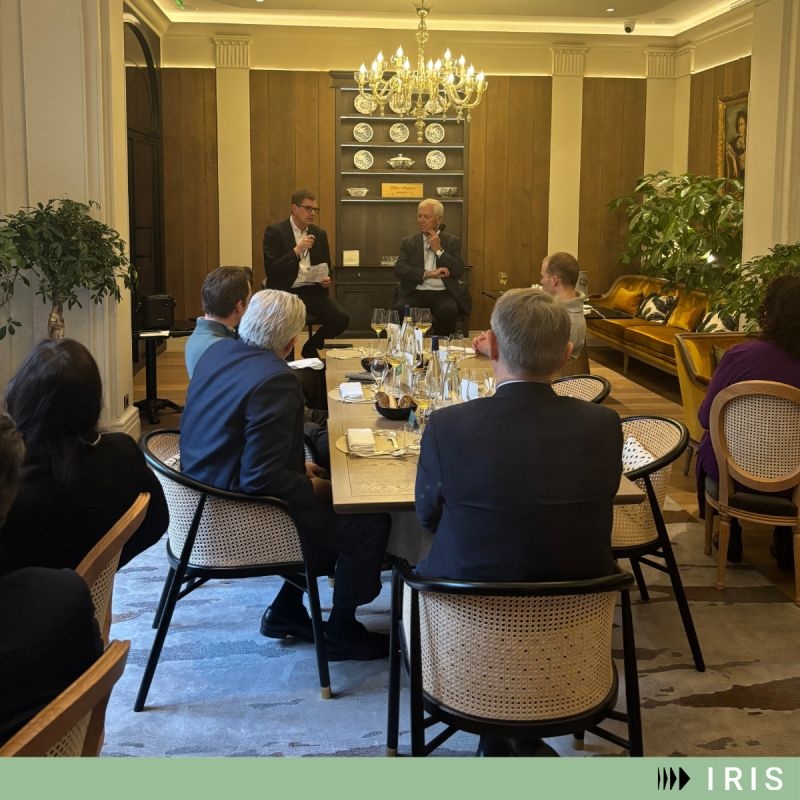
At a lunch in Paris in January 2025, Jean-Luc Robert sat beneath a chandelier, facing a table of listeners. Beside him was Curt Gunsenheimer, managing partner at IRIS, an investor that had backed Kyriba over many years. There were glasses on the table, plates on the wall and a considerable amount of corporate history in the room. The setting was intimate enough to make the financial numbers seem faintly absurd.
A few months earlier, an investment announcement had valued Kyriba above $3 billion. Robert had already handed over the chief executive’s job. Now he was talking about the business he had spent 20 years leading. The photograph captures a different scale of enterprise: two people with microphones, explaining decisions to people within conversational distance.
Behind the valuation lay a modest-sounding problem. A company ought to know where its money is. Once it operates across banks, currencies and countries, that apparently reasonable expectation becomes a substantial software assignment. Robert made it a long one.
Two exits before the long assignment
Kyriba was not Robert’s first experience of building a business. He had been founding chairman and CEO of Eurosept Associés, a consulting firm acquired by EDS. He also founded and led European Engineering Software, a financial-software provider acquired by SunGard Data. Consulting and software were already part of his working vocabulary before treasury became the defining subject of his career.
His education joined two disciplines: business at École Supérieure de Commerce de Paris, and an LLM at Université Paris II - Assas. Those credentials establish a background in commerce and law. The companies establish something more practical: experience creating organizations that other businesses eventually bought.
Then came a much longer stretch in one chair. Robert began his tenure as Kyriba’s chairman and CEO in 2003 and remained until September 2023. Twenty years can disappear inside a tidy executive biography. In practice, that span takes a software company through changing customer expectations, new competitors, successive investors and the recurring obligation to make the product useful again.
The appeal of an unglamorous question
Treasury software has an image problem only if glamour is the test. Its subject is the cash that keeps a business functioning, and its audience has little use for a beautiful answer that arrives too late. Robert’s proposition at Kyriba put that work in the cloud, giving finance teams a way to centralize treasury activity across locations.
He described the opportunity in practical terms: traditional systems installed on company premises were expensive and came with maintenance costs. A cloud service could make treasury tools accessible to a wider set of multinational organizations. The delivery model mattered because it changed how customers obtained and used the software.
The 2008 financial crisis sharpened the need. As credit tightened, companies paid closer attention to cash visibility and forecasting. Robert identified that pressure as an influence on Kyriba’s product development. The useful question became more demanding: where is the cash, how much will be available, and how quickly can a finance team establish the answer?
There is a restrained comedy in the premise. Money can be present in a company’s accounts and still require considerable detective work before the people responsible for it have a usable picture. A treasury system earns its place by shortening that investigation.
An Atlantic business, one market at a time
Robert’s professional base was San Diego; his education and earlier businesses connected him to France. Kyriba’s financing history shows an enterprise attracting support on both sides of the Atlantic. In 2017, it announced a $45 million investment led by Sumeru Equity Partners, alongside existing investors including Bpifrance, IRIS, Daher Capital and HSBC.
That investor list also says something about the market. A software specialist, a French public investment bank and an international bank could each find a reason to participate. Corporate treasury sat at the intersection of their interests. Bpifrance highlighted the company’s ability to develop in Europe and the United States, and the bicultural character of its team.
By 2018, Kyriba’s annual revenue had surpassed $110 million, up 43%, and it added 229 clients during the year. These are dated measures of the business under Robert, useful because they show a particular stage of its growth rather than turning the whole career into one final number.
In early 2019, the company announced its acquisition of FiREapps, which specialized in enterprise currency management. The fit was legible: companies handling cash internationally also faced exchange-rate exposure. Adding currency-risk capabilities widened what Kyriba could offer the same finance departments.
“Congrats to the team ! Great start of 2019 ! Welcome FireApps !”
Jean-Luc Robert, on LinkedIn
Robert’s public welcome was brief and cheerful. Elsewhere in his LinkedIn activity, congratulations repeatedly went to the team. That is a small detail, but a more tangible one than a grand claim about leadership style: these were the words he chose when the business had something to celebrate.
The same year brought a Bridgepoint-led $160 million investment round and a $1.2 billion company valuation. Kyriba outlined plans to put $60 million into product innovation over two years. The announced agenda included development across treasury, foreign-exchange risk, payments and working capital. Raising money came with a fairly specific shopping list.
Historical operating figures, before the 2019 Bridgepoint investment.
International expansion also meant confronting established suppliers on their own ground. In March 2020, Robert described an ambition to increase Kyriba’s German customer base from 15 to 200 over five years. The target was a plan, with all the uncertainty that belongs to a plan.
He pointed to the company’s experience in Britain as evidence that it could win customers in another competitive market. Germany would require people as well as software: the business was assembling a Frankfurt team for sales, implementation and support. The ambition had an address and job descriptions.
This is the less photogenic part of global expansion. A map can acquire a new colored dot in seconds. Serving customers there takes a local operation, the capacity to install the system properly and people who answer when something needs attention. Robert’s German comments dealt with those particulars.
From seeing money to doing something with it
Banks were becoming another route into the market. In a December 2019 interview, Robert described institutions looking to migrate toward software as a service while dealing with older technology. They wanted to bring services to market quickly. Kyriba could supply capabilities they could incorporate into their own corporate offerings.
The relationship made the business more interconnected. A software company working with corporate finance departments could also work through banks serving those departments. Bank connectivity, already central to a usable treasury picture, became part of the commercial story as well.
At Kyriba’s 2020 Global Summit, Robert described a shift from a single solution for seeing cash to a platform covering its movement, protection and optimization. Those activities suggest a useful sequence: establish the position, act on it, manage the risks and put the available resources to work.
- 01 / SeeUnderstand the cash position
- 02 / MoveConnect payments and systems
- 03 / ProtectManage financial exposure
- 04 / OptimizePut liquidity to work
By May 2022, he was discussing Enterprise Liquidity Management: connecting systems and unifying financial data so finance leaders could make decisions across the organization. His stated future for Kyriba was a platform that continued supporting customers through that whole chain. The aspiration stayed close to the customer’s working day.
Robert also took the argument into a wider technology discussion. At the July 2023 Rencontres Économiques in Aix-en-Provence, he participated in a panel on new technologies and industrialisation. His contribution linked technological change with the ability of finance departments to make decisions immediately. Even on a stage discussing industry’s future, his subject returned to the speed of a financial decision.
A different chair
Recognition arrived along the way. In 2020, Goldman Sachs included Robert among its 100 Most Intriguing Entrepreneurs at the Builders + Innovators Summit. He also received EY Entrepreneur Of The Year recognition in San Diego. By then, he was well into the second decade of the Kyriba assignment.
On September 5, 2023, Kyriba announced Melissa Di Donato as its new chair and CEO. Robert was stepping down and joining the board. His statement looked back over 20 years, expressed pride in the company’s development and endorsed his successor. Di Donato arrived after leading SUSE, with previous roles at several enterprise-software companies.
Later that month, Sidetrade announced Robert’s appointment as a non-executive director alongside Gilles Rigal. It singled out his experience in cash management, SaaS entrepreneurship and the US market. The connection was concrete: Sidetrade worked in software for the order-to-cash process, another part of the business of getting money where it needs to be.
In October 2024, Bridgepoint announced its reinvestment in Kyriba alongside new minority investor General Atlantic. The company valuation exceeded $3 billion. That milestone came under Di Donato’s leadership; Robert’s operating tenure had ended the previous year. A company’s story continues after the handover, with new people responsible for the next set of decisions.
IRIS had first invested in Kyriba in 2010 and remained involved through successive investments. As the company expanded internationally, its research and development teams remained in Saint-Cloud, France. The transatlantic story had a physical shape: a software business serving companies abroad, with product development still rooted in France.
Which brings the story back to the Paris lunch. After the investment rounds and international plans, Robert was sitting with an investor who had accompanied the business for years, talking to a room of guests. The operating role had changed. The accumulated experience still had an audience.
The question underneath it all remained admirably plain. Where is the money? Robert’s career shows how much work can live inside four ordinary words.