Patrick Goggin has a useful objection to the grand language of brand purpose. He does not particularly want an intimate relationship with a paper towel. He wants it to clean up the mess. In a business fond of giving ordinary purchases extraordinary emotional assignments, this is a refreshing place to begin. The kitchen counter has veto power.
He uses that example to make a serious point. A product has a job. A company can connect that job to a broader contribution, provided the connection holds up in what it actually does. His hypothetical paper-towel business could help clean up an urban environment. The idea starts with usefulness and asks how far it might travel.
Goggin, partner and CEO of Morning Walk, has been circling that question for years. His career includes international brand work at Leo Burnett, the development of its HumanKind philosophy and a move into independent agency leadership. The names of his frameworks suggest a strategist who likes to give an unruly problem a handle. The problem keeps moving.
A global job, then a Chicago door
When Jacobson Rost announced Goggin’s arrival in March 2009, it hired him as chief strategy officer in its new Chicago office. He came from Leo Burnett Worldwide, where his most recent position was executive vice president and director of global growth. The move brought a career spent across markets into an independent agency’s developing Chicago operation.
During his 17-year Leo Burnett career, he had managed brands including Coca-Cola, Chevrolet, Mercedes-Benz, McDonald’s, Samsung, SAB Miller and Procter & Gamble. His work covered North America, Europe, the Middle East, Africa and Asia-Pacific. Those names offered plenty of scale; the geographic spread offered different settings in which to ask how people relate to the things companies sell.
The Chicago job had a specific remit: connect client service with creative work, develop agency alliances and bring emerging media and technology into brand-building efforts. That brief already contained several interests that would recur in his later writing. Strategy would need to travel between departments. New tools would have to earn a practical place in the work.
The idea came with people attached
Goggin traces part of his thinking to Coca-Cola work in Africa. He recalls working with Charlie Frenette and the company’s team on values-driven marketing, connecting individual customers with the communities around them. In his telling, the experience helped seed HumanKind, the philosophy he developed at Leo Burnett in the mid-2000s.
HumanKind put a brand’s purpose beside the actions through which people could experience it. The approach responded to a changing communications environment, as audiences gained ways to participate in stories that companies had once largely controlled. A brand could make a claim; people could answer, reinterpret it or offer their own account.
His later writing returns to the commercial consequences of that change. The customer’s response belongs inside the plan. A company’s reason for existing should help organize what it makes, how it behaves and how people encounter it. This is a demanding interpretation of purpose because it reaches beyond an advertising line and into the everyday decisions that make the line believable.
There is also a recognizable habit of mind here. Goggin looks for a framework that lets people discuss the same problem in the same language. HumanKind supplied one such vocabulary. He would keep developing others as the business changed around him, trying to preserve a connection between human behavior and growth.
A name you can take outside
In November 2023, Jacobson/Rost became Morning Walk. Goggin and Steve Simoncic, the agency’s chief creative officer, had purchased previous owner Jerry Flemma’s shares. The company’s history reached back to Sheboygan in 1957; its operations now included Chicago and Milwaukee. This was a new ownership chapter for an established business, with a name suggesting something anyone could begin before breakfast.
Walking had already figured in the agency’s creative process. The new identity expressed optimism, energy and forward motion. It also gave the company a pleasantly concrete verb. In advertising, where a meeting can occasionally produce more terminology than decisions, going for a walk has the advantage of requiring an actual departure.
At the rebrand, Goggin reported 35 percent company growth over roughly the preceding 18 months, from existing and new clients, following the adoption of performance branding. The figure belongs to that period and to the company’s account of its progress. It explains why the change carried a business argument alongside the fresh name.
Agency-reported growth over approximately 18 months before the November 2023 rebrand, combining organic growth and new clients.
Follow the relationship past the click
At Morning Walk, Goggin developed Truth to Transactions, a way of connecting business challenges, brand purpose and the customer’s path to purchase. The title states its obligation plainly. An idea has to travel far enough to affect what someone does. A strategist cannot simply leave it looking attractive at the beginning of the journey.
His performance branding approach brings brand development and performance marketing into the same system. Branding works on recognition, meaning and emotional connection. Performance activity pursues measurable responses. Goggin wants those efforts to inform one another, rather than grow into separate structures with separate definitions of success.
The concern also appears in his argument about dependence on technology platforms. When a company repeatedly buys access to customers through somebody else’s system, it leaves part of the relationship outside its own control. He favors using direct customer knowledge to develop experiences and services that make people more willing to return.
For BOSS Snowplow, Morning Walk’s work included digital data transformation and discussion of how customer insights could serve the business. The example gives the ecosystem language some weight. These ideas have to function for a company selling equipment, with customers whose needs extend well beyond enjoying an advertisement.
A dinosaur enters the spreadsheet
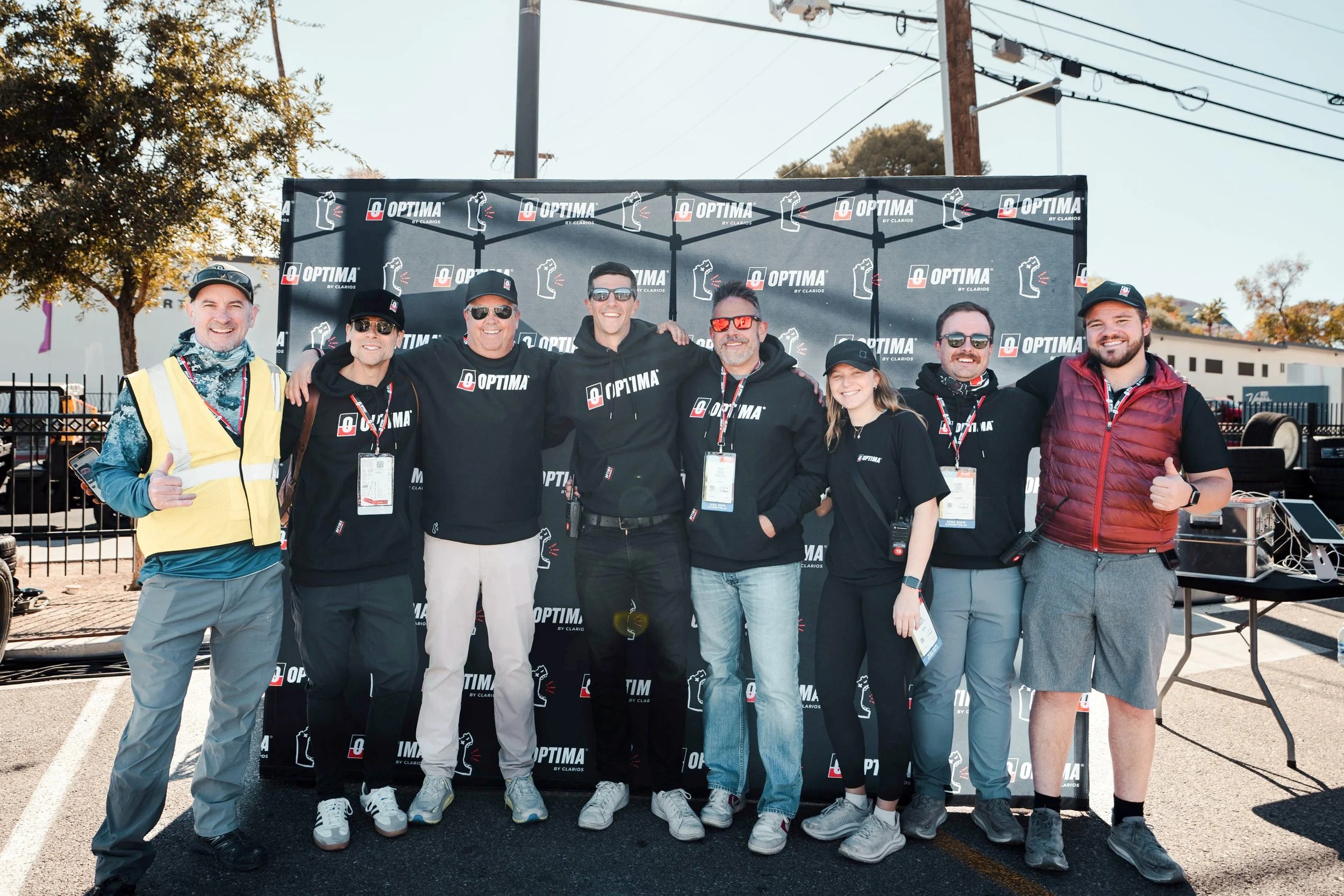
The work can be considerably louder than the theory. At OPTIMA Unleashed during SEMA 2024, Morning Walk’s team helped bring together drifting cars, ride-along experiences, influencers, social content and a 30-foot mechanical fire-breathing dinosaur. Few phrases in a marketing plan improve so reliably upon reaching their final noun.
Creative director Tom Gorton’s account describes a coordinated effort, with production work beginning in Milwaukee and team members managing the details on site. He also describes consumer data collection and the event’s role in connecting OPTIMA with enthusiasts. The spectacle had a purpose beyond the photograph: give people an experience and help the brand understand its audience.

It is an instructive scene for Goggin’s argument because several disciplines share the same physical space. Design, production, client service and performance measurement all have work to do. The event makes their connection visible. The customer experiences the result as one occasion, however many job titles were needed to arrange it.
The tools move quickly. So must the team.
By 2025, Goggin was describing AI as part of Morning Walk’s daily approach to research, planning, targeting and content optimization. His account of performance branding put these tools inside a process that begins with purpose and carries through media and measurement. Speed matters, but the work still needs a direction.
“Technology is a tool to amplify strategy, it is not a strategy.”Patrick Goggin
The distinction is useful because a tool can accelerate a decision before anyone has decided whether the decision is sound. Goggin’s phrasing gives the strategist continuing responsibility. Software can assist with the work; someone still has to connect that work to the client’s problem and decide what deserves attention.
In his June 2025 reflection on Cannes and accountability, he focused on the organizational demands of AI adoption: teams adapting to different processes, creative rhythms and creator-led work. He treated the challenge as something that happens inside the business. The emphasis was on client outcomes and daily improvement, with the less glamorous work of adaptation carrying much of the load.
Grateful, with a list still open
Goggin’s company biography gives him a compact personal motto: head in the clouds, feet on the ground. It also describes life with his wife and three children. The motto fits his public work rather neatly. Big organizing ideas occupy one end of the day; the practical requirements of other people occupy the rest.
For Morning Walk’s second anniversary in November 2025, he described gratitude alongside restlessness and acknowledged an obsessive streak. He saw HumanKind, Truth to Transactions and Performance Branding Ecosystems as repeated efforts to make sense of complexity. He was willing to put his own habits into the account, including the less convenient ones.
His ambitions for 2026 included connecting marketing activity with customer journeys and outcomes, improving media decisions, developing creator and experiential work, and building an AI-led Morning Walk operating system. The list reads as work in progress. It gives his appetite for improvement a set of tasks rather than a ceremonial finish.
His leadership advice elsewhere emphasizes shared purpose, participation, celebration and direct support when people fall short of expectations. At the anniversary, he finished with a walk to coffee and appreciation for people who keep trying. For someone who has spent years devising frameworks, it is an appealingly ordinary destination: a cup of coffee, colleagues to thank, and more work waiting when he gets back.