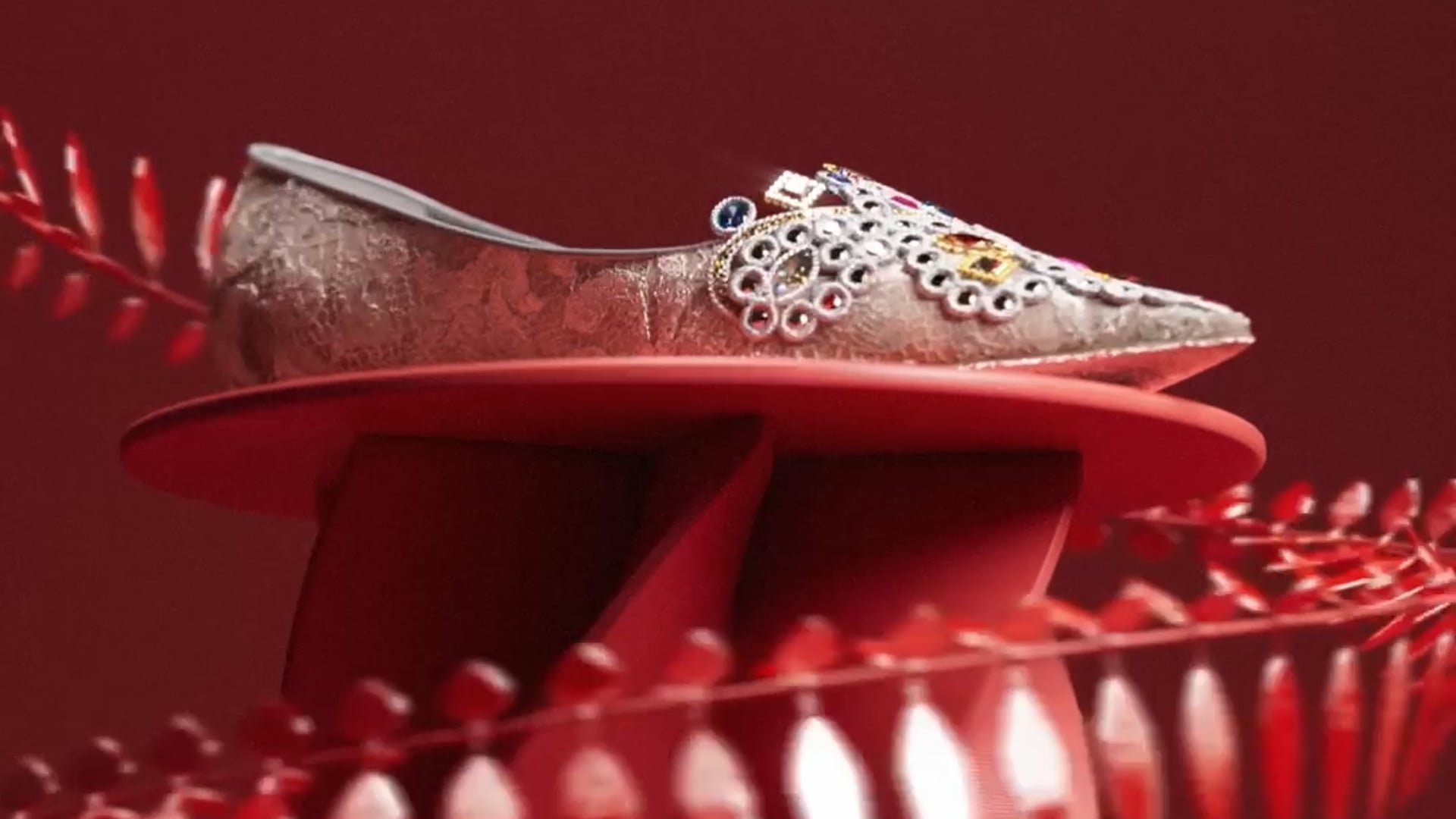
There is a shoe in the middle of a red machine. Around it, a jointed body bends and glitters, not quite animal and not quite architecture. It is recognizably a dragon dance without ever producing a dragon. This is the neat trick in Modest's twenty-second Chinese New Year film for René Caovilla: the agency removed the most obvious symbol from the brief and kept the movement that made the symbol meaningful.
The result is a useful introduction to Modest Creative Company, a Santa Monica shop founded by advertising veteran Ryan Gerber and presented as part of Hylink's international orbit. At a reported 13 employees, it was too small to resemble the sprawling agency networks whose offices occupied its map. Yet its published footprint stretched through Bogotá, Hong Kong, Shanghai, London, Paris and Singapore. The central proposition was not that thirteen people could be everywhere. It was that a small senior creative center could know whom to call.
The small center and the long bench
Gerber came to the company with the résumé of a cheerful agency nomad: R/GA, Wieden+Kennedy, 72andSunny, TBWA Media Arts Lab, Beats by Dre and a long list of other stops. In 2023, Hylink named him Creative Partner and Executive Creative Director for the Americas. The announcement praised his ability to navigate cultures, which sounds like ordinary agency language until you look at the operational problem underneath it.
A global campaign is a chain of translation. The strategy becomes a concept; the concept becomes a film, a post, a billboard or an event; each execution lands in a market whose audience knows when an outsider has taken a shortcut. Large agencies solve the problem with payroll and process. Freelancers solve it with trusted collaborators. Modest sat somewhere between the two - a boutique creative identity with access to Hylink's offices, media knowledge and production infrastructure.
A creative route, not an org chart
The difference matters to a client. The thing being purchased is not merely labor. It is judgment about which labor belongs on the job. Public team profiles connect Modest to creative directors, writers and motion designers. A brief could therefore begin with a brand problem and expand into film, animation, illustration, out-of-home work or social content without the company pretending every specialist sat together in one enormous studio.
Research is cheaper than cliché
For the 2024 Caovilla campaign, the obvious move was to put a dragon next to the Veneziana collection and call it Chinese New Year. Modest described precisely why it did not. The dragon is so familiar and so frequently used that a direct rendering risked becoming both obvious and extractive. The team researched the old dragon-dance myth and translated its undulation into a digital kinetic sculpture. The cultural reference lived in the behavior of the object rather than on its surface.
When the symbol is exhausted, borrow its verbs.
That is the most portable lesson in the company's work. Start with the action, ritual or tension behind a recognizable image. A dragon does not merely look like a dragon; in a dance it ripples, coils, advances and depends on many people moving as one. Those verbs gave Modest a visual system. The product could sit inside that system instead of wearing a cultural sticker.
This is also where boutique attention earns its keep. The output was a very short film. The labor was in deciding what not to show. Creative companies often list strategy, design, motion and production as separate services. Here they appear as one decision carried through several disciplines: research found the source, art direction abstracted it, digital production gave it motion, and editing compressed the whole argument into twenty seconds.
Frozen meat, warmed up
Wild Fork presented a different puzzle. The retailer had built its business around a large selection of frozen meat and seafood, but price-led, lower-funnel advertising was not enough to introduce the brand to new customers. Its first brand campaign needed an idea broader than inventory. Vokal shaped a platform around nourishing a better life. Modest was credited as brand creative agency, alongside Other on media and We Are BMF on public relations and social.
The campaign's turn was simple: cooking is for everyone. Not the flawless overhead shot of dinner, but the smell, noise, smoke and cheerful imperfection that arrive before anyone eats. For a retailer selling the ingredient, this shifted attention from the freezer to the person at the grill. It moved the brand up the funnel without abandoning what the product actually does.
Wild Fork had plenty to sell, but conversion advertising alone limited discovery.
The useful emotional territory was cooking, feeding and gathering - not frozen inventory.
Strategy, brand creative, media, PR and social had named owners.
The mess and pleasure of cooking could travel across film, social and retail communication.
What the client was really buying
Modest sold professional services: strategy, concepts, design and production. It did not publish a rate card or campaign budgets. That is normal for an agency whose cost changes with the crew, markets, media and number of deliverables. The better way to understand the business is as a set of decisions wrapped around a brief. A client paid for senior creative direction at the center and a variable group of specialists at the edge.
This put Modest between three common alternatives. A global holding-company agency offered more permanent capacity but carried more layers. A production studio could make the film beautifully but might enter after the central idea was fixed. A direct roster of freelancers offered flexibility but made the client manage the roster. Modest's pitch was integration without bigness: one creative partner to shape the idea, then assemble and direct what it needed.
The model has conditions. It works when the client can name a real brand problem, grant senior people access to decisions and accept a team that changes with the assignment. It strains when the work requires hundreds of always-on assets, a vast embedded account team or strict separation between many markets. A network only saves effort when responsibilities and approvals are explicit. Otherwise, every extra node becomes another place for the idea to soften.
The first thing to fail is the front door
Small creative businesses are often better at making the work than preserving the institution that made it. Modest's current public record is scattered across a LinkedIn page, a Vimeo account, collaborators' portfolios, trade coverage and legal filings. Gerber's own biography dates his founder and Chief Creative Officer tenure from 2023 to 2025. The company's web address now leads to an unclaimed Squarespace domain.
That does not erase the work. It does reveal a weakness in founder-led studios: when the principal moves, the portfolio can become an archaeological site. The Caovilla film survives because Vimeo holds it. The Wild Fork credit survives because partners named one another. The corporate idea survives in a trademark filing and an unusually exuberant LinkedIn description. But the connective tissue - the case studies explaining why one decision led to the next - is thin.
There is one last lesson here, and it has little to do with advertising craft. Archive the thinking while the team is still together. Record the brief, the rejected obvious move, the division of labor and the result. A clever film proves taste. A durable case study proves a method. For a company selling judgment, the second artifact may ultimately be worth more.