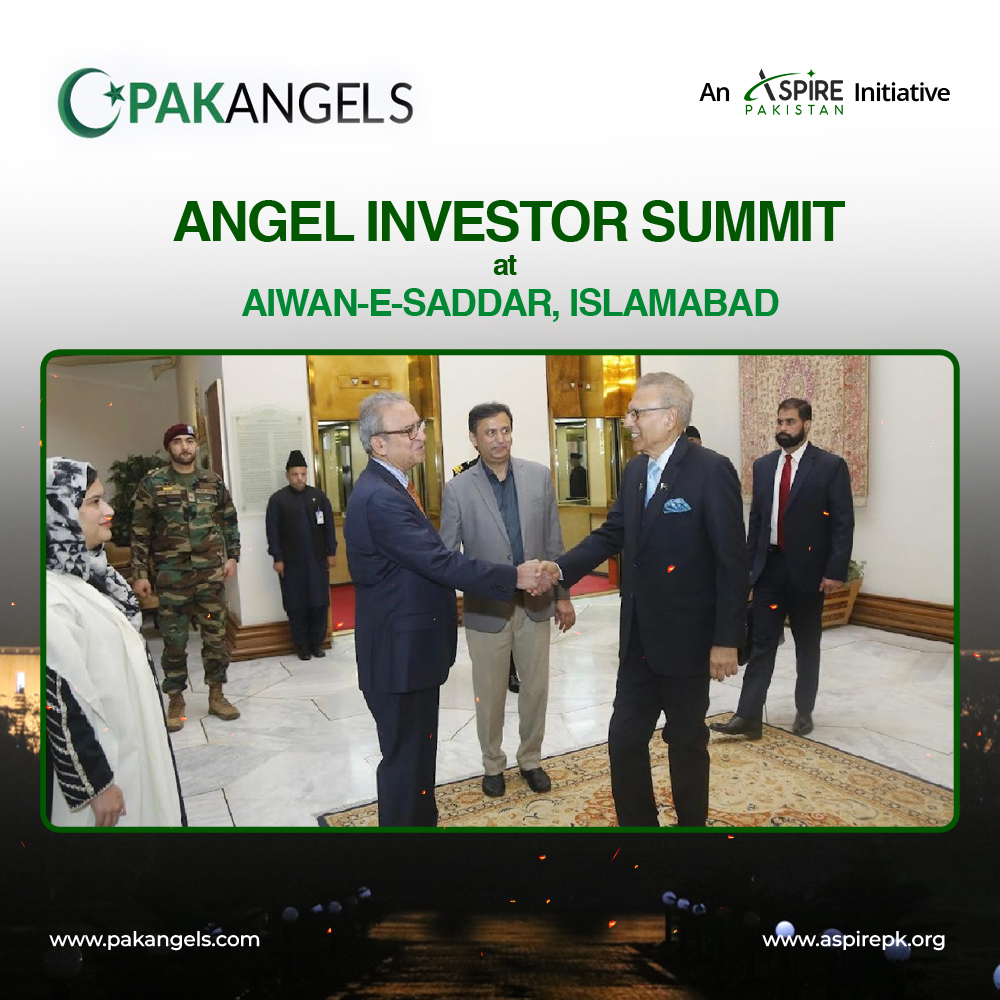
In December 2023, a startup pitch could get you inside Pakistan’s President’s House. Pak Angels brought ten promising ventures to Islamabad for an investor summit. Six delivered three-minute pitches. Healthcare and electric vehicles were among the subjects under discussion. It was a conspicuous address for an ordinary entrepreneurial problem: you have built something, and the people who could help it grow are somewhere else.
- For founders: mentorship, investor readiness and introductions to local and overseas angels.
- For learners: free online AI training, practice and team hackathons.
- For investors: curated startup access, with advertised investments starting at $5,000 per startup.
That problem explains the first part of Pak Angels. The more interesting part comes before anyone has a pitch. What if the person with a useful idea has never built an application? What if the missing introduction is to a skill? By adding practical AI training, Pak Angels began working further back along the same chain.
The investor room came first
Founded in 2022, the San Jose-based platform is led by Mohammad Anwar Khan. His background gives its Silicon Valley connection some substance. An SEC-hosted director biography records that he founded contactless-payments company ViVOtech in 2001 and co-founded digital-wallet business Omnyway in 2014. He had experience turning technology into something businesses could use before helping other founders attempt the journey.

The early events were about making investment less remote. In March 2023, Pak Angels and ASPIRE Pakistan collaborated on an angel summit at the Islamic Chamber’s Karachi headquarters. An OIC activity report records more than 50 participants and over 20 startups. In November, NIC Karachi hosted a collaborating investment symposium. December brought the President’s House showcase.
These gatherings served two audiences. Founders needed access to people who could assess an early business. Prospective investors needed a way to understand unfamiliar companies. Pak Angels’ public offer includes pitch materials, evaluation insights, legal and financial diligence, and guidance on exits. The introductions come with a process.
Then the classroom became a workshop
In July 2024, Pak Angels launched its Generative AI training initiative. The teaching choice matters. Participants would learn to use existing models to build applications, avoiding the initial burden of creating a model from scratch. Its skills programme welcomes students, faculty, freelancers, founders and professionals. Programming experience is not required.
The format puts practice next to instruction: online learning, practical development and hackathons. iCodeGuru and ASPIRE Pakistan are operational partners. PEC provides an engineering route; HEC and NCEAC help extend the university connection. These relationships give the programme ways to reach people beyond an existing circle of startup founders.
“Empowering Startups, People, and Industries for a Prosperous Pakistan.”Pak Angels’ stated purpose
Look at the first cohort’s winning projects. SereneCoders addressed parents trying to stay calm during a child’s meltdown. FitFuelBot proposed personalized fitness and diet support. Mixed Intelligence tackled the repetitive work of listening to calls and transferring information into forms. They are unusually useful examples because the problem fits in a sentence. A prospective user can understand what is being attempted.
These are participant projects, with all the testing and judgement that description implies. A fitness assistant still needs appropriate health safeguards. An audio workflow still needs accurate transcription and careful data handling. Building a demo makes those questions concrete; it does not settle them.
Free has a payer
The advertised six-week training costs learners nothing. PEC’s published inaugural address explains part of the arrangement: the council would bear backend costs for its first three cohorts, while Khan contributed without a charge. Other cohorts draw on sponsors and partners, including ULEFUSA. Removing tuition depends on someone supplying the money, instruction and coordination.
Rounded from the official skills page. Self-reported totals; these measures do not establish a single-cohort completion rate.
Pak Angels’ skills page reports more than 63,000 registrations, over 26,000 people trained and roughly 11,000 certificates awarded. Read those as separate measures. Registering expresses interest; training describes participation; certification records another threshold. Collapsing them into one impressive number would hide the work between signing up and finishing.
Demand also exposed a mundane constraint. Pak Angels reported that its Cohort 11 opening reached Zoom’s 1,000-attendee capacity, with additional viewers watching on YouTube Live. The practical response was an extra viewing route. A growing classroom needs somewhere for the next person to sit, even when the classroom is online.
A pitch still needs a business
For founders, the platform’s startup directory makes the breadth visible: infant incubators at KangarooCareAI, rental cars at Blink Lab, real-estate software at Fortify. Pak Angels occupies the connective space between these ventures, mentors and potential backers. Its investment programme advertises a starting amount of $5,000 per startup. That is investment capital, separate from the free training offer.
Alternatives include Paklaunch, Angel Investment Network Pakistan, incubators and direct angel relationships. Pak Angels’ distinctive proposition is the combination of diaspora connections, founder support and accessible applied learning. The useful question for a founder is which relationship supplies the next missing piece: a reviewer, an introduction, a customer conversation or capital.
By October 2026, that builder pipeline had another visible output. Reporting on Cohort 11 described 963 working projects across two hackathons, including tools for irrigation planning, small-manufacturer operations and checking legal references. Those submissions show what participants attempted. Their next test belongs outside the judging room: whether a real user finds the application reliable and useful enough to keep using.
Copy the sequence
Other communities can borrow the order: teach a usable skill, give a team a short deadline, require something demonstrable, then bring in people who can challenge it. Forty-eight-hour hackathons make the deadline tangible. Mentors and institutional partners make it possible to repeat.
The conditions matter. Participants need connectivity and time to practise. Organizers need instructors, sponsors and reviewers. Teams need access to users after the competition. Without customer testing, a winning application can remain a weekend accomplishment. Pak Angels’ useful contribution is bringing those first steps closer together, so that more people can arrive at the investor conversation carrying something another person can try.