Owais Anjum has an ambition that makes an interesting demand of a founder: he wants his company to outlast him. For someone whose job involves making decisions, it is a commitment to a future in which other people will make them. Emumba’s work has changed over the years, from a cricket social network to enterprise software and AI. The longer project is to build an organization capable of changing again.
That gives his career a more useful shape than a procession of job titles. Anjum has been a programmer, a development manager, the head of a Pakistan operation for a Silicon Valley company, and a founder. Across those roles runs the work of getting people to build together. A software business needs good code. It also needs someone to notice who could write better code next year, and what might help them get there.
The team came before the startup
His education combined a bachelor’s degree in computer science from GIK Institute with an MBA from San José State University. His early employers included CresSoft and KAPS Computing. By the time he appeared in an interview with Jehan Ara in 2009, he had spent six years in Silicon Valley, including three as a software development manager at Numetrics.
Numetrics developed enterprise software for the electronics industry. Anjum helped establish its offshore operation in Pakistan and led it as managing director. That placed him between a business in Cupertino and engineers in Pakistan, with the practical responsibilities that such a relationship entails. Across borders, expectations have to survive the journey as well as the specifications.
There was a community dimension to those years. He participated in OPEN Silicon Valley, and his conversations with Jehan Ara included ways to share knowledge and develop the industry in Islamabad. He also argued that young people should pursue work suited to their interests and abilities. The concern with potential appears early, before Emumba supplied a stage on which to practice it.
Cricket supplied the first pitch
Emumba began in 2011. Among its early ventures was Cricout, a social network for cricket fans, accessible on the web and through smartphone apps. The proposition had an appealing simplicity: give people who already wanted to discuss the game a place built for that conversation. Cricket supplied both a subject and a reason to return.
Anjum left his managing director role at Numetrics to concentrate on the venture. Cricout raised $85,000 from Silicon Valley investors in 2013. Its ambitions included reaching a large enough audience to produce positive cash flow. Those details capture the distance between developing an application and making a business of it. The former can be scheduled; the latter has the discourteous habit of consulting the market.
In that period, Anjum also spoke about mobile technology at a Google Business Group event in Islamabad. His interest extended to the people who would encounter the internet first through a phone. A cricket app was therefore part of a broader question about how a software company in Pakistan could reach customers beyond its immediate surroundings.
Emumba moved into software services in 2015. Enterprise customers brought a different setting for its engineering work: their own products, operating requirements, and reasons to buy. It is tempting to make this turn sound inevitable in retrospect. A change of business direction is easier to describe once a company has survived it. At the time, the team still had to do the work.
“Surrounding myself with people who are much more capable than myself is a dream come true.”
Owais Anjum · 2019
The boss makes the final
Anjum’s account of 2019 makes room for a seven-a-side football tournament. He joked about a team allowing a 45-year-old enthusiast into its ranks; they reached the final. He was pleased to have lasted. It is a pleasingly modest sporting claim for a chief executive, a profession seldom accused of underselling its contributions.
That same year, Emumba established a Toastmasters club. Anjum described himself as a beneficiary of the program and hoped quieter colleagues would become confident speakers. The pairing is revealing: a team needs places to compete and places to practice. Software expertise does not automatically make a person comfortable explaining an idea to a room.
Communication has consequences beyond the room, too. Someone who can explain a design can question it, defend it, or help another person improve it. Giving engineers repeated opportunities to speak is one practical way of making knowledge travel. It also gives leadership development a calendar, rather than leaving it as an attractive phrase in a presentation.
at the end of 2019
at the end of 2025
Two historical snapshots from Anjum’s year-end reviews; these are not current headcount estimates.
A return to the classroom
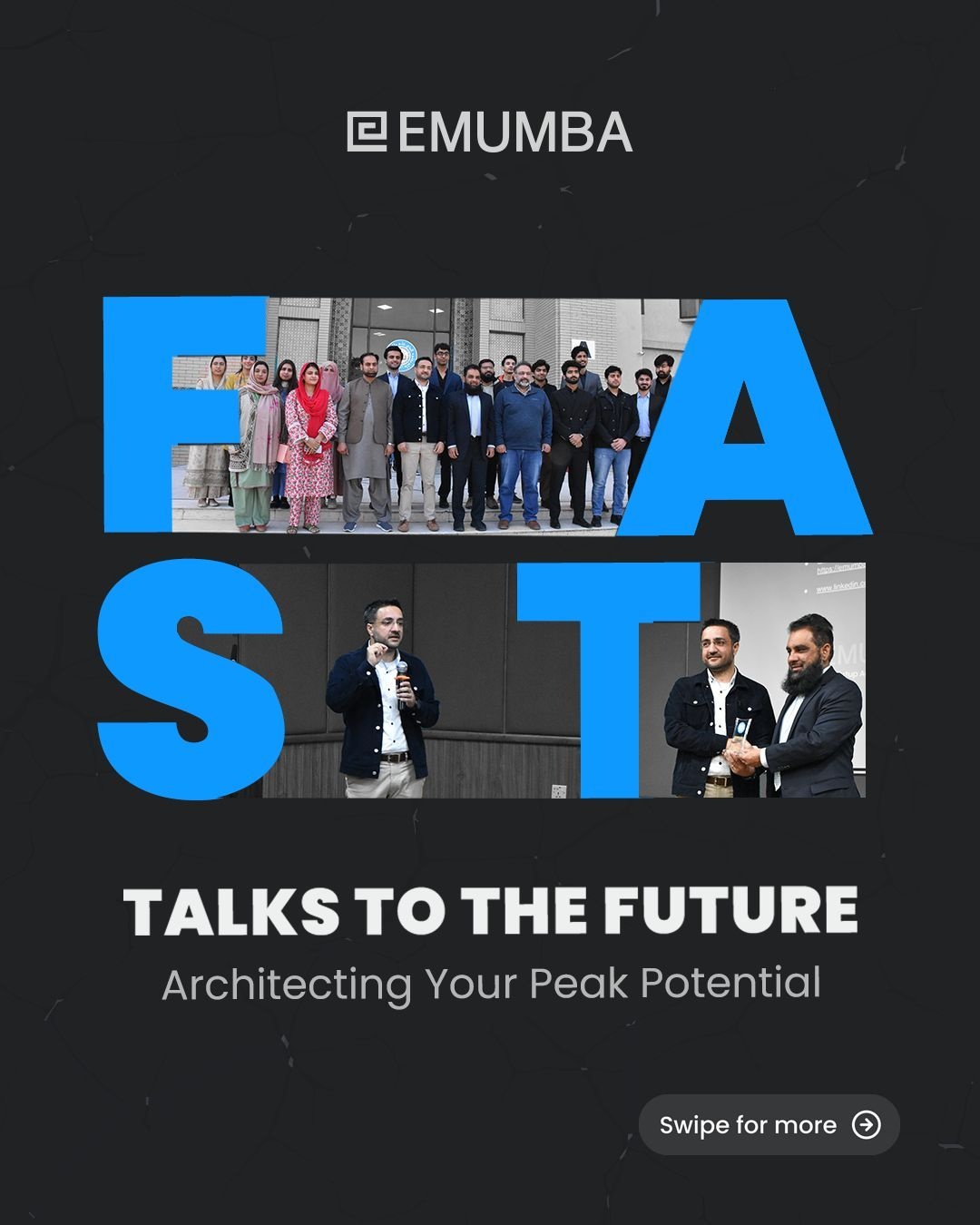
FAST has a recurring place in his story. At CresSoft in 1997, he worked alongside graduates of the university. Later he tutored a course at its Lahore campus. After returning to Pakistan in 2006, he hired his first batch from FAST Islamabad. At Emumba, its alumni continued to be part of the team.
When he returned to speak to graduating students in 2025, the talk was called “Architecting Your Peak Potential.” The title borrowed the language of engineering for a subject that resists neat specifications. People develop at different speeds, discover interests late, and occasionally turn out to be good at something their first job never required.
His presence in that classroom joined several parts of a career: colleague, tutor, employer, guest speaker. The relationship had accumulated through ordinary decisions over many years. Universities often enter founder biographies as a line of credentials. Here, one also appears as a continuing meeting place between an employer and the people who might eventually help shape it.
The teaching extended elsewhere. NUST’s account of its 2019 activities lists a team-building strategy workshop conducted by Anjum. His Agile Pakistan profile emphasizes managerial coaching as well as product development. Together, those engagements make a specific point: the management of engineering teams is itself something he has tried to teach.
AI needs a map, too
Generative AI brought a new version of the learning problem. Emumba’s experiments touched design, architecture, testing, deployment, and the operation of language-model applications. Keeping track of the available tools became a task in its own right. A company can hire clever people and still need a common way of organizing what they know.
Anjum shared the Genie Mindmap, a visual guide developed from the company’s work, alongside a five-part video series. He invited feedback and presented it as a resource for developers and decision makers. Making the map public gave others something concrete to inspect. A diagram can be questioned more productively than a general assurance that a company understands AI.
architecture02Testing03Deployment04LLM operations
He also considered the organizational effects. In a 2024 essay on the changing office of the CIO, he argued that generative AI could expand its role in product innovation. His caution concerned collaboration: product, engineering, and the CIO’s organization would need to work together. The software might open an opportunity; people would still have to agree how to pursue it.
That is a familiar concern in a new technical setting. His earlier career required cooperation across geography. AI asks for cooperation across functions, with different teams bringing different expectations. An organizational chart can assign responsibility. It cannot, by itself, make a conversation go well.
The product experiments continue
Enterprise work did not remove the desire to create products. In his review of 2024, Anjum described four earlier attempts that had fallen short of expectations. He then introduced InterWiz AI, developed under CTO Zishan Iqbal’s leadership. Emumba used it internally before offering it to customers.
That sequence matters. Using a product inside the organization gives its makers a direct acquaintance with its shortcomings. Colleagues become users, and feedback no longer requires a carefully arranged customer meeting. The company gets an opportunity to discover whether a promising idea is useful during an ordinary working day.
By the end of 2025, Anjum was writing about roughly 325 colleagues across Pakistan, the United States, and the UAE. His review included work with Microsoft and Extreme Networks and the achievement of AWS GenAI Competency. It also remembered mango parties, pottery, and chess. The corporate year, in his telling, had room for activities that did not require a release date.
A company beyond its founder
The 2025 annual dinner brought the long-term ambition into a particularly human setting. Anjum described a gathering of more than 700 employees and family members, with conversations about purpose, values, and building a company that could outlast their lifetimes. The audience included the people who share the consequences of working life without appearing on an organization chart.
A dinner cannot settle the question of a company’s future. Neither can a founder’s declaration. Longevity will depend on decisions made when the speech has ended: whom to trust, what to teach, how to handle a failed experiment, and when to let someone else lead.
Anjum’s career has repeatedly put him near those decisions. The setting has moved from a Silicon Valley software company to Islamabad, from cricket fans to enterprise customers, and from familiar engineering tools to AI. His stated ambition leaves the final chapter open. For a founder who wants others to carry the company forward, an open ending seems appropriate.
Follow the conversations
Writing, talks, and the company behind the story.
Owais Anjum on LinkedIn ↗Explore Emumba ↗Read his 2025 year-end reflection ↗Watch the Genie Mindmap series on YouTube ↗The 2009 conversation with Jehan Ara ↗His return to FAST Islamabad ↗