When Harris acquired Bizmatics in 2021, Vinay Deshpande reached for a surprisingly domestic phrase. The buyer, he said, offered “a permanent home for Bizmatics.” A software company had changed owners. Its co-founder and CEO was talking about where it would live.
The wording catches something a transaction announcement can easily miss. A business has employees whose plans extend beyond a signing date, customers whose routines depend on its products, and work already promised for next month. The ownership paperwork may be finished. The obligations have barely looked up from their desks.
Deshpande had helped start Bizmatics with Rajiv Apte in 2002. By the time of the acquisition, the company had been operating for nearly two decades. It had built PrognoCIS, developed commercial partnerships, and appeared on the Inc. 5000. There was a substantial working life inside that short announcement.
His choice of words gives us a way into it. Follow Deshpande’s career through its founding dates, growth figures and product decisions, and the interesting question becomes what keeps a software business useful once the excitement of starting it has passed.
A third company, with a longer horizon
Bizmatics came after two earlier ventures. Deshpande co-founded Digital Tools in 1989 and SoftPlus in 1994. The dates place his entrepreneurial work well before the Bizmatics chapter. By 2002, the act of beginning a company was already familiar territory.
Three founding dates make an appealing little staircase on a résumé. They also conceal most of the climbing. Each new enterprise requires choices about what to build, whom to serve, and which requests deserve the next week of engineering time. A founder can carry experience from one business into another; the new customers still expect their own problems to be understood.
With Bizmatics, the choice of partner mattered. Apte was both a friend and a business collaborator. Their work became PrognoCIS, a software suite whose scope extended into scheduling, payments and the administrative routines of its customers. Selling a suite means taking responsibility for the connections between tasks as well as the tasks themselves.
That responsibility gives the founding partnership a particular weight. One feature may be easy to demonstrate on its own. A collection of features has to cooperate when someone uses them in sequence. The first screen can make an excellent impression while the fifth quietly ruins the afternoon.
The customer already has a working day
One revealing detail in Deshpande’s product discussions is the attention paid to existing forms. PrognoCIS could reproduce paper forms as configurable digital versions. The ambition included continuity: someone moving to a screen should be able to recognize the job they were trying to do.
There is a certain restraint in that idea. Software gives its makers endless opportunities to rearrange someone else’s desk. A familiar field can be moved, renamed or concealed behind a pleasing icon. The designer gets a cleaner picture. The customer gets homework.
Respecting an existing form requires a different sort of attention. Why are the questions in that order? Who reads the information afterward? Which detail looks redundant until the person responsible for the next task explains it? These are ordinary questions, but they place the user’s experience ahead of the demonstration.
Deshpande’s account of Bizmatics’ development emphasized conversations with customers and collaboration among the people who would solve a problem. The picture is of a company learning across roles: the people buying a tool, the people supporting it, and the engineers making it work. Understanding the task came before proposing the fix.
“You need passion to maintain your curiosity to move forward.”
Vinay Deshpande, 2020
Curiosity is a useful word here because it leaves room for being surprised. A customer’s supposedly peculiar requirement may describe an entire category of work the builder has overlooked. Listening carefully can turn that inconvenience into a better specification.
A customer example from 2017 makes the problem concrete. A business operating across Tennessee and neighboring states needed its software to accommodate people working at different locations. PrognoCIS adapted according to location and supplied relevant alerts. The account described a product responding to the way the organization actually operated across state lines.
That sort of request rarely appears in a founding-date timeline. It belongs in a founder’s story because it reveals the commitments inside the product: keep the familiar process usable, recognize the circumstances that have changed, and help the customer carry on.
It also makes customization a business decision. Every accommodation creates something to maintain. The challenge is to preserve the customer’s useful habits while giving the product a structure that can serve more than one organization. A founder operating in that space has to think about both the next conversation and the next version.
Growth, then the plumbing
By 2014, Bizmatics had a growth figure to put beside the product story. The company reported revenue growth of more than 95 percent between 2010 and 2013 and made its debut on that year’s Inc. 5000. Deshpande was CEO.
Announced September 2014
The period matters as much as the percentage. This was growth across three years, several years after the founding. It places the milestone in the operating life of the business, after the novelty of opening the doors had worn off and customers had time to decide whether to stay.
The figure supplies scale, though it cannot explain the daily work underneath it. More customers mean more introductions, more requests and more occasions when one part of a product must agree with another. Growth gives an organization additional resources and additional promises at roughly the same time.
Payments became one visible part of that work. In June 2016, Bizmatics and Integrity Payment Systems announced a partnership to connect payment acceptance with PrognoCIS. The announcement identified Deshpande as co-founder, CEO and president. He described the collaboration in terms of extending the practical business value of the product.
Payment acceptance is an excellent test of whether an integration helps. The transaction must reach the right account. The person receiving it needs to know what happened. Any extra checking falls to somebody with other work waiting. A small connection on a product diagram can occupy a large amount of human attention when it goes wrong.
A later Braintree integration continued this attention to payment operations. Online payments and receipts connected to the billing module belonged to the same working chain. The useful question was whether the process reached a finished state with less intervention from staff.
Connected tasks, illustrated. The value depends on the handoffs.
Those announcements give Deshpande’s career a tangible texture. There are partnerships to negotiate and external systems to connect. A product becomes more useful partly because its maker accepts the trouble of making it cooperate with something built elsewhere.
The sale with a future tense
Then came Harris. The acquisition announcement, distributed in March 2021, placed Bizmatics within a business that buys and operates specialized software companies. Harris described its approach as acquiring businesses, managing them with established practices, and building them for the future.
For Deshpande, the announcement paired the prospect of growth with opportunities for employees and customers. The emphasis was on what could continue and expand under the new owner. It offered a future tense for an enterprise he had helped establish years earlier.
That language is particularly relevant to software. Customers invest time in learning a product and organizing their work around it. Employees acquire knowledge that does not fit neatly into a manual. A buyer receives those relationships along with the code. Their value depends on continued attention.
By June 2021, Bizmatics was describing changes to its implementation process under Harris. The company reported a 10-15 percent reduction in the implementation phase and improvements in communication and the route from demonstration to going live. These were company-reported operational results, attached to a specific stage of the customer relationship.
The detail gives the acquisition a useful second scene. After the announcement comes the work of introducing customers to the product. Someone has to make the instructions clearer, coordinate the people involved and hand responsibility to the next team. A shorter implementation schedule is a modest-looking achievement that can matter a great deal to the person living through it.
It also brings the story back to the founder’s original territory: the relationship between software and a working day. Ownership changed. The need to make that relationship function continued.
Still a place at the table
Deshpande’s public record now includes a governance role. Community Wellness Collective lists him as vice chairman and secretary of its board. Board work gives an entrepreneur another setting in which to consider coordination, responsibilities and the future of an organization.
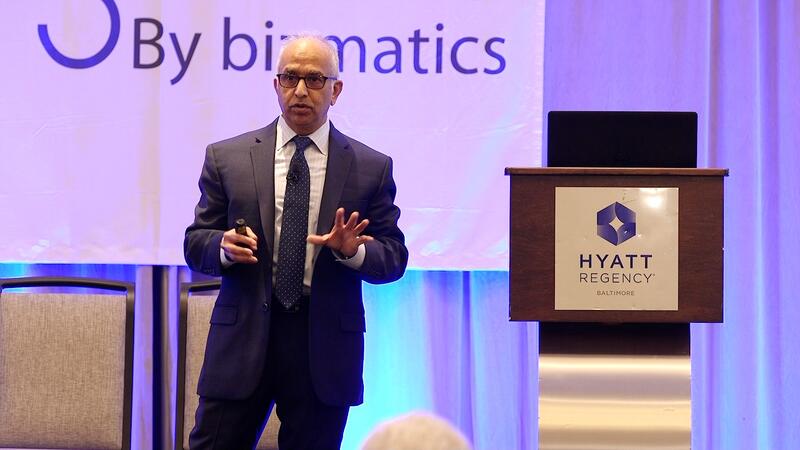
It is a different place from the product stage in Baltimore, where the photograph shows him explaining his work with a clicker in hand. Yet both settings ask a leader to make something understandable to other people. A company needs customers who can use what it makes, colleagues who can carry it forward, and plans that survive the meeting.
Across Deshpande’s career, the dates offer one kind of story: Digital Tools, SoftPlus, Bizmatics, Harris. The smaller details offer another: an existing form preserved, a payment connected, an implementation made easier. Those details show what the years were for.
A lasting company must keep being useful after its founding becomes history. Deshpande’s words at the acquisition suggest he understood the importance of giving that work somewhere to continue. The deal supplied a date. The company still had a working day ahead of it.