The happiest path through a piece of software is a pleasant fiction. It is the route imagined in a product meeting: the user remembers the password, the network behaves, the payment clears and every button receives exactly the tap it was designed to receive. Rajiv Jain has spent much of his working life peering just beyond that tidy route. His preferred territory is where an impatient customer, a peculiar device or one untested assumption sends the experience off-script.
Jain calls the instinct curiosity. In one crisp description of quality assurance, he wrote that developers build while QA engineers ask, "How could this break?" The question is not gloomy. It is a form of hospitality. Someone has imagined the confusion before the customer is forced to live through it.
That single question connects an unusually broad technical career. Jain worked on object-oriented graphics systems in the 1990s. He later led technology organizations in wireless commerce, digital greetings, photography and consumer internet products. In 2012, after senior roles at AT&T, American Greetings, Corbis and Perion, he founded ThinkSys. The company became his long experiment in making software quality less ceremonial and more operational.
An engineer learns to see the system
The educational foundations were technical and demanding: a B.Tech from IIT Kanpur, followed by an M.S. at the University of Rochester. His ThinkSys Ventures biography records an All Rounders Gold Medal from his graduating class at IIT Kanpur, a distinction that hints at range rather than narrow specialization. He later completed an executive course at Harvard Business School.
The patent trail offers a more tangible glimpse of the early engineer. Jain appears as a co-inventor on systems for object-oriented graphics, collaborative software frameworks and graphics acceleration. These were problems of extensibility and coordination: how software objects carry state, how components collaborate, how a visual system can accept capabilities its original designers did not anticipate. Even in the dry grammar of a patent, the recurring fascination is clear. Build a framework that can survive change.
Years later, his name also appeared on electronic greeting-card inventions at American Greetings. It is a charming career juxtaposition. One chapter concerns polymorphic graphics objects. Another concerns putting digital media into a familiar paper ritual. Both require the same translation: complicated technology must eventually become a human experience that behaves as promised.
Selected operating chapters
At AT&T, Jain served as GM and vice president for e-commerce. At American Greetings Interactive, he was CTO. At Corbis, the photography company chaired by Bill Gates, he led large engineering teams and worked closely with the chairman. At Perion, he became Chief Technology Innovation Officer and led the technology integration following the company's $32 million acquisition of Smilebox.
Integration is where management prose meets stubborn reality. Two sets of systems, teams and assumptions have to become one functioning operation. Jain's public record does not offer a dramatic war story from the project, but the assignment itself says something useful: he was trusted with the seam. The seam is where systems reveal whether they are truly adaptable.
“Developers build things. QA engineers ask: ‘How could this break?’ It’s not negativity. It’s curiosity.”Rajiv Jain on the QA mindset
Building the company he wanted to hire
Jain founded ThinkSys in 2012 with an expressed passion for software development and a goal of helping organizations build high-quality software with confidence. The corporate phrase is "release confidence," and it deserves a pause. Confidence cannot be installed from a package manager. It accumulates through observed behavior: tests that remain useful, people who retain context, reports that describe reality and a team willing to own what happens after deployment.
His writing about outsourcing is similarly specific. The trust problem, he argues, comes from inconsistency, rotating resources, fragmented communication and unclear ownership. Geography is merely the easy suspect. The operational remedy is less glamorous: stable teams, transparent process and a small proof of concept before a client scales the relationship.
This is Gregor Mendel with Jira tickets: change one condition, watch the result and resist the urge to call a hunch a system. ThinkSys now describes its work around automation, manual and exploratory testing, performance, security, APIs and AI applications. Underneath the catalogue sits an older promise. Customers should know who is responsible, what was tested and what the evidence says.
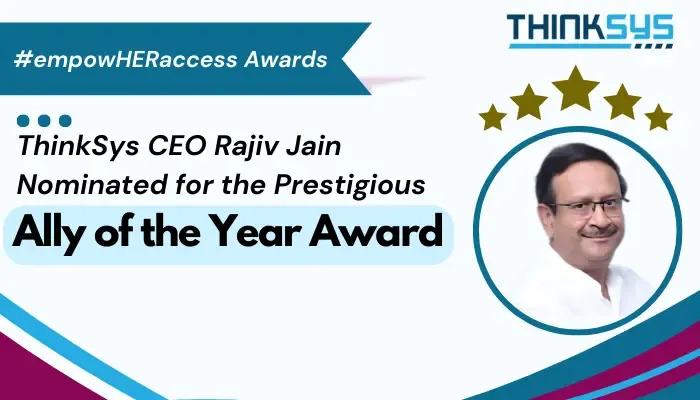
That responsibility also reaches company culture. In 2024, Jain was selected as a finalist for the #empowHERaccess Ally of the Year Award, recognition tied to supporting women in technology. His response emphasized that inclusion had to live in company practices, not simply in declarations. The nomination fits a career spent thinking about systems: values become credible when the structure repeatedly produces them.
The tester's eye meets the AI flood
Artificial intelligence has made Jain's old question newly expensive. Code can now be generated faster, which sounds like pure abundance until someone remembers that every fresh line creates another claim about how a system will behave. More code can mean more features. It can also mean a larger surface on which an elegant-looking mistake may land.
Where the engineering bottleneck moves
In an August 2026 conversation for the podcast How CTOs Use AI, Jain and fellow founder AJ discussed reported productivity jumps on new builds and the stubborn friction of legacy code. Their central observation was less about a magic tool than a moving constraint. Writing code is getting easier. Judging its quality is becoming the harder work.
Jain's position is practical rather than theatrical. He has argued publicly for flexible, open architectures and AI-augmented processes that remove manual effort without giving up control. The human role changes, but it does not vanish. Someone still decides which behavior matters, which failure is tolerable and whether a passing test has measured the right thing.
His older essay on testing a minimum viable product shows the same refusal to sell a simple answer. Early customers may tolerate rough edges, he observed, but poor quality can kill the product before it earns a second chance. Automation brings speed to repeated releases. Yet an MVP changes so quickly that a carefully built test suite may become obsolete before it is ready. His conclusion was conditional: automate where the product has enough shape to reward it.
Speed is useful only when a team can still see what the speed is producing. Put feedback close to creation, keep ownership visible and let evidence decide when to scale.
Curiosity as a management practice
Jain's description of a strong tester reads suspiciously like a description of a strong executive. He values prioritization, attention to detail, creativity, curiosity and the ability to see through the user's eyes. Each trait is an antidote to a familiar management failure. Prioritization keeps the urgent from swallowing the important. Detail catches the small defect with a large consequence. Creativity imagines a scenario no checklist included. Curiosity connects events that look unrelated. Empathy remembers who will eventually use the thing.
Former colleagues add another dimension in public recommendations. They describe a results-driven leader who understands the balance between perfection and time to market, sets a high bar and collaborates across functions. One remembered his belief that one plus one could equal three. It is an unfashionably cheerful equation, but it suits a systems thinker. The connection between parts can create value that neither part contains alone.
His service on the Mobile Entertainment Forum board from 2007 to 2008 and as a founding board member of the University of Washington's Information School extends that instinct beyond a single employer. More recently, TiE Silicon Valley invited him to hold one-on-one office hours with founders on products, teams, customer acquisition and fundraising readiness. Advising a founder is another form of quality assurance. You look for the assumption that has escaped inspection.
There is no grand mystery in Jain's operating philosophy. Its difficulty comes from repetition. Ask the awkward question before launch. Keep the team long enough to learn the system. Translate technical work into language the business can understand. Measure what happens in production. Begin the next cycle a little less surprised.
Technology careers are often narrated as a procession of inventions. Jain's looks more coherent when read as a procession of tests. Can an object-oriented graphics framework extend? Can two acquired technology organizations integrate? Can an outside engineering team earn inside trust? Can AI increase output without lowering judgment? The questions change their clothes. The habit remains.
Optimists build the future. Useful optimists also invite someone to jiggle the handle before the customers arrive. Rajiv Jain has made a career of that second invitation, with the patience to know that a discovered flaw is not an insult to the work. It is how the work becomes dependable.