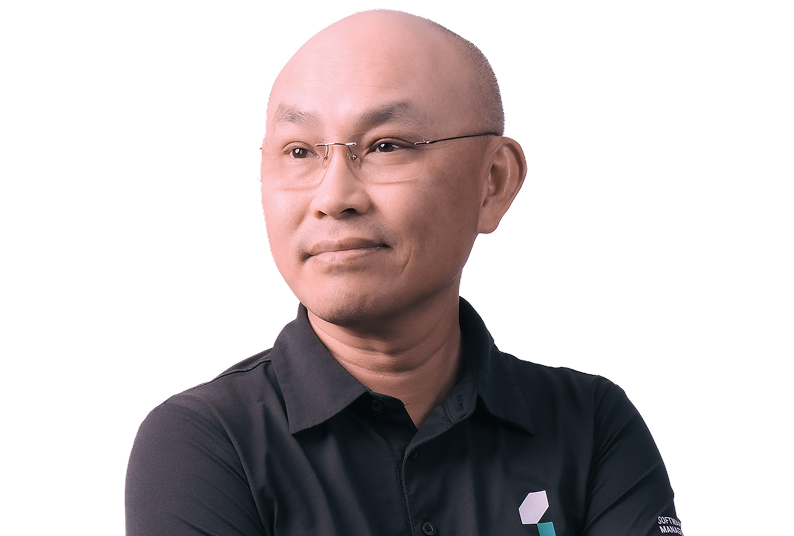
A boat, a boot-up, and a bet on Vietnam
Vu Lam left Vietnam when he was eleven years old. He did not travel with his family. He boarded a fishing boat crowded with other refugees and arrived in the United States with, by his own account, a pair of shorts and a shirt. Decades later, when he is asked why he ever talks about that crossing, his answer is not about hardship. It is about permission. "Having a story like mine may make other people push to do something on their own as well," he has said.
That instinct - to build, and to encourage others to build - runs through everything Lam has done since. He studied electrical engineering at the University of Illinois Urbana-Champaign, graduating in 1989, and went straight into one of the most storied institutions in American technology: Bell Labs. He spent six years there as a member of technical staff, learning how serious engineering gets done before most of the software industry he would later serve even existed.
He did not stay an employee for long. In 1995 he co-founded Paragon Solutions and spent the better part of a decade as a partner. A stint as VP of offshore services at First Consulting Group followed. By the time he founded KMS Technology in 2008, Lam had a clear thesis about where he came from and what it could become.
The logic was almost stubbornly practical. Outsourcing rewards sheer headcount, and Lam concluded that Vietnam simply did not graduate enough technical students to win that race against far larger neighbors. Products were different. A great product does not need an army to build - it needs talent, focus, and a problem worth solving. KMS Technology became the vehicle for that idea, a software company straddling Vietnam and the United States.
The tool that became a company
Katalon was not launched with a pitch deck and a splashy announcement. It started as a fix for a private annoyance. Inside KMS, Lam watched his own engineers lose hours - not testing software, but wrestling with the setup around it. Configuring Selenium. Wiring up Appium. The actual work of quality kept getting buried under the plumbing required to start.
So the team built an internal tool to strip that friction away. It worked well enough that other people wanted it. That is the quiet origin of Katalon Studio, and eventually of Katalon the company, which Lam has led as CEO since 2017. What began as a productivity patch grew into a full platform spanning web, mobile, API and desktop testing.
That framing - QA teams as heroes rather than gatekeepers - is central to how Lam talks about his market. He argues that advanced organizations treat quality assurance as a strategic business enabler, not a safety net bolted on at the end. It is a founder's empathy for the exact users he once managed.
Scaling a two-continent company
In June 2021, Katalon closed a $27 million Series A round led by Elephant Partners, part of a total of roughly $29 million raised. The money was the headline. The subtext mattered more: a product born inside a Vietnamese incubator was now competing, and winning, on a global stage. Katalon has been named a G2 Leader for more than fourteen consecutive quarters and a two-time honoree on the Deloitte Technology Fast 500.
Lam did not stop at one company. He founded QASymphony in 2011, co-founded the mobile testing platform Kobiton in 2016, and launched the human-resources software company Grove HR in 2019. That same year he joined the board of Endeavor Vietnam, lending his experience to the next generation of high-impact founders in the region he keeps returning to.
Betting on the AI era
Lam's more recent focus is what happens to testing when artificial intelligence enters the loop. Under his leadership, Katalon launched TrueTest, described as an AI-native testing system that learns from real users in production, and a companion True Platform aimed at accountability in agentic software delivery. He is blunt about the direction of travel. "The shift toward AI-powered testing isn't just accelerating, it's inevitable," he has said.
But he is careful not to write people out of the story. His view is that AI raises the ceiling rather than replacing the practitioner. "Looking ahead, the future of quality will belong to teams who can combine AI fluency with human insight to lead testing into a smarter, more adaptive era," he has said. It is the same conviction that has shaped his whole career: tools should do more, so that people can matter more.
There is a neat symmetry to where Lam has ended up. A boy who arrived in America with almost nothing spent his career reducing the friction that keeps other builders from starting. The plumbing that once slowed his own engineers is now handled by software used by tens of thousands of teams. And the country he left at eleven has, in his telling, become a place that ships products the world relies on - which was the point all along.
Having a story like mine may make other people push to do something on their own as well.
The shift toward AI-powered testing isn't just accelerating, it's inevitable.
QA professionals are the unsung heroes of software innovation, navigating intense pressure to move faster without compromising quality.
The future of quality will belong to teams who can combine AI fluency with human insight.