At Bitly, the testing tool had acquired an unfortunate talent: it could store information without bringing people together. Developers lacked access. Excel filled the gaps. QA had scenarios, but the rest of engineering had only a hazy view of what those scenarios meant. A system bought to organize testing had become another place to look for answers.
- Qase puts manual tests and automated results in a shared workspace.
- Its AI generates cases, converts them into scripts and supports cloud execution.
- The customer stories make a quieter case: people need to see one another’s work.
That is a good place to begin with Qase. Software teams can produce enormous quantities of testing evidence and still struggle to answer an ordinary question: are we ready to release? The evidence sits in different tools, with different owners. Qase sells a way to gather it, connect it to requirements and make it intelligible.
A filing cabinet learns to talk
Bitly’s requirements were refreshingly mundane: a usable interface, a manageable migration and access for colleagues who needed to follow testing without performing it. In Qase’s August 2024 customer account, QA director Alisa Demennikova described a move toward a shared source of truth. The team also used the migration to reorganize its test suites.
“Qase’s dark mode was a motivator”Alisa Demennikova · Bitly
There is something pleasingly human about that detail. Procurement may speak in feature matrices; the people using a product all afternoon also care whether it is agreeable company. More consequentially, Bitly began setting aside sprint time for new test scenarios and committing to better reporting. Buying software accompanied a change in habits.
The first repair was the interface
Qase founder and CEO Nikita Fedorov began with a modest product. The May 2018 alpha offered projects, teams, cases and suites. By the September open beta, navigation had already forced a rethink. After several attempts to fix usability problems, the layout was rebuilt, moving menus into a sidebar and freeing the working area from a fixed width.

The beta announcement also recorded the most popular request from alpha testers: importing cases from other systems. Customers were not arriving empty-handed. They already had years of work, however awkwardly stored. A new platform had to accommodate that memory before it could improve the future.
In August 2023, Qase announced $7.2 million across its Series A and seed funding, naming Chrome Capital as the Series A lead alongside FinSight Ventures and S16VC. The stated plans included team expansion and a marketplace for test management tools. By then, the commercial proposition had grown well beyond a repository.
The test has two lives
Consider a checkout test. A person writes what should happen: choose an item, enter an address, pay, receive confirmation. An automated framework expresses the same intention in code. Keeping those two accounts connected is less glamorous than generating another script, but it helps teams understand what a result actually proves.
Requirement02
Reviewed case03
Human / code04
Shared result
Qase’s platform organizes cases, reusable steps, plans and runs, links defects and collects automated results. Its AI Test Designer drafts cases from requirements, including Jira or GitHub issues, for review before saving. AI QA Architect converts manual cases into automation, with exports for Playwright, Cypress and Selenium. Cloud execution feeds results back into the same testing workflow.
These capabilities once carried the AIDEN name. In June 2026, Qase retired that separate brand because AI had become part of several stages of the product. The useful distinction is now between tasks: drafting a case, converting it, running it and examining its evidence. An agent’s name tells a release manager rather little.
Fewer tools, less guessing
Qase’s July 2026 MCP redesign offers a revealing example of learning in public. Its first server exposed 83 tools to AI assistants, essentially one per API operation. That meant many similar choices and a large bundle of descriptions to load before work began. The second version reduced the surface to 30 task-oriented tools.
13 core tools + 17 discoverable tools. A smaller menu, not a published performance benchmark.
Reporting a CI run and triaging a defect became composite jobs rather than chains of little operations. Rarely needed tools became discoverable on demand. Qase explicitly declined to claim a benchmark improvement. The lesson readers can borrow is straightforward: organize an interface around the work someone wants finished, then watch how often they need correcting.
When a red result needs an explanation
Summer’s other changes stayed close to everyday irritation. Qase added a Playwright trace viewer so a failed result could lead directly to a replay. Developer Andrei Vaganov described changing Qase’s dropdown components, then discovering a test depended on the old menu-closing behavior. The replay exposed that dependency in seconds.
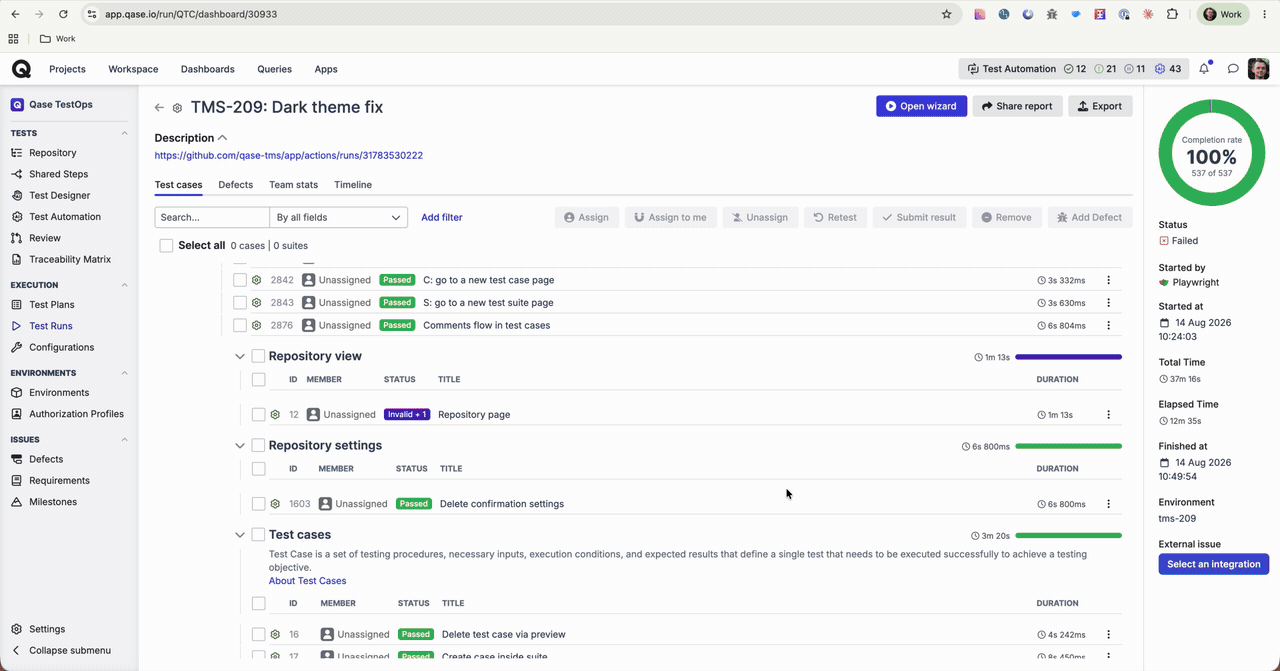
Autofixer addresses the next step. It copies a prompt containing actual run context for an external AI assistant to propose a repair. A person reviews the diff and decides. That matters when a failing test reflects an intentional product change: automatically making everything green could conceal the question the test was supposed to ask.
The bill, and the buying decision
Current Teams pricing is $35 per full seat monthly on annual billing, or $42 on monthly billing, starting at five seats. That makes the annual-plan minimum $175 a month, or $2,100 a year. View-and-comment collaborators cost $10 monthly. Teams includes 2,000 monthly AI credits; additional credits cost $0.40 each. Enterprise pricing is negotiated.
Alternatives include TestRail, PractiTest and Testmo, plus Jira-oriented Xray and Zephyr. Qase’s pitch emphasizes a shared layer over existing frameworks and workflows, with more than 35 integrations. Wolt’s 2023 case study illustrates the audience: over 400 developers and 15 QA engineers, previously using spreadsheets, documents and separate CI reporting.
The sensible trial is therefore organizational as well as technical. Import real cases. Connect a real pipeline. Ask a developer and a release stakeholder to interpret the results. SUSE used engineers’ hands-on evaluations to guide its choice. If nobody maintains requirements, reviews generated cases or acts on failures, a handsome dashboard merely displays neglected work. Qase is most useful when a team wants to make its evidence shareable - and is prepared to change how it uses that evidence.