A telephone line has two lives. In one, it carries a call. In the other, it travels through purchase orders, carrier records, inventories and invoices. The first life is easy to notice. The second can become expensive while everyone is listening to the first.
Consider the Department of Veterans Affairs. In August 2020, Turning Point Global Solutions said its newly deployed telecom management system helped the department oversee an annual telecom spend of $260 million. That was the customer’s budget, not the software company’s revenue. The assignment was to make ordering, payment and inventory behave as parts of one operation.
- The job: connect the records and workflows behind telecom and health IT.
- The tools: NiOS for government telecom; O2 products for carrier interfaces, orders and analytics.
- The buyer: agencies and providers with many systems, suppliers and rules.
A bill is a systems problem
NiOS stands for Network Inventory and Optimization Solution. In production since 2004, it links a service request to an order, an inventory record and eventually a bill. It checks charges against the terms an agency agreed to, then supports disputes when the records disagree.
That sounds like accounting until a network changes. An old circuit must remain connected until its replacement works. A service can be technically retired and financially very much alive. TurningPoint’s transition tools include safeguards against premature disconnects. The point is continuity as well as cost.
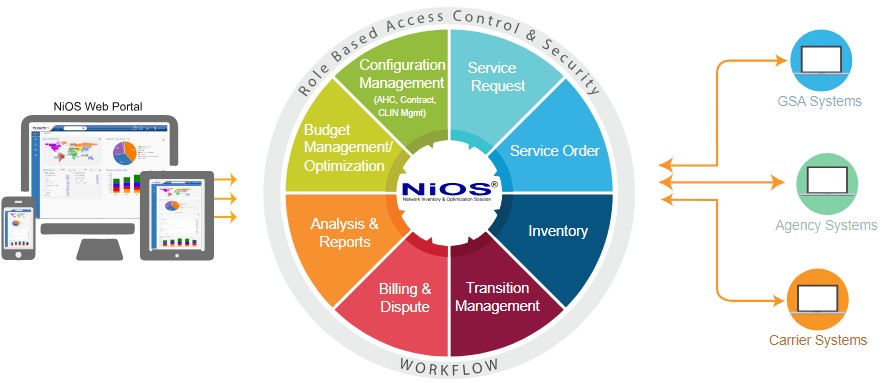
The VA deployment ran in AWS GovCloud, with TurningPoint working as a subcontractor to B3 Group alongside Booz Allen Hamilton. This is how much institutional technology arrives: several companies, a shared assignment, and software fitted into an existing environment.
Security has its own chronology. NiOS reached FedRAMP authorization in December 2025. The official Marketplace records December 17 as its certification date, with a Moderate classification. That status belongs to the offering; it should not be stretched into a blanket claim about every TurningPoint product.
In a separate managed-mobility case study, TurningPoint describes an agency whose offices negotiated wireless arrangements independently. It replaced that fragmentation with a configured portal, centralized vendor management, training and a dedicated support desk. The company reports a 3:1 return and a 2025 re-award. The agency is unnamed, so the figure is best read as one vendor-reported outcome. The operating change is still instructive: make the purchasing process visible across offices, then give users somewhere to take their problems.
The people behind the portal
Bangalore S. Shivacharan and David R. Hughes founded TurningPoint in 2002. Both had previously co-founded Wisor Telecom. Their background helps explain the company’s attention to the back office, where carriers exchange instructions and business rules determine whether an order can proceed.

Co-founder and CEO

Co-founder and managing partner
TurningPoint sells proprietary platforms and the work around them: configuration, integration, engineering, help desks and ongoing operations. That combination places it between a software vendor and a services contractor. A customer can buy a system and also buy people who understand what to do when an order gets stuck.
The company emphasizes repeatable delivery. Its development organization holds a CMMI Maturity Level 5 appraisal; a September 2026 announcement reported Level 3 for services. These credentials describe assessed processes. Customers still have to judge the results of each engagement.
MyConnect, many carriers
At Charter Communications, the product acquired another name. TurningPoint’s O2 order portal became MyConnect for Spectrum Total Connect, a service for businesses spread across multiple locations. Quoting and ordering connectivity across different carriers had involved substantial manual work.
The portal allowed bulk uploads and automated quote gathering. TurningPoint said processing moved from weeks to days. Its fulfillment specialists also worked with Charter staff to resolve problems. The software and the operating team were part of the same answer.
The current O2 family separates related jobs. O2CI handles carrier interfaces and number porting. O2OM coordinates orders from quote to cash. O2BI supplies configurable reports and dashboards. In August 2025, NUSO selected O2CI integrated with 10x People’s nPort for porting and provisioning.
One anonymous wholesale-provider case study makes the initial problem unusually clear: rejected orders kept coming back for resubmission. TurningPoint says it normalized interfaces, mapped data and automated corrections, producing a 35% decrease in rejections. The useful lesson is to repair the handoff that keeps generating work.
- 01Request
- 02Order
- 03Inventory
- 04Reconcile
Hospitals have handoffs, too
The same integration problem appears in healthcare administration. Pennsylvania selected TurningPoint for system integration and a data hub in its Medicaid modernization program in 2020. The planned components included an operational data store, business rules and a service bus connecting modules.
“Our role is to ensure the interoperability of the many modules that make up Pennsylvania’s MES.”David Hughes · January 2020
Those words describe the niche precisely. Different teams can build sound components and still leave an organization with a coordination problem. TurningPoint’s role is to make the parts exchange information. Its health IT work serves agencies and their systems rather than offering patients a consumer health app.
A September 2026 contract takes the work into another setting: Maryland’s planned Local Food Exchange. TurningPoint will develop a marketplace connecting producers with schools and participating agencies. Product listings, orders, fulfillment and invoices form a familiar sequence, even when the inventory is food.
The small print has a price
Winning the work requires more than a working portal. In a 2026 DHS wireless-services competition, TurningPoint’s evaluated price was about $23.2 million against WidePoint’s $29.7 million. DHS initially chose WidePoint. These were evaluated proposal prices, not a NiOS price list.
TurningPoint protested. On September 24, GAO sustained two challenges concerning mandatory requirements and denied the conflict-of-interest allegation. It recommended reevaluation and a new award decision. A partly sustained protest is not a contract win, but it illustrates how closely this market turns on contractual details.
For a prospective customer, the practical test starts with its own records. Can orders, inventory and invoices be reconciled? Will departments adopt a common process? Integration needs access, accurate inputs and an owner for exceptions. In a simple environment with little waste, the savings may not justify the work. In a sprawling one, the handoff deserves a budget of its own.