An invoice is a wonderfully persistent document. The employee moves on. The office changes hands. The software falls out of fashion. Yet the invoice arrives, punctual as ever, asking the organization to remember a decision it may have made years ago. Calero has built a business around checking that memory.
- Connect the bill to the contract, the inventory and actual usage.
- Manage telecom, mobile devices, SaaS and financial market data together.
- Turn a discovered problem into an approved change, then check the next bill.
Its customers face a particular kind of confusion. Finance can see the charge. IT can see the equipment. Procurement can see the agreement. Each record may be perfectly respectable. Put them together, however, and a different question appears: why are we still paying for this? That question gives technology expense management its reason to exist.
A fifty-percent clue
Consider Valmont. In Calero’s account, the industrial company operated across more than 80 facilities in 30 countries. Telecom oversight had become difficult: inventory visibility was limited, reporting required manual work, and carrier management was inconsistent. The trouble began with the organization’s ability to assemble an accurate picture of its services.
Calero centralized telecom expense management, including invoice auditing, inventory information, reporting and carrier oversight. Its published results describe a 50% reduction in telecom costs over five years and more than $500,000 in annual savings, without adding staff. Those are vendor-reported customer outcomes across a sustained program; they are not a promise for every buyer.
The useful detail is the sequence. Better records supported invoice validation and contract negotiations. Routine financial work became easier to repeat. A reader can copy that sequence before buying anything: reconcile the inventory, check the agreement, identify the owner, and investigate the charge. The invoice becomes evidence to examine rather than a monthly instruction to pay.
Built from the back office outward
Calero’s beginnings explain its breadth. In December 2013, Clearlake Capital brought together Movero, PINNACLE and Veramark. Telecom expense software met mobility management services. This was a combination of established operations, with management drawn from the constituent businesses. The familiar startup story of a lone founder discovering a problem does not fit this formation.
Riverside Partners acquired Calero with management in 2017. A merger with MDSL was announced in November 2019, backed by Oak Hill, Riverside and continuing investor Sumeru Equity Partners. MDSL brought a history in financial market data management stretching to 1995. Calero-MDSL subsequently shortened its name to Calero in 2023. Its product scope remained broad.
The investment terms in the 2017 acquisition and 2019 merger announcement were undisclosed. Calero sells enterprise software and managed services, with direct sales and a referral and reseller channel. A free SaaS visibility offer provides an entry point. A full engagement calls for a conversation about scope, integrations and service responsibilities, rather than a universal sticker price.
Four kinds of expensive loose ends
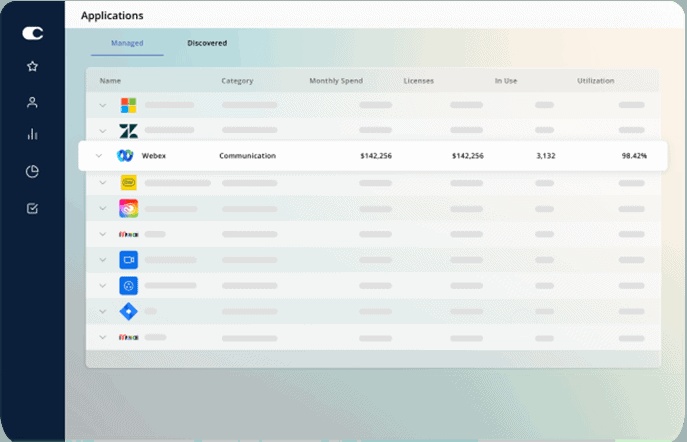
Telecom management covers inventory, ordering, invoices, audits and disputes. Mobility extends into physical work: procuring devices, provisioning them, arranging repairs, handling returns and retirement. SaaS management examines applications, licenses, usage and renewals. Market data management adds the requests, entitlements, exchange requirements and licensing obligations that financial institutions must track.
That last category is revealing. Financial data subscriptions have rules about who can use what, alongside their recurring costs. Calero’s expertise spans the operational details behind the charge. Its proposed advantage is breadth across these categories and the workflows connecting them. Buyers comparing it with Tangoe or Sakon should examine their own mix of expenses and required services.
The company reports more than 3,000 customers across 102 countries. Its audience includes corporations, universities and government agencies, with IT, finance, procurement and operations sharing the work. The attractive customer is one whose technology arrangements have become difficult to coordinate across departments, suppliers or borders. Complexity supplies the demand.
The hard part comes after the dashboard
Finding an unused service leaves another job unfinished. Someone must approve the change, tell the provider, update the records and confirm that billing reflects the decision. Calero’s April 2026 ConnectIQ launch targets that interval, coordinating actions and data across connected systems. Its ServiceNow offering links familiar service requests to inventory, expense information and fulfillment workflows.
“The real challenge in enterprise technology isn’t visibility, it’s coordination.”
Eric Martorano / President & CRO / April 2026
This is also a useful buying test. Ask who owns each action after an exception appears. Ask which systems participate and who verifies the result. As a practical matter, incomplete records, restricted integrations or an organization unwilling to approve changes will limit what an expense platform can accomplish. A discovered saving still needs a completed task.
There is a human side to the operating model, too. Calero’s careers page names collaboration and ownership among its values and advertises paid volunteer days and learning support. Those are stated employer policies. For customers, the more immediate cultural question is whether finance and IT can agree on responsibility. A shared platform is useful when the people looking at it share a process for deciding what happens next.
A sensible evaluation would use one real invoice, one disputed charge and one device return. Follow each through the proposed service. The demonstration should reveal who performs the work, where approval sits and how completion gets recorded.
Now the meter is running
In September 2026, Calero extended SaaS management to AI consumption, adoption and costs. The announced capabilities include discovering unapproved AI tools, tracking seat licenses alongside consumption entitlements, identifying low adoption and alerting teams to usage spikes. The familiar subscription now has another complication: its cost can move with tokens, quotas and other metered activity.
The same discipline travels well. Establish what exists. Match it to an owner and an agreement. Understand consumption. Set a policy, act on exceptions and verify the next invoice. For a small organization with a handful of subscriptions, the administrative effort may outweigh the benefit of an enterprise platform. For a sprawling estate, that discipline can become a job in itself. Calero sells a way to organize it.