In April 2024, Jody Shapiro had a question for himself. Productiv, the software company he had co-founded six years earlier, wanted to accelerate its growth. Customers were responding to its move toward procurement and spending optimization. What kind of chief executive would help it get there? The answer he arrived at had an awkward feature: it described somebody else.
Shapiro helped recruit Sean D. Murray to replace him. In explaining the decision, he framed it around the needs of the company and its ambition to reach $100 million in annual recurring revenue. That was a destination, rather than a claim about revenue already earned. Productiv needed an experienced commercial leader for the next part of the journey.
A founder announcing his successor can produce a remarkable amount of corporate upholstery. Shapiro put the uncomfortable question in public: could a non-founder move the company forward faster? Read alongside his work on software usage, the episode offers a useful way into his character. He had spent years asking organizations to inspect their assumptions. His own title eventually received an inspection.
The boy asking about cereal prices
Long before software budgets, there was a supermarket. Growing up in a Boston suburb, Shapiro wondered why cereal cost what it did. He asked his mother who set the prices. Somewhere behind the shelf label, he suspected, there was a system somebody had designed.
He was also a child who built things and wanted to understand their workings. Coding arrived at nine. The attraction was immediate: here was another set of rules that could be examined, altered and made to do something. The interest in business developed alongside the interest in machines. A price and a program both invited the same troublesome word: why?
His education followed both interests. He studied computer engineering at the University of Massachusetts, computer science at Cornell, and later business at Wharton. The sequence matters because his eventual work required him to move between technical detail and commercial consequences. Knowing how software functions is useful. Knowing why somebody should buy it is a separate examination.
His early career included Microsoft, PictureTel and Silicon Graphics, followed by work in media technology and engineering management. He later worked at Google on television advertising and enterprise analytics. These were different ways of confronting a familiar problem: technology may work beautifully while its value remains surprisingly difficult to explain.
A receipt is a poor description of a working day
At Google, Shapiro led Google Analytics Premium, the enterprise offering later known as Google Analytics 360. He also led product management for Google TV Ads. Both roles dealt with connecting activity to outcomes. Advertisers wanted more than an assurance that something had been delivered. They needed to understand what happened afterward.
In a 2014 discussion of Analytics Premium, he described enterprise customers needing a fuller view of the customer journey, including connections to advertising systems and other business data. Training, implementation and support belonged in that picture too. An enterprise product had obligations beyond the dashboard. Somebody had to be able to use the answer.
The same distinction would become central to Productiv. A company could count software licenses, know the renewal date and still understand remarkably little about the work those licenses supported. A login was evidence of entry. It said less about whether someone had found the tool useful, collaborated with colleagues or used the particular features being purchased.
Imagine trying to understand a restaurant by counting people who opened its door. You would have an accurate number and several unanswered questions. Enterprise software had developed an equivalent accounting habit. Shapiro’s opportunity was to look further inside.
The question gets more useful
Three founders, hundreds of applications
In 2018, Shapiro founded Productiv with Ashish Aggarwal and Munish Gandhi. Their backgrounds spanned engineering, product and business operations. The company emerged publicly in spring 2019 after nearly a year in stealth, with an $8 million investment led by Accel and a launch at the Oktane conference in San Francisco.
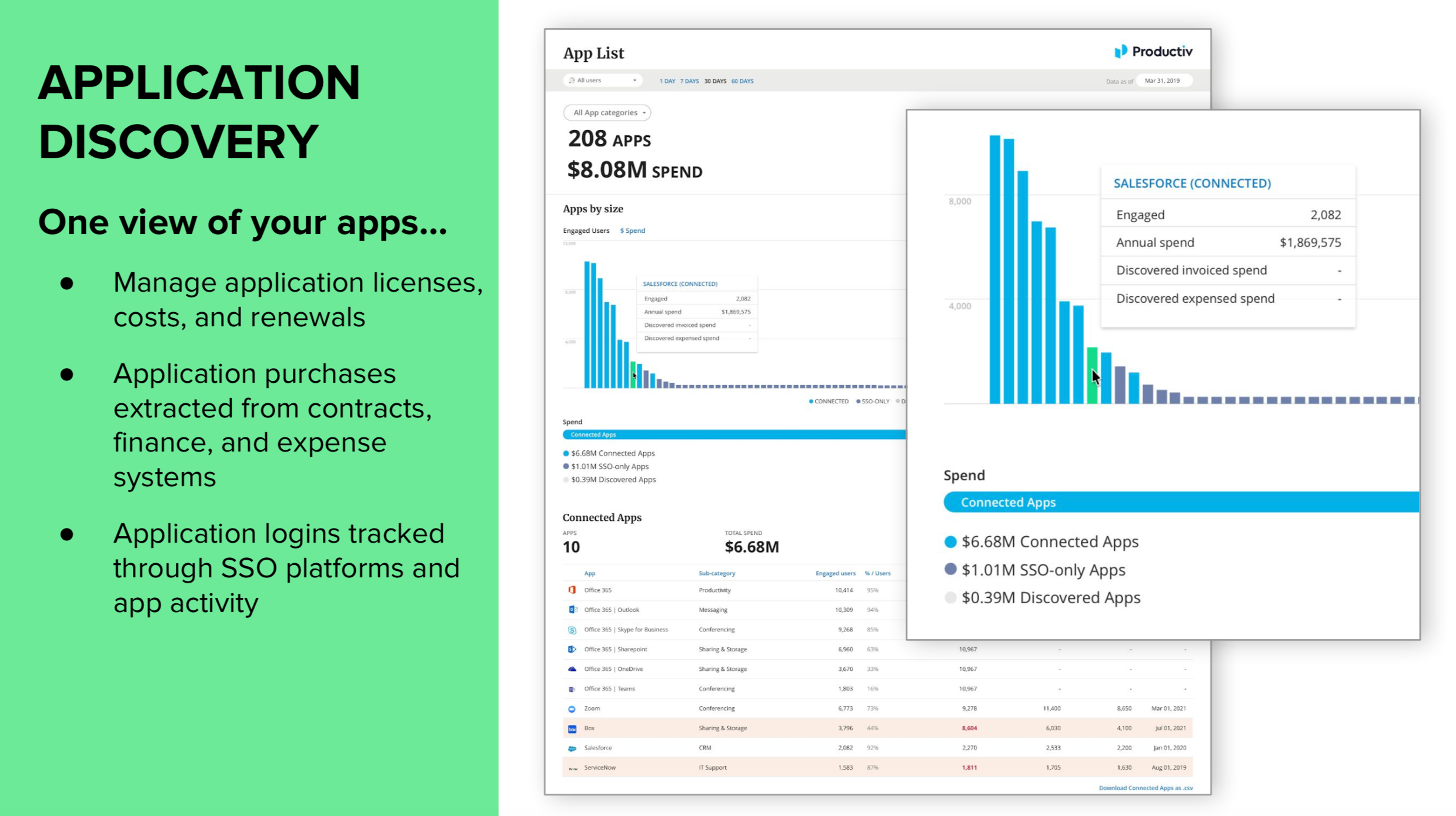
The original proposition was application engagement: give IT leaders a detailed understanding of how software was actually being used. Discovery and license management were necessary starting points. The larger ambition was to connect that inventory to the behavior of teams and the decisions a business needed to make.
In its launch account, Productiv described an early customer whose employees used three separate storage applications. Knowing that three contracts existed was only the beginning. Understanding the usage helped the organization decide where to consolidate and standardize. A cheaper software bill was one possible result. Less time shuttling between tools was another.
This is where Shapiro’s earlier analytics work becomes legible in a new setting. The object of measurement had moved from the customer visiting a website to the employee navigating a working day. The commercial question remained stubbornly practical: what does this investment enable people to do?

The dad jokes had a serious investor
Rama Sekhar knew Shapiro before Productiv existed. They had been classmates at Wharton in 2009 and shared an interest in entrepreneurship and, as Sekhar put it, “terrible dad jokes.” There are more formal ways to establish an investor relationship. They are seldom as memorable.
When Norwest led Productiv’s $20 million Series B in November 2019, Sekhar described the qualities that had stayed with him: curiosity, enthusiasm for technology and sincerity. The connection had taken roughly a decade to turn into an investment. It is a useful corrective to the idea that a funding round begins with a pitch deck and ends with a handshake.
The business continued to attract backing. A $45 million Series C followed in March 2021, bringing reported total funding to $73 million. By 2023, Productiv appeared at number 31 on Deloitte’s Technology Fast 500, which listed its revenue growth at 5,631% over the ranking’s measurement period. These are company milestones, earned by a team, rather than measures of Shapiro’s personal wealth.
Leave room for the inconvenient question
Shapiro brought practices from Google into the smaller company, including a weekly gathering where employees could ask questions and an emphasis on colleagues mentoring one another. Ambitious goals were part of the inheritance. So was the idea that people needed access to the conversation about how the business was doing.
His advice on culture was unusually direct. Openness places a demand on a leader as well as on an employee. Inviting a question is easy when the answer is flattering. Openness becomes more useful when someone asks about a decision that has gone badly or a problem that has not been solved.
“There should be no unaskable thing.”Jody Shapiro · On company culture
In his 2024 Product Talk conversation, Shapiro returned to curiosity, collaboration and customer feedback in building teams. These themes fit the problem his company had chosen. Productiv asked customers to bring different departments into a shared view of spending and usage. Internally, a company making that argument needed ways for its own people to exchange information.
There is a pleasingly mundane quality to the method. Regular meetings. Questions. Mentorship. None requires a theatrical founder persona. Each requires repetition, and the willingness to hear something that complicates an otherwise satisfactory plan.
The unauthorized app may be telling you something
Shapiro’s reading of shadow IT, the applications employees use outside formal company management, was similarly inquisitive. Unsanctioned software can create spending and security problems. It can also reveal what people are missing.
In 2023, when ChatGPT appeared at number eleven on Productiv’s list of shadow applications, he described the broader phenomenon as an indication that employees’ technology needs were going unmet. That interpretation gives the worker a motive beyond disobedience. People may be finding an answer to a problem their approved tools have left open.
A year later, Productiv’s analysis put ChatGPT at the top of the shadow IT list. Its research also reported that average application portfolios had fallen from 374 in 2022 to 342 in 2023. Traditional software sprawl was becoming more manageable even as generative AI introduced fresh complications. A tidier inventory could coexist with a new governance problem.
For Shapiro, the useful response involved examining behavior before deciding what to do about it. Which applications were present? Who used them? What need did they serve? Those questions connect the child puzzling over supermarket prices to the executive trying to make sense of an office full of subscriptions.
His own chair, under review
The CEO succession gave that habit a personal consequence. In his announcement, Shapiro said he would continue on the board, advise Murray, spend time with customers and partners, and work with Aggarwal’s team on product strategy. He described the transition as emotional and joyful. Stepping aside from daily leadership left several ways to remain useful.
The hiking photograph that Gandhi shared the following April offers a smaller, friendlier coda. The three co-founders were together again at Stanford Dish. Gandhi wrote about the memories the walk brought back. There is no need to turn a group photograph into a theory of corporate governance. It does show relationships continuing beyond the org chart.
Shapiro’s public LinkedIn profile now lists a stealth startup. The next venture has yet to acquire the public detail of Productiv’s story. What already has a shape is his approach to building: understand the system, ask the awkward question, and follow the answer far enough that it can change what you do. Even when the item being reconsidered is your own job.
Keep the conversation going
Interviews, writing and moments from the Productiv years.