Somewhere inside Goldman Sachs’s telecom bills was a fee that should not have existed. The contract said it was waived. The carrier kept charging it. For twelve months, according to Sakon’s account of the engagement, the discrepancy survived. Then Sakon found it during its first month processing invoices. The resulting credit was $400,000.
The interesting part is the word “waived.” The bill could look perfectly routine. Finding the mistake required another document, and a way to make the two documents disagree in public. That is the business Sakon has built: connecting records that large organizations struggle to keep together.
- Sakon matches telecom bills with contracts and live inventory.
- Its software and managed services cover payments, networks and mobile devices.
- The practical lesson: check that a promised change actually reached the carrier’s bill.
The bill is only one witness
A telecom invoice answers a narrow question: what does the carrier want to collect? It cannot, by itself, tell you whether a circuit still serves an occupied office, whether a phone belongs to a current employee, or whether a negotiated discount was applied. Those answers live elsewhere. A company can pay promptly while remaining impressively confused.
Sakon’s AP Automation offering ingests invoices, validates charges, allocates spending and routes approvals. It also offers managed payment. The important control is a three-way match: invoice against contract against inventory. A disputed charge then needs to travel through the less photogenic business of evidence, follow-up and a credit.
At Goldman Sachs, the published case describes more than 3,000 monthly invoices covering 65,000 service line items across 33 countries. Processing time fell from ten business days to fewer than five. These are Sakon’s reported customer results, rather than a forecast for the next buyer. Still, the mechanism is easy to understand: fewer disconnected handoffs, more checks before payment.
A company built to translate
Sakon began in 2003 as GSG, a knowledge center and back-office provider to telecom expense management companies. Its early expertise was inventory. In 2005, it built a database of normalized definitions so different carriers’ terminology could be compared. The seemingly modest task of agreeing what things meant came before the platform.
Mobile Manager followed in 2008, then wireline SaaS in 2010. GSG adopted the Sakon name in March 2018 after launching the Sakon platform that January. An AOTMP white paper from that period described growth without outside funding. The origin matters because it explains a company whose software remains attached to operational work: reconciling records, handling exceptions and knowing the carrier’s vocabulary.
“When you pull it all together, good things happen.”Dan Hughes, Sakon president · 2018
Your workflow platform needs a memory
ServiceNow supplies a revealing customer example. Its own mobility records were fragmented across regions and departments, with manual validation and slow financial reconciliation. Sakon’s published case covers more than 10,000 devices and reports over $1 million annually in efficiency and reconciliation savings. The intervention combined its mobility platform, managed services and a scoped ServiceNow application.
That combination is the point. A workflow platform can route a request beautifully and still need better information about the employee, phone, carrier account and cost center involved. Telecom Connect brings those associations into ServiceNow. Employees can make requests where they already work; finance gets a clearer account of who owns the expense.
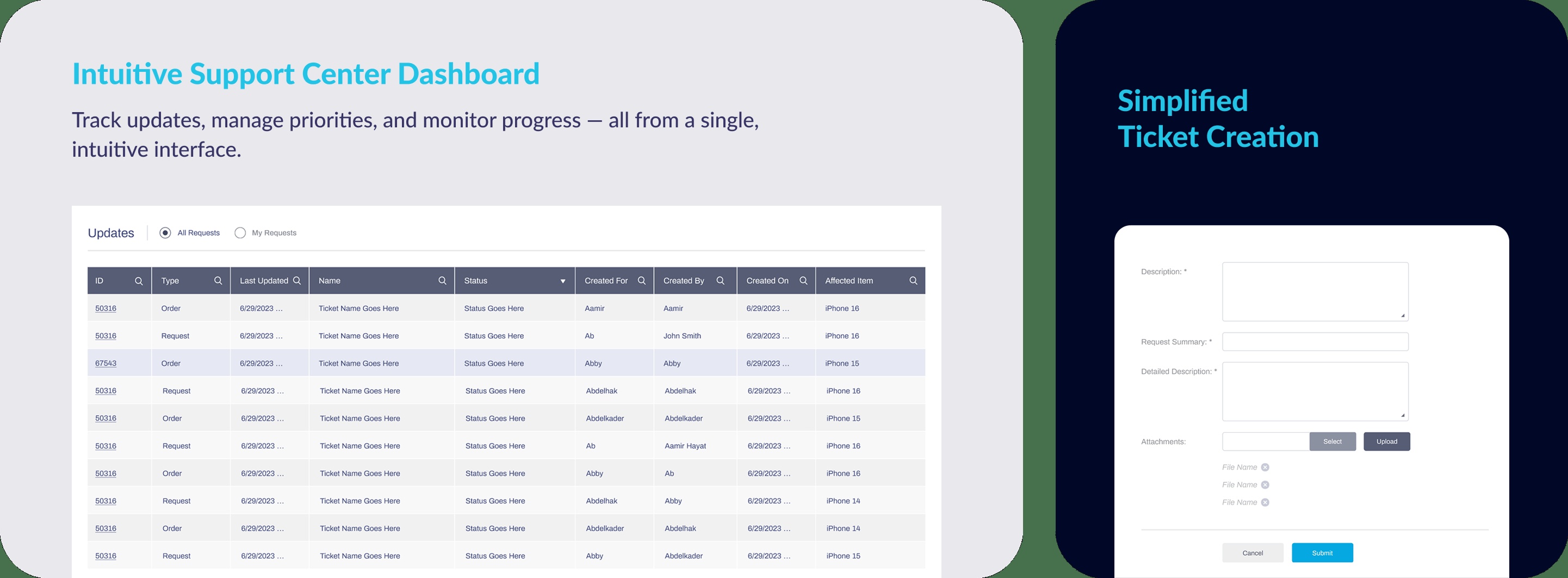
Across the broader portfolio, Wireless Lifecycle covers ordering, provisioning, support and retirement. It includes logistics such as staging and shipping devices, plus support for IoT lines and fixed wireless access. Network Lifecycle, now presented as Network360, combines carrier feeds, internal ownership and order history. Moves, additions, changes and disconnects feed the inventory instead of disappearing into email.
The recommendation that needed a receipt
The most instructive failure appears in Sakon’s hospital-network case study. During the pandemic, remote work drove a sharp change in mobile usage. Sakon recommended unlimited plans for physicians. The customer asked its provider to change the plans; the provider did not make the change. The hospital received a $2 million overage bill.
According to the case study, the hospital recovered the money because the recommendation and request had been documented. The lesson travels well beyond telecom. A correct analysis needs an execution trail. Someone must verify that a requested change happened, then check the next bill. An alert that nobody closes is expensive stationery.
Buy the reconciliation, then judge the savings
Sakon sits in the telecom expense management and managed mobility market alongside alternatives such as Tangoe and Calero. Its case rests on combining inventory, carrier integration, financial workflows and people who handle the operational details. The useful comparison is how well each provider covers your carriers and systems, and who takes responsibility when the records disagree.
The commercial model combines enterprise software subscriptions with implementation and managed services. A sensible quote should spell out migration, integrations, support, payment services and ongoing operations. A $400,000 recovered credit is a customer outcome, not the price of the product or proof of every buyer’s return. Evaluate recovered cash separately from estimated staff time and potential future savings.
Today, Sakon also promotes Telecom AI: normalized, mapped records feeding conversational queries and actions in tools such as ServiceNow and Microsoft Teams. Its own product argument starts with data quality. That is a useful ordering of priorities. An assistant needs to know which service belongs to which site before anyone trusts it to change the service.
The approach makes most sense when multiple carriers, countries and internal systems create enough complexity to justify the work. With a small, simple estate, a careful internal process may suffice. Even at enterprise scale, old ownership data and unexecuted orders can undermine the result. Start by matching one bill to its contract and inventory. Make the discrepancy somebody’s job. Then check whether the next bill changed.