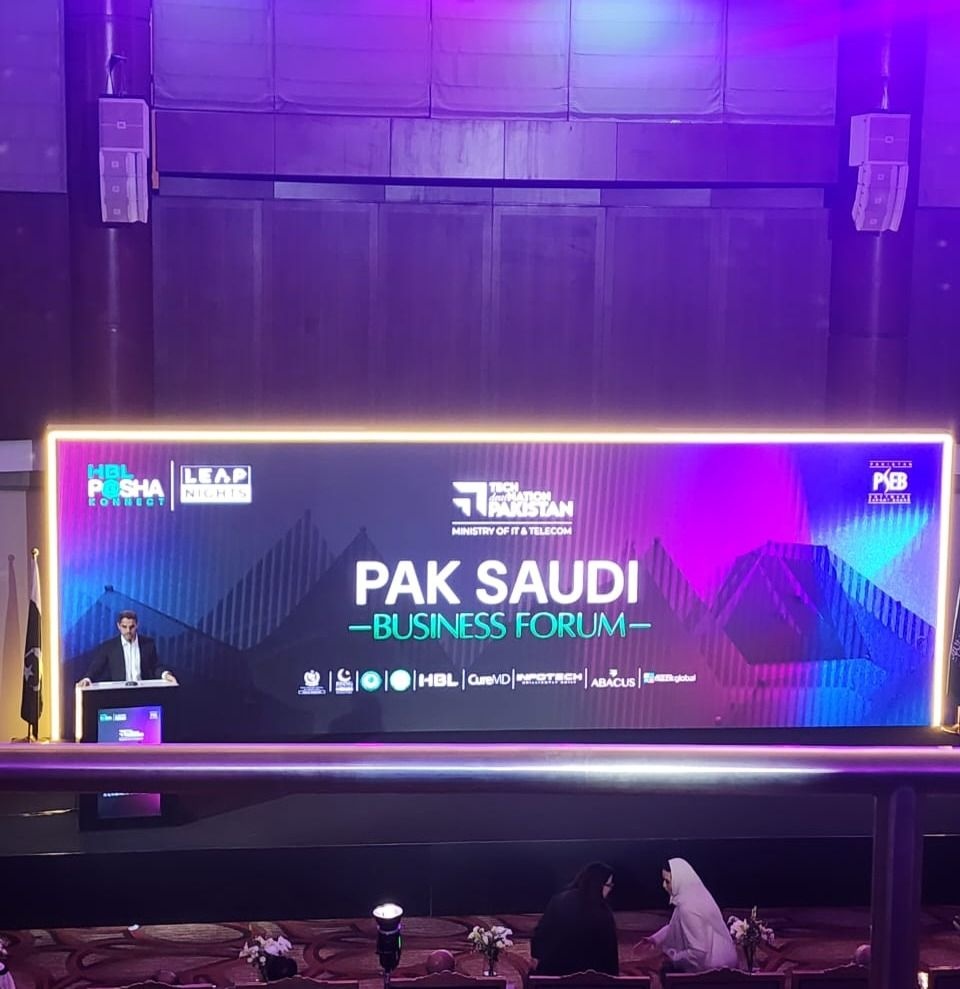
At the Pakistan-Saudi Business Forum on February 8, 2025, Adnan Tariq found plenty to appreciate. There were speeches, business connections and the prospect of further collaboration. There was also, as he made a point of remembering, good food. A technology gathering may have an ambitious agenda; dinner enjoys the considerable advantage of being immediately useful.
The detail brings some welcome air into a career filled with imposing terminology. Tariq, the co-founder and CEO of Funavry Technologies, has worked on distributed systems, event processing, software-defined networks and the coordination of research across institutions. He has a doctorate from Stuttgart and a teaching chapter in Islamabad. By the time he entered those business conversations in 2025, he had spent years thinking about how separate parts work together.
That is a useful thread to follow through his career. The parts have changed: computers, research teams, students, enterprise platforms. The practical difficulty of getting them to cooperate has been a recurring professional subject.
The doctorate behind the business card
Tariq’s education took him through three engineering institutions. He graduated from the Ghulam Ishaq Khan Institute of Engineering Sciences and Technology in 2001 with a degree in computer systems engineering. A master’s in software systems engineering at RWTH Aachen followed in 2007. In 2013, he completed his doctorate in computer science at the University of Stuttgart.
His dissertation was titled Non-functional Requirements in Publish/Subscribe Systems. Its oral examination took place on June 28, 2013. Kurt Rothermel and Ralf Steinmetz were the named reviewers. The document puts an exact date and a specific problem behind the familiar abbreviation “PhD”.
Publish/subscribe systems organize communication between those producing information and those interested in receiving it. The non-functional requirements concern how that communication behaves. Security and quality of service belong to the same engineering conversation as the mechanism that delivers the message. A system’s usefulness depends on more than its ability to demonstrate a feature once.
Tariq’s subsequent research stayed close to those concerns. Event-based systems, adaptive communication and distributed computation gave him a professional landscape in which delay, failures and coordination were subjects to investigate. The glamour of software often resides on the screen. Much of the responsibility lives underneath it.
- 2001GIKIComputer systems
- 2007RWTH AachenSoftware systems
- 2013StuttgartComputer science PhD
An award for making the machinery behave
Research is a crowded authors’ table, and Tariq’s work makes that visible. GraphCEP brought together Ruben Mayer, Christian Mayer, Muhammad Adnan Tariq and Kurt Rothermel. At the 2016 Distributed and Event-Based Systems conference, their work won both the overall Grand Challenge and the audience challenge award.
The project combined parallel complex event processing with graph processing for real-time data analytics. Even its title has the compactness of a suitcase packed by an engineer. The subject was the processing of information as it arrives, with computation shared across resources. It belongs to the unshowy but consequential task of making timely analysis possible.
A further collaboration, with David Richard Schäfer and Rothermel, addressed workflow replication. Their paper, Exploring the Search Space between Active and Passive Workflow Replication, received the best paper award at SOCA 2017 in Kanazawa, Japan.
The question involved keeping workflows moving through environments where devices or communications can fail. Replication supplies additional copies of work, but those copies bring their own costs and decisions. Reliability, in other words, requires design. Simply asking the computer to be more dependable has yet to become a satisfactory method.
His co-authored 2018 work on privacy and quality of service in complex event processing explored another trade-off: how changing event order could protect private patterns while preserving useful analysis. Across these papers, the subjects differ, but the concern with useful behavior under constraints is easy to recognize.
Another collaboration joined Tariq with Boris Koldehofe and Rothermel on securing broker-less publish/subscribe systems through identity-based encryption. Published in IEEE Transactions on Parallel and Distributed Systems in 2014, it placed security directly inside the communication problem. Later work with Sukanya Bhowmik and colleagues examined publish/subscribe middleware in software-defined networks. These are specific contributions to the infrastructure of communication, rather than a general interest in technology. The recurring names also show research relationships continuing across different questions and different years.
Six institutions, one coordination problem
At Stuttgart’s Institute of Parallel and Distributed Systems, Tariq’s responsibilities extended beyond his own research. He led the Self-Organizing Software Systems and Adaptive Communication Systems project divisions. His academic biography also records his role as technical manager and coordinator of ALLOW Ensembles, an EU-funded project involving six European research institutes.
The project had a budget of €2.9 million. That figure describes the research programme he helped coordinate; it belongs to a different ledger from company revenue or personal wealth. The distinction matters because the achievement here is the management of a shared technical undertaking.
It adds a substantial middle chapter to the career. Between writing a paper and running a business lies the work of helping people produce something together. A consortium supplies its own variety of expertise, obligations and institutional habits. Software coordination may be expressed in protocols. Human coordination tends to require rather more conversation.
The progression towards entrepreneurship therefore includes experience with research management as well as engineering. There is no need to invent an early declaration of business ambition to make the connection interesting. The documented responsibilities already show a researcher taking on work larger than an individual experiment.
A classroom in the middle of the career
On July 17, 2017, Tariq joined the National University of Computer and Emerging Sciences, known as FAST-NUCES, as an assistant professor. The appointment brought his European research experience into an academic setting in Islamabad. The university’s faculty materials list the same three educational milestones: GIKI, Aachen and Stuttgart.
This part of the story deserves room alongside the founder’s title. Teaching is a distinct professional responsibility, with its own audience and demands. A research result has to survive questions from specialists. In a classroom, the explanation also has to give someone a way into the subject.
Tariq’s research collaborations continued to appear in the publication record around this period. A career can contain overlapping commitments without resolving itself into a single neat costume. The academic and entrepreneur chapters sit close together: the teaching appointment began in 2017; Funavry dates its founding to 2018.
Funavry’s test: what happens after delivery?
The company Tariq co-founded now describes its work across technology and global business services. It builds platforms, automates processes and operates services. For clients, that puts software development in the same conversation as the work a business needs to carry out every day.
Tariq’s published CEO message expresses the ambition plainly. He says the company began with an intention to stay responsible for outcomes after the code. It is a revealing emphasis for someone whose research career dealt with the behavior of systems under real constraints.
“We started Funavry to be the partner that stays with the outcome, not just the code.”
Adnan Tariq · CEO message
In that message, he reports growth to more than 200 professionals and delivery of over 500 projects across nine countries since 2018. These are the company’s own figures. They describe the scope Tariq says the organization has reached, while his accompanying emphasis falls on lasting value and client trust.
Funavry’s current geography includes offices in New York, Riyadh and Islamabad, with engineering and delivery centered in Islamabad. Tariq’s personal LinkedIn location is Stuttgart. The map of the business and the location on a founder’s profile need not occupy the same pin.
The international operation gives the earlier technical subjects a different setting. Enterprise clients have processes to run, people to support and systems that must keep working together. A promising demonstration can open a conversation. Continued operation gives that conversation a much longer examination.
The conversation around the table
Leadership also appears in a smaller setting. Funavry has described a CEO Connect session in which Tariq met new employees to discuss the company’s vision, values and plans. The account places questions and dialogue at the center of the gathering. For a profile so rich in systems terminology, the ordinary act of sitting down with colleagues is a useful detail.
His February 2025 trip supplies another. Tariq announced that he would attend LEAP on Funavry’s behalf, expressing interest in meeting industry leaders and discussing collaboration. His account of the Pakistan-Saudi Business Forum that month returned to the value of making connections and his hope for continued cooperation between the two countries.
Then came the mention of the food. It is a small observation, but it rescues the update from the fate of sounding like a conference brochure. People attend these events carrying serious business intentions and perfectly ordinary appetites. Both can fit into the same evening.
Tariq’s public career contains several kinds of shared work: the research paper with multiple authors, the European consortium, the classroom, the company and the business forum. Each asks something different of him. Together, they give substance to the title on his business card. The systems have become larger, and the conversations have acquired new participants.