Four software developers in a small conference room off Karachi’s Tariq Road wrote the first lines of code for Careem. In Atif Azim’s account of those early days, the room gets a mention before the ride-hailing company’s eventual scale does. It is a useful place to begin. Before the familiar app, before the international dealmaking, there was a handful of people working out what to build.
Azim had already helped build a company that Cisco bought. He had studied in London and California, worked in Silicon Valley, and seen what happened when an invention found customers. Yet the next consequential setting in his career was this modest Karachi workspace. The geography had changed. The practical question remained familiar: could a small team make something that people elsewhere would depend on?
His career offers several answers, from network security to transport software and, more recently, data and artificial intelligence. The interesting part is how often other people enter the picture: fellow founders, early customers, engineers, students. Azim’s name belongs on the company biography. The work, as he describes it, requires a rather longer guest list.
A university becomes a customer
Azim studied electrical engineering at Imperial College London before going to Stanford for postgraduate study. The move put him in an environment where starting a technology company felt like a plausible next step. Around him, people wanted to build products and change how things worked. Ambition had plenty of company.
His early career included consulting at KPMG in San Francisco in 2000 and 2001, followed by work at Brience. The latter had raised substantial funding and attracted expectations of a stock market debut. Then the dotcom crash interrupted those expectations. Azim left with colleagues and co-founded Perfigo, a network security business. An anticipated corporate success had become the prelude to a much smaller undertaking.
Stanford became Perfigo’s first customer. That is a pleasing return on a university connection, though the important detail is commercial: an institution was willing to use the product. Other West Coast universities followed. Perfigo was finding a market in places where lots of people and devices needed to connect without making the network vulnerable.
Its CleanMachines software checked devices seeking access and enforced security policies. The appeal was practical. Universities and smaller organizations could buy a packaged solution to a persistent problem. An ingenious product still needed to be usable by the people responsible for keeping a network running. Nobody wanted an exciting demonstration followed by an exciting disaster.
Approximate cash consideration Cisco announced for Perfigo. A company acquisition price, not a measure of Azim’s personal wealth.
On October 21, 2004, Cisco announced its agreement to acquire Perfigo for approximately $74 million in cash. The plan included bringing the team into Cisco’s Security Technology Group. Azim went on to work at Cisco; his later board biography credits him with helping grow the network security product line into a $200 million business. Building inside a large company added another kind of experience to the startup years.
The investment plan acquires a keyboard
VentureDive’s beginnings straddle 2011 and 2012: its founding precedes the product-building chapter Azim places in mid-2012. The original intention was to invest in technology ideas and teams. After reviewing the opportunities, the founders decided to develop products themselves. An investment thesis had acquired a software team.
Careem was starting around the same time. VentureDive built its early technology platform and took an equity stake. The arrangement joined engineering work to an interest in the venture’s future. Azim’s recollection locates the beginning in that conference room off Tariq Road, with four developers writing the first code. It is an unusually tangible detail in a business story often told through valuations.
By April 2016, Azim was appearing alongside Careem’s Junaid Iqbal at a Startup Grind event in Karachi. The event described him as an early investor who headed the team developing Careem’s platform. The relationship had become substantial enough to bring the two businesses onto the same stage. It also made visible the engineering contribution behind a consumer-facing brand.
Careem later brought the VentureDive team into its own organization. In 2018, Azim described former colleagues working for Careem in Dubai and Karachi. The handover matters: software partnerships change as customers grow. A team that helps a venture get started may eventually become part of that venture. The people carry the knowledge with them.
- London → StanfordEngineering study, then Silicon Valley
- 2004 · Perfigo → CiscoNetwork security finds a larger home
- 2012 · Karachi → CareemA small team builds the early platform
- 2022 · VentureDive + NexDegreeData and AI capabilities expand
- 2026 · The boardroomIndependent director, Unilever Pakistan Foods
A company needs more than its founder
Azim’s fellow VentureDive founders brought complementary experience. Shehzaad Nakhoda had led engineering teams, including at Salesforce. Saad Fazil brought user experience expertise and experience with Nokia HERE. Their backgrounds help explain the company’s combination of software development and product design. A functioning system and a comprehensible experience both needed someone’s attention.
VentureDive’s work extended beyond ride-hailing. IslamicFinder, developed with a Saudi partner, served Muslims looking for information including prayer times and nearby mosques. The company also worked on mobility challenges in Dubai. These projects occupied different markets, but each required software that made sense in a particular setting, with particular users. A reusable technical skill still needed local understanding.
Azim’s advice about growing a business has been direct: “Make sure you invest in people, the right people.” He has also emphasized the processes needed to support expansion. That combination is less glamorous than the acquisition headline, and considerably more useful on an ordinary working day. Hiring capable people leaves the further task of organizing work so they can do it well.
“Make sure you invest in people, the right people.”
Atif Azim · 2017
Another room, open to other founders
In 2013, Azim joined Imran Moinuddin, Farzal Dojki and Yusuf Jan in founding DotZero in Karachi. The venture offered coworking space alongside access to mentoring and professional networks. The physical premises mattered, but so did the possibility of finding someone nearby who had already faced the problem on your desk.
Dojki’s account of the beginning puts Azim and Moinuddin among the first people with whom he shared the idea. The founders developed a presentation, took it to the P@SHA community, and moved toward execution after Jan joined. Even a place intended to help startups needed its own familiar sequence: conversation, collaborators, legalities, logistics, opening the door.
By 2015, DotZero could accommodate about 125 people. Its founders described a model that assessed startups’ potential and could adjust rent to their circumstances, with some beginning without paying. It gave an early business room to work while revenue caught up with intention. The arrangement recognized a difficulty that a handsome business plan cannot always resolve: the landlord generally prefers money.
Azim has argued that Pakistan has the ingredients for a stronger technology economy: universities producing talent, investors willing to back it, and customers prepared to adopt new systems. DotZero supplied a meeting place for some of those ingredients. His mentoring and early investing made that argument a practical commitment as well as a public one.
What changes when AI enters the business
In September 2022, VentureDive announced an agreement to acquire NexDegree, a company specializing in data and artificial intelligence. The connection had a longer history: NexDegree’s Imran Moinuddin was also a DotZero co-founder. People who had helped create shared space for entrepreneurs were now joining capabilities inside a technology business.
By April 2025, Azim was describing a deliberate shift toward data and AI while retaining broader software services. His examples included multilingual call analysis, with particular attention to Arabic, and tools for retail shelf monitoring and trade promotion planning. The proposed work was specific enough to picture: conversations to review, shelves to inspect, promotions to evaluate.
The UAE and Saudi Arabia were central to that direction. Azim emphasized understanding regional needs, developing local partnerships and strengthening teams’ data science and machine learning skills. The familiar challenge had returned in a new form. A company could acquire expertise, but it still had to connect that expertise to a customer’s working day.
The founder on both sides of the table
Azim’s responsibilities have also taken him into financial services governance. He served on the boards of Meezan Bank and Al Meezan Investment Management; his 2026 biography records a current board role at Raqami Islamic Digital Bank. These positions add the perspective of institutions responsible for oversight, alongside the experience of a supplier building technology.
In April 2026, he was elected an independent director of Unilever Pakistan Foods, with the term effective April 20. Its first-quarter accounts also list him as chair of the sustainability committee and a member of the audit committee. His career now includes questions about how organizations oversee decisions, as well as how teams make products.
Back to the conference table
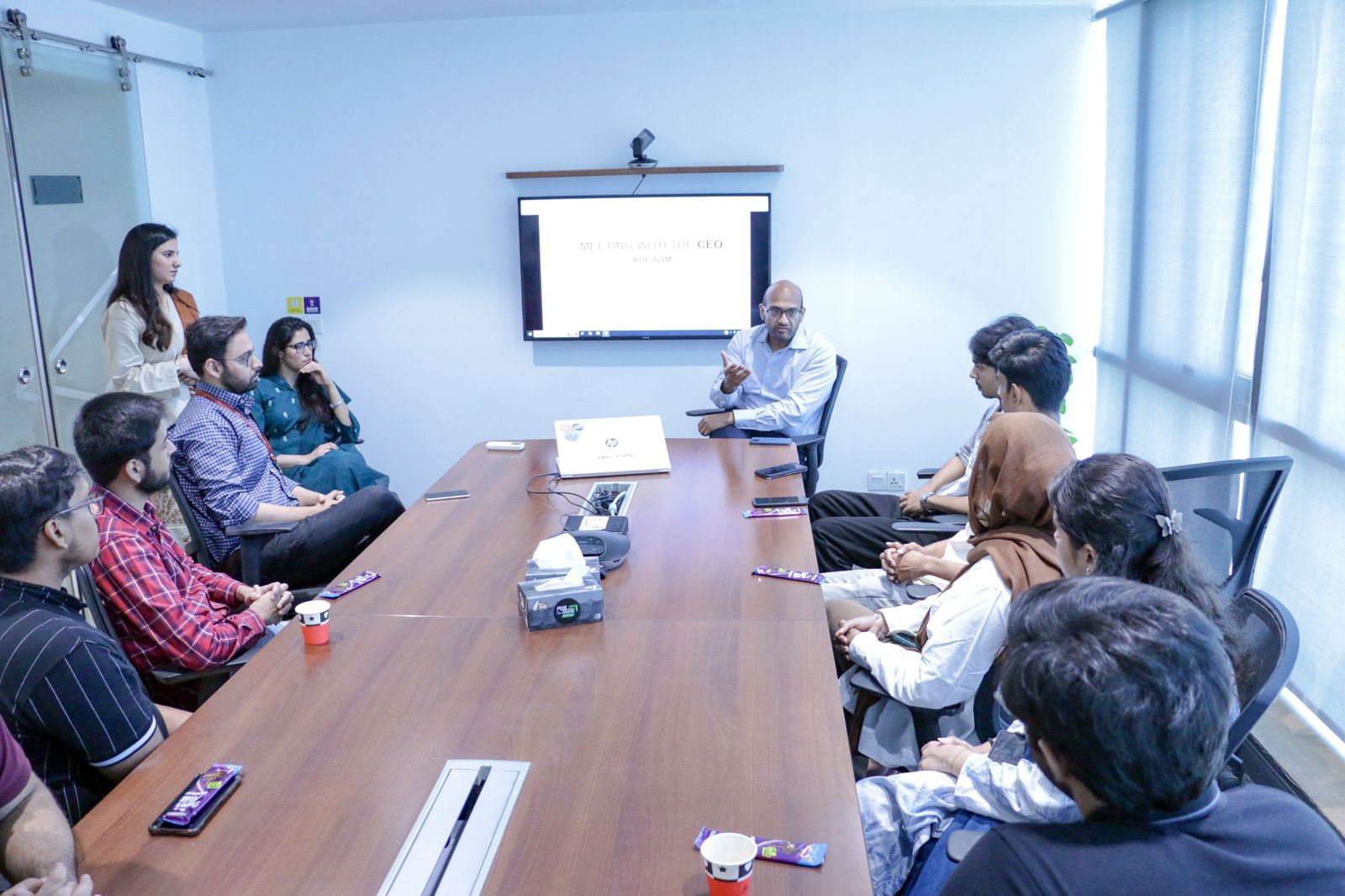
On April 16, 2025, students from IBA Karachi’s School of Mathematics and Computer Science visited VentureDive. Azim spoke about his entrepreneurial journey, the growing importance of data and the role of AI. He encouraged them to develop technical expertise alongside the softer skills needed to work with other people, and to keep learning.
The advice fits a career in which customers, collaborators and colleagues repeatedly alter what happens next. Stanford became a customer. A security startup became part of Cisco. A Karachi engineering team became part of Careem. A shared workspace brought entrepreneurs into contact. Each transition required people to recognize something useful in one another’s work.
The photograph from the student visit shows another conference table. No valuation appears on it. There are people listening, people talking, and questions to answer. For a founder whose work has travelled so far, it is a familiar scale at which to begin again.