The applicant in Bulgaria was technically able and not very comfortable with English. In the hiring process Adnan Lawai later described, written problems gave him a way to show what he could do. The candidate excelled. Folio3 helped him with the language. He became one of its chief architects.
Lawai told that story in 2019, while explaining a hiring process developed at Clickmarks and carried into Folio3. It is a useful place to meet him. Before the partnerships, acquisitions and executive title, there is an engineer considering how a system measures something - and whether it might be throwing away a good answer.
His approach included aptitude testing, exercises suited to the job and interviews after the written work. The demands varied by role. A developer faced programming questions; a product manager designed screens. The point was to see a person doing something resembling the work.
“Employee time is very, very valuable.”
Adnan Lawai, on hiring, 2019
That concern for how people enter a team runs through a career that has crossed research laboratories, American technology companies and a move to Pakistan. The map has changed several times. The people remain central.
The engineer before the business card
Lawai earned bachelor’s and master’s degrees in electrical engineering at MIT. His graduate research at the Media Lab involved digital video and advanced modem design. Those are rather specific beginnings for someone whose later responsibilities would stretch across software businesses, customers and investment.
He worked at General Instrument and then Silicon Graphics, where his remit included digital media and advanced graphics. At SGI, he led the company’s involvement at the MPEG-4 forum. His early career belonged to the technical work beneath the experience on a screen: how pictures are represented, transmitted and made usable.
At Clickmarks, he became chief technology officer. The company worked on enterprise application integration and wireless enablement. Lawai’s responsibilities extended into technical sales, marketing and alliances with Sun Microsystems and Plumtree Software. He had to help determine the technical direction and help explain its value to other businesses.
Engineering and selling have an intimate, occasionally awkward relationship. A system must survive both the demonstration and Monday morning. Lawai’s job at Clickmarks put him near both ends of that bargain. It is an apt prelude to a company built around developing software for customers.
A different direction on the map
In 2005, Lawai moved to Pakistan to head Folio3, the business he co-founded with Umair Khan. The move gave an international software company a very particular center of activity. Teams in Pakistan would work with clients and colleagues elsewhere, carrying out product development across borders.
By January 2009, when he sat down with Jehan Ara for In the Line of Wire, the conversation included projects developed in Pakistan, sometimes in collaboration with Folio3 offices in Bulgaria and Silicon Valley. The geography was already more complicated than a headquarters pin.

The interview photograph offers a pleasingly ordinary view of the enterprise. Lawai sits across a table from Ara, with mugs between them and a CIO WebStudio sign behind him. The equipment is modest. The conversation covers three countries.
That early operation matters because it locates his ambition in actual teams. Pakistan, Bulgaria and Silicon Valley were places where colleagues worked on shared projects. Making the arrangement useful required technical work to travel between people who did not all share an office.
- 01MITElectrical engineering
and research - 02GI + SGIDigital media
and graphics - 03ClickmarksTechnology
and technical sales - 04Folio3Co-founder & CEO
2005 onward - 05Mentors FundFounding partner
2017 onward
An expanding set of responsibilities; roles can overlap.
Eighty-nine people, one ambitious plan
In 2009, Folio3 employed 89 people. Founded four years earlier, it would take twelfth place in the Pakistan 25 ranking published in 2011. The business was helping entrepreneurs and small enterprises build and manage offshore software development operations.
Its work included development, testing, support and marketing, alongside projects for larger companies. This was a broad collection of responsibilities for an organization still young enough to count its age on one hand.
Published 2011
Asked about his vision for the next five years, Lawai wanted international recognition for Folio3 in outsourced software product development and a leading position in Pakistan’s technology industry. The ambition joined two audiences: the customers abroad and the technology community where much of the work happened.
There is something revealing about that pairing. A software services business must persuade customers that it can deliver, while giving its own people work worth doing. An international name and a substantial local presence can reinforce each other. Lawai’s early statement placed both on the same horizon.
A room full of operators
His professional life also unfolded in rooms where entrepreneurs compared experiences. In June 2007, he joined a panel on global entrepreneurship at an OPEN Silicon Valley gathering at SAP’s headquarters in Palo Alto. Umair Khan moderated. Fellow panelists included Raghib Hussain, Faraz Hoodbhoy and Salman Akhtar.
The subject suited someone already running a business between countries. Such a panel brings a practical version of globalization into view: founders discussing the merits and difficulties of taking a company beyond one market. Lawai participated while Folio3 was still in its early years.
In July 2015, he was the featured guest at Startup Grind Karachi, at Dotzero on Tariq Road. The announced format was a fireside chat surrounded by networking. A decade after the move to Pakistan, his career had become material for other people considering their own ventures.
Another relationship took a more formal shape in 2017. Lawai became a founding partner of Mentors Fund, part of the circle assembled by Khan. The founding group included operators with experience at companies such as SquareTrade, Screenhero and Guitar Hero.
Khan began by talking with friends he wanted a reason to work with. Lawai was among them. Twenty-six people gathered at Shuja Keen’s home for the launch. The fund emerged from an existing network of entrepreneurs, rather than a set of strangers discovering one another through a pitch deck.
The fund’s approach pairs capital with mentorship for entrepreneurs modernizing traditional industries. Its stated priorities include clear revenue models, capital efficiency and practical support: introductions to customers, investors, technical people and advisers. That gives Lawai another setting in which operating experience can be useful to someone building a company.
A network is easy to draw and harder to make useful. The fund’s proposition depends on people answering questions, making introductions and helping founders navigate unfamiliar decisions. For an executive whose work already crossed technology and customers, it is a recognizable extension of the job.
The customer is still somewhere specific
Folio3’s expansion has also meant adding expertise nearer its customers. In September 2023, the company announced its acquisition of AzroNet Business Systems, a business in the NetSuite ecosystem. Lawai welcomed John Wynn and the AzroNet team into the company.
The acquisition strengthened Folio3’s UK and European team and added capabilities in OpenAir and professional services automation. The announcement emphasized regional presence, local expertise and support for customers. These are concrete concerns for a global company: someone must understand the system, and someone must be available when the customer needs help.
Lawai’s role at this stage carries a different scale from the earlier engineering positions. The work includes bringing organizations together and extending the range of problems a team can handle. An acquisition announcement compresses all of that into a few paragraphs. The useful consequences have to appear in the work afterward.
On June 9, 2026, he signed a memorandum of understanding with Pakistan Petroleum Limited’s managing director and CEO, Mohammad Khalid Rehman, at PPL’s headquarters in Karachi. The agreement set out an exploration of AI applications in upstream oil and gas operations and enterprise functions.
AI meets an operating business
- Drilling optimization
- Exploration
- Predictive maintenance
- Enterprise functions
Areas identified for exploration in the Folio3-PPL memorandum of understanding.
Drilling optimization, exploration and predictive maintenance give that intention a specific vocabulary. The agreement establishes a direction for collaboration. Its significance, at this point, is the choice of work to investigate, with the outcomes still ahead.
Across those changes, Lawai remains an engineer turned operator, working where technical possibilities meet a customer’s particular requirements. The technology has moved from digital video and graphics to enterprise systems and AI. The recurring obligation is to make something useful for people who have a job to finish.
Bring your walking poles
There is another photograph worth keeping beside the business milestones. In February 2025, Lawai shared a group hike with mountaineer Asad Ali Memon. Memon thanked him for arranging it. At the Castleridge trailhead, the group stands in outdoor jackets with packs and walking poles, framed by green hills.
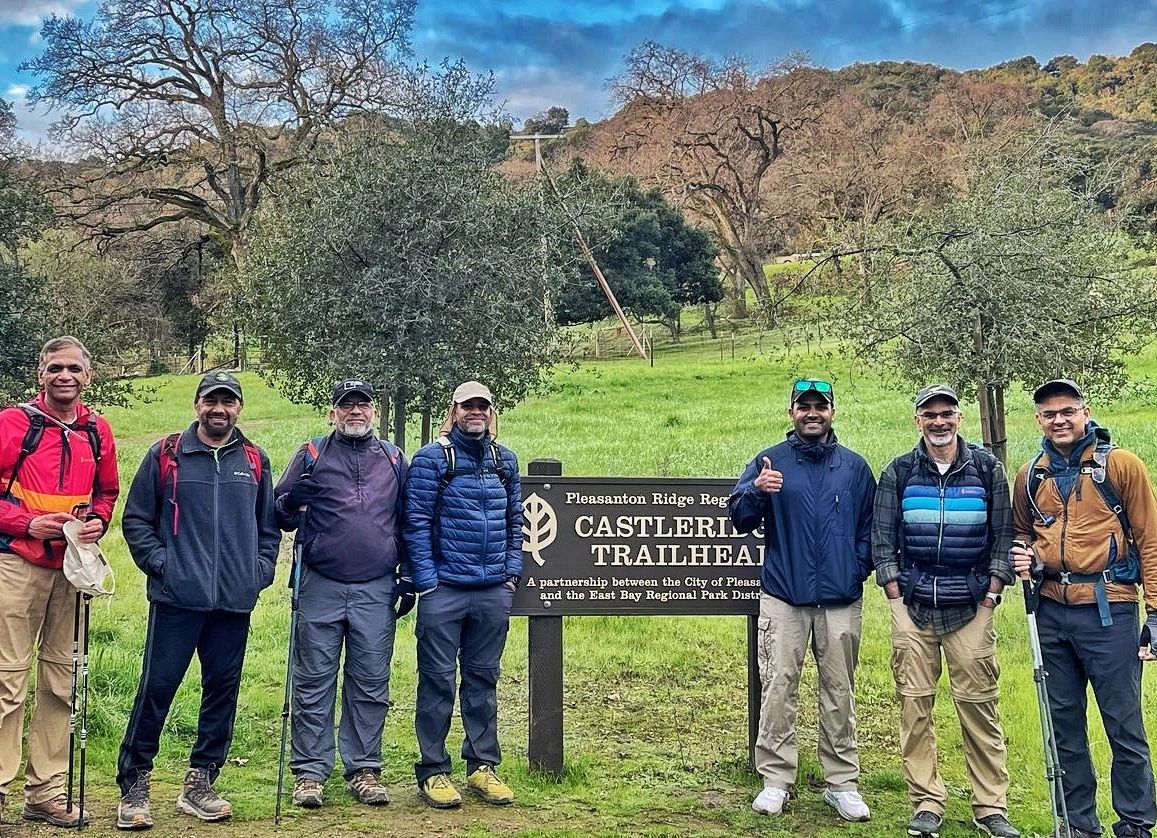
Memon’s account describes conversation, a stream crossing and a viewpoint over Silicon Valley. It is a welcome change of setting in a biography full of software companies. Here, the shared undertaking has a trailhead and everyone can see the terrain.
Lawai also hosted a conversation with the climber at Folio3’s Karachi office. He wrote afterward about the team’s response and hoped the visit would encourage more adventurous company trips into Pakistan’s mountains. His thanks went to the colleagues who organized the session.
People went walking together. Later, colleagues gathered to hear a climber talk. These encounters make room for a person whose professional biography might otherwise disappear into titles and company names.
In the trailhead photograph, Lawai stands at the edge of the group, smiling, with a pole in hand. The co-founder, the engineer and the investor have all come along. For the moment, they share a much simpler assignment: take a walk with friends.