On September 24, 2010, Beta Soft Systems held a happy hour at a San Jose lounge. There were mojitos, tapas and restaurant gift cards to win. The revealing detail was who needed catching up with whom: the founders were meeting consultants who normally worked at clients’ offices. A company could employ the people doing the work without sharing their working day. Even the office party required a little coordination.
- Beta Soft combined IT staffing with custom software delivery.
- Its documented footprint connected California and India.
- The reported $20 million business belongs to FY2013.
- Business directories now flag the company as closed or inactive.
That small social arrangement opens up the larger business. Beta Soft sold access to technical people, then expanded the offer to include responsibility for technical projects. For a buyer, those are different purchases. A consultant joins the machinery you already run. A delivery team takes charge of making something work. Much of the interest in this company sits in the space between them.
The person between the people
Ritu and Vishal Mangla founded Beta Soft in 2005. Historical material identifies Ritu as president and CEO and Vishal as vice president. Their company entered the crowded business of IT staffing and consulting, serving organizations that needed skills beyond their existing teams. Its recruitment messaging addressed clients ranging from startups to Fortune 500 businesses, alongside people trying to find their next assignment.
Consider its published description of a business analyst. This person was to understand what a client wanted, then direct the development team toward a solution. The job lived between a business request and a technical instruction. Anyone who has watched a perfectly reasonable request emerge as a perfectly wrong feature will recognize the value of that position.
The quality assurance role occupied another boundary. Beta Soft asked testers to develop scenarios, review designs, help implement test plans and communicate with customers about defects. Writing software was one part of the work. Establishing what it should do, and checking what it actually did, were jobs in their own right.
“Like other IT consulting companies, we are always in need of quality software engineers.”
Vishal Mangla · company announcement, 2010
Two ways to buy the work
Beta Soft’s employer description set out a useful distinction. It supplied talent for time-limited projects at large companies and offered comprehensive IT work to smaller businesses. It also described an outsourcing model in which clients could hand responsibility for deliverables to its in-house team. The customer could buy capacity inside an existing operation or buy a defined piece of delivery.
Add a person
Consultant → client team
The client directs the work.Assign a project
Brief → supplier team → delivery
The supplier owns agreed deliverables.The distinction matters more than an impressive list of technologies. If you already have capable technical management, another engineer may remove a bottleneck. If you have an outcome in mind but nobody to organize the work, another engineer can leave the management problem untouched. The practical lesson from Beta Soft’s offering is to decide which gap you are paying to close.
Its market position was therefore broad: a services supplier connecting staffing, consulting and development. Buyers could compare such an offer with specialist recruiters, development agencies, larger outsourcing firms or direct hiring. The useful comparison is who manages requirements, accepts completed work and handles changes. A long menu of capabilities cannot settle those questions.
A talent pipeline with a street address
The company’s US-India operation made this more than a California recruiting story. Its 2010 announcement described a center in Chandigarh and reported an export award from Software Technology Park of India. Later recruiting material said technology services, product development and outsourcing had joined the portfolio in 2009.
There is a quieter record of the talent pipeline. DAV Institute of Engineering and Technology lists three IT placements with Beta Soft in 2011. California State University, East Bay lists the company among its 2011-2012 career-fair attendees. These records put recruiting on both sides of the ocean, in the everyday places where employers meet people entering work.
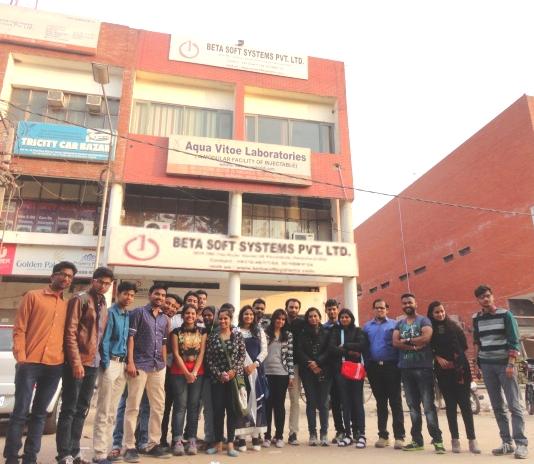
In February 2016, twenty-seven IT students and two faculty members from RMD Sinhgad School of Engineering visited the Panchkula office. Their report describes discussions of web development, mobile applications, testing and PHP. Students asked about technologies and hiring expectations. They left with diaries and pens. It is a pleasingly physical scene in a business usually described through abstract words like resources.
Put a date on the number
Historical recruiting material also reported more than 350 employees.
Beta Soft’s recruiting copy described a $20 million business for FY2013. That figure belongs to a particular period; it should travel with its date. It suggests the scale the company claimed after expanding its services, rather than a present-day measure of sales. The distinction is especially relevant for a business whose old job advertisements remain searchable.
Those advertisements also make its expertise tangible. A 2014 systems-analyst classified called for Java, Oracle, SQL and other technologies, with travel and relocation to client sites across the United States. A Java developer description covered implementation, maintenance, debugging, documentation and technical support. The work extended past the moment a program first ran.
The handoff is the lesson
Today, BBB says Beta Soft is believed to be out of business, and Crunchbase labels it closed. Florida’s registry records withdrawal of its foreign registration in March 2016, a narrower event than a worldwide shutdown. The profile is best read as a historical account of a services business and its operating choices.
There is still something useful to copy. Before buying technical help, name the handoff: a person, a specification, a test plan or an accepted deliverable. Set ownership around it. Staffing makes sense when someone can direct the added capacity; outsourced delivery needs a scope both sides can judge. Beta Soft’s story makes that ordinary decision visible. Somewhere between the client’s request and the finished software, someone has to take responsibility.