A seed field is an unforgiving place to discover that your software needs a better internet connection. Gro Alliance, a seed-production business with facilities across seven states, already had an application. According to Folio3’s account, it also had calculation bugs, limited iOS compatibility and unreliable location information. The technology existed. Getting useful work through it was the problem.
- Folio3 builds applications and connects the systems businesses already use.
- Its specialist practices stretch from enterprise finance to agriculture and healthcare.
- Its current AI push adds governance and automation to that integration business.
That distinction helps explain Folio3 Software. A business can buy an application and still spend its afternoons reconciling what the application missed. Someone must understand the exceptions: a field worker without a signal, an order that never reaches the warehouse, a finance team waiting for information another system owns.
01 / The field is the specification
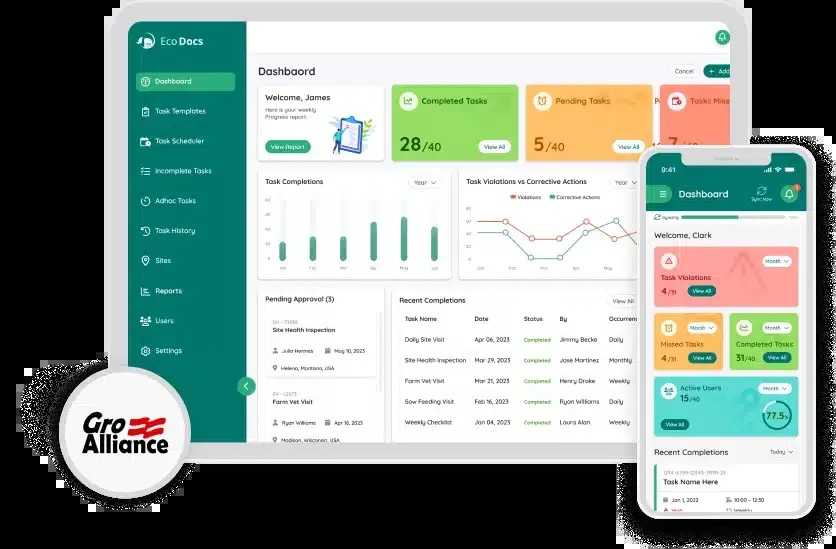
For Gro Alliance, Folio3 describes a sequence of unglamorous work: study users, prioritize problems, agree on wireframes, customize an existing foundation, then deploy and train. The resulting system covers field assignments, crop activities, hybrid management and reporting. The case says soybean operations were being brought onto it too.
The useful lesson is about where to begin. A feature list alone would have missed the conditions under which people used the product. Buyers can copy the sequence: watch an actual task, identify the failure, approve the workflow, and test it with the people who must live with it.
02 / A company built around the handoffs
Founded in 2005, Folio3 began helping Silicon Valley startups through an offshore development model in Pakistan. Its founders, Adnan Lawai and Umair Khan, brought prior technology-company experience. Lawai, now CEO, had been CTO at Clickmarks and worked at Silicon Graphics. Khan serves as executive chairman.
The company’s history describes an expansion into enterprise software, ERP implementation and larger business applications. Today, its divisions span AI, applications, NetSuite, Microsoft Dynamics, ecommerce, agriculture, digital health and cloud services. The common thread is connecting technical decisions to the way a particular business operates.
There is also a pleasing complication in Khan’s résumé. The software founder co-founded Zareen’s Restaurants and teaches entrepreneurship at Berkeley. Discussing AI with Redwood City Pulse in August 2026, he pointed to pricing, ordering and waste reduction in restaurants. Operational details seem to follow him outside the software business.

03 / Follow the order, then the money
Consider BlackStrap, the outdoor apparel business. Folio3’s case describes duplicate purchase orders, warehouse inaccuracies, scrap-tracking problems and slow payments. It implemented NetSuite SuiteSuccess AFA Standard Edition, with warehouse functionality and a Shopify connector. The work included custom ACH payment templates.
Folio3 reports that payment processing fell from five days to the same day and that manual work-order and inventory processes declined by 40%. Those are project-specific, vendor-published outcomes. Their significance is the specificity: purchasing, picking and payments are places where a disconnected business loses time in small, repeated amounts.
fewer manual processes
in work orders & inventory
The distinction from a standalone software subscription is responsibility for the connections. Folio3 sits in the market for engineering and implementation partners. An internal team, another development agency or an ERP specialist may be the alternative. Its appeal is having platform expertise and industry knowledge inside the same engagement.
It also develops reusable software. NStitch addresses apparel production; Propertese serves property management; AgriERP covers agricultural operations. Connectors and these specialist products give the services business something to build upon when the next customer’s problem resembles the last one.
An earlier agricultural project shows the same logic at a different scale. For TrueTrac, Folio3 helped develop a suite covering produce traceability, food-safety data and field operations. LabelTrac synchronized label information to mobile devices so harvesting companies could print container labels in the field for multiple shippers. LaborTrac captured payroll information where the work happened. A central console brought the modules together.
These are specialized chores, and that is the point. A grower does not need software to admire agriculture in the abstract. The label must identify the produce, the payroll record must capture the labor, and the information must reach the next person. Each successful handoff makes the larger system more useful.
04 / The bill belongs in the story
A Clutch customer review supplies a concrete modernization example. Sunburst Digital reported spending about $35,000 converting an educational product from Flash to HTML5, including rebuilding 78 interactive pieces. The engagement ran from December 2020 to May 2021. Consultant Joe DeSario said the quote was roughly a third of alternatives.
“There were no surprises.”Joe DeSario, Sunburst Digital consultant
Clutch review, May 2021
That is a single historical purchase, rather than a price for a new project. Folio3’s business mixes scoped delivery, engineers embedded with customer teams, ongoing support and software licensing. The commercial question is consequently practical: which responsibilities are included, who owns maintenance, and what happens after the first release?
The people delivering that work matter as much as the engagement model. Folio3’s published values include ownership, earning trust, curiosity and doing more with less. Buyers can translate those aspirations into observable requirements: named responsibility for decisions, regular demonstrations, written acceptance criteria and a handover that lets their own team operate the result. A values page becomes useful when it changes the questions asked before signing.
05 / AI meets the existing business
Folio3 now leads its corporate pitch with AI. Its AI Guardian product applies identity, data, spending and audit controls to AI use. Published pricing starts at $15,000 for implementation, with a platform license advertised as low as $8,000 per quarter. The product is Azure-first; that matters when assessing deployment fit.
The company’s discovery process calls for examining existing systems, ranking workflows, validating a use case and launching an MVP before scaling. This approach needs accessible data, an accountable customer team and a task worth improving. Buying a custom build for a routine need already covered by a standard product would deserve a harder justification.
The revealing question for a prospective customer is simple: show us the handoff that fails. Follow one field task, one order or one payment all the way through. Folio3’s most persuasive cases begin at that level, where an improvement can be observed by the person who used to do the extra work.