A workboat is a rather severe critic of office technology. It moves. It works far from convenient cables. Its crew would quite reasonably like to speak to people on land. When Morrison, the offshore pipeline and diving contractor, needed better connectivity for vessels in the Gulf of Mexico, Global Data Systems offered a combination of cellular service and satellite backup. The interesting part came afterward: Morrison could afford a separate network for its crew.
- GDS runs connectivity, security, cloud and workplace IT for businesses with complicated operating environments.
- Its offshore work combines connection types rather than asking one network to do everything.
- The useful lesson: buy a working service, a recovery plan and a clear owner of the problem.
That last detail makes a better introduction than a catalogue of firewalls. An infrastructure decision had acquired a domestic consequence. The same system serving a vessel’s work could help someone check email or contact family. An IT budget had briefly become a social budget. The distinction would have been lost in a spreadsheet headed “bandwidth.”
01 / The call home was in the network
GDS’s 2019 announcement describes its NOMAD solution using LTE cellular with satellite as backup, managed through a software-defined wide-area network, or SD-WAN. The deployment also included firewall, intrusion detection, anti-malware and content-filtering protections. Morrison’s IT manager, Royce Pellegrin, credited the lower cost with making crew connectivity possible.
“This new ability to check email or communicate with loved ones has considerably improved crew morale throughout the vessels.”Royce Pellegrin / Morrison IT manager / 2019
The wider purchasing lesson is easy to miss. “Which connection should we buy?” assumes there must be a winner. A vessel needs different answers in different places. A cheaper route can carry traffic where available; another route can preserve access when conditions change. The engineering work lies in arranging that relationship, protecting the traffic and operating the system after installation.
GDS extended its maritime portfolio in 2021 with NOMAD VOYAGER, powered by Intelsat FlexMaritime. It offered satellite connectivity for offshore journeys, regional LTE and customized service plans. Intelsat supplied the satellite network; GDS packaged connectivity with security, management and support. The partnership helps explain where this company sits: between the underlying technology and the customer who needs an operating result.
02 / A pilot’s garage, then a much larger responsibility
The founder story has a pleasingly practical beginning. A sponsored 2022 Business Report profile says Chuck Vincent, an Eastern Airlines pilot, began building PCs for friends and family in his garage in 1987. When the airline closed, he opened a full-time computer shop. The business moved from assembling PCs toward networking and servers. A computer on a bench became computers that had to work together.

The current leadership roster lists Chuck as chairman, his son Chris as CEO and Doug Pickle as president. Pickle’s promotion was announced in May 2025. This is an established service business whose story runs through hardware, networks and the organizations depending on them. Its appeal is easier to understand in a customer’s operations department than in a venture-capital pitch.
GDS now describes itself as a “Managed Intelligence Partner.” Beneath the newer language sits a recognizable proposition: take responsibility for interconnected systems that customers cannot conveniently manage as separate purchases. Its stated mission remains making IT simple. Simplicity, in this setting, means moving complexity to people equipped to deal with it. The complexity does not graciously vanish.
03 / The invoice is part of the machine
A published GDS healthcare case describes an unnamed provider with more than 700 locations in 35 states and Washington, D.C. It had inconsistent phone systems, weak connectivity and over 1,000 service-provider invoices a month. GDS combined managed SD-WAN, backup LTE, cloud phones and consolidated billing. The case reports annual savings above $1.2 million and roughly 20 percent lower telecom spending. Those are results for that engagement, rather than a price promise.
GDS’s unnamed home-healthcare customer case. A historical engagement, not a forecast for every buyer.
There is a small insult hidden in every unmanageable invoice: someone must decipher it. The economic case for a managed provider can therefore extend beyond equipment and circuits. Buyers should count the work of coordinating vendors, identifying who owns a fault and keeping locations consistent. A slightly cheaper component can be an expensive system if it creates another recurring administrative task.
GDS’s published master service agreement reflects this broader business. It covers communications, installation, rental, managed and consulting services, along with equipment and products. The business model combines contracted services with the practical work of deploying and supporting technology. The agreement and service orders matter because “we manage your IT” is a very spacious sentence. A buyer needs to know precisely what fits inside it.
04 / The revealing hour was 1:34 a.m.
One of GDS’s more useful case studies begins with a failure. On December 20, 2018, a customer suffered a Ryuk ransomware attack. GDS records first detection at 1:34 a.m. and describes a compromised privileged account being used to remove security tools. Its investigation also found that its protections had not yet been fully deployed across the network.
The response included isolating malware, reviewing logs, cleaning affected systems, changing passwords and restoring encrypted data from backups. GDS reports minimal downtime and no data loss. Its follow-up recommendations included completing deployment, reviewing policies, testing backups and maintaining a disaster-recovery plan.
The practical lesson is about the unfinished edges of a project. A purchased security tool has a deployment boundary; an attacker may find the other side. Ask what is covered today, which accounts can disable protection and whether restoration has actually been rehearsed. A vendor’s incident story is more informative when it contains awkward facts. Here, the incomplete rollout belongs beside the successful recovery.
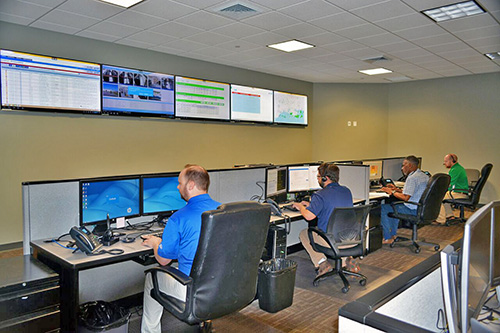
GDS describes a continuously staffed network operations center and helpdesk, plus security monitoring facilities. It announced Cyber Verify Level 3 in July 2025 and says it renews SOC 2 Type 2 assurance annually. In February 2026 it announced a place in CRN’s MSP 500, within the Pioneer 250 category. Such credentials help a buyer begin due diligence. The buyer still needs the applicable report, service scope and escalation arrangements.
05 / Water, workboats and the new intelligence pitch
The customer list reaches beyond offshore operations. GDS serves healthcare, government, industrial businesses and utilities. Its November 2025 Cameron Parish Waterworks District 10 case describes a cybersecurity gap analysis, guidance on federal threat notices, support with technology and documentation, and virtual chief information security officer advice. The product in that relationship includes judgment: deciding what a small organization should address first.
Its newer AI Readiness Assessment applies a related approach to identity controls, data organization, useful workflows, staff adoption and governance. The package includes maturity scores, identified gaps and an action roadmap. GDS connects that assessment to its managed Microsoft 365 offering and subsequent Copilot deployment. This is a proposed path for customers, rather than evidence that every deployment produces the promised gains.
GDS occupies the crowded market for managed IT and security, with a particular case to make where remote geography meets operational responsibility. Alternatives include an internal team coordinating carriers, a regional managed service provider or a maritime communications specialist. The comparison should turn on the actual job: coverage, security, response, recovery and the number of parties a customer must coordinate.
Before borrowing the approach, test the conditions. Can the backup carry the applications you need? Does cellular coverage exist along the route? Who handles faults outside the provider’s scope? Which existing contracts constrain a migration? Concentrating services with one partner also concentrates dependence. Buyers should retain documentation, access arrangements and a credible exit plan.
The offshore crew network offers the most useful final measure. A good technology decision may reveal its value in something modest enough to escape the procurement document. The work gets done. A connection holds. Someone calls home. There are worse ambitions for an IT company than making those things uneventful.