On March 11, 2022, Sergei Dreizin closed Akvelon’s operations in Russia. About 800 people worked there, more than half the software engineering company’s workforce. The business he had co-founded in 2000 had spent years building connections across borders. Russia’s invasion of Ukraine made some of those connections impossible to continue on the same terms.
Dreizin had grown up in Moscow. His business partner, Constantine Korovkin, had studied computer science in Kharkiv. Their company had people on both sides of the border. A decision that might appear tidy in a corporate announcement would have to be lived through by employees, families and customers.
It is an arresting place to begin a career story. Founders generally prefer to count the offices they open. Here was one explaining why three had to close. To understand that decision, it helps to go back to an earlier departure, and to a less ceremonious setting for entrepreneurship: a living-room floor.
A keyboard is a poor pillow
Dreizin moved to the United States in 1992, after the Soviet Union collapsed. He earned a bachelor’s degree in computer science at the University of Minnesota. His career included Honeywell and eight years at Microsoft, where he contributed to the design and implementation of online services including Microsoft Passport.
Passport was an identity service, a piece of the machinery that helps people sign in. It belongs to the less photogenic end of technology: users tend to notice such systems most when something fails. Experience there gives Dreizin’s later career a practical starting point. Before selling engineering to other businesses, he had worked on the engineering itself.
In 2000, he and Korovkin began their company while still working at Microsoft. Dreizin later recalled late-night coding, searching for a suitable niche and falling asleep over his keyboard on the living-room floor. The remembered scene has very little of the polished founder portrait about it. The furniture, at least, was economical.
His account also gives luck a place beside effort. That is a pleasing admission in a field where hindsight can make every accidental turn resemble a master plan. They worked, experimented and kept going. The certainty arrived later, when there was a company whose beginnings could be explained.
The work behind somebody else’s product
Akvelon’s business puts its engineers inside other organizations’ ambitions. Its work spans software development, cloud systems, data and machine learning. The customer may have the product name on the screen; an engineering partner helps make the thing function. There is a certain professional discretion built into that arrangement.
A small episode from 2010 captures the texture of the work. Akvelon released an updated add-in that brought Microsoft Dynamics CRM administration into the Enterprise Business Server console. Dreizin explained that users would see little obvious difference, while substantial changes had happened underneath. The purpose was to give administrators a convenient place to manage their tasks.
By 2017, the company was also connecting Dynamics CRM with Gmail. An update added two-way calendar synchronization and ways to review or create CRM activities from the inbox. These are unromantic problems until you are the person repeatedly moving information between two applications. Then convenience becomes a fairly persuasive feature.
In October 2020, Akvelon announced its entry into Google Cloud’s Partner Advantage Program. Dreizin described a commitment to helping customers solve difficult engineering problems. The platforms had multiplied since his Microsoft days; the commercial proposition still depended on people who could understand a system and improve it.
Whiskey in the expense column
Ask a founder about growth and you may receive a speech. Asked about his fastest-growing expense in a company interview about its 2015 Washington growth ranking, Dreizin offered “wages and whiskey.” He then made the serious point: employees had made the growth possible.
The joke works because it briefly punctures the solemnity of the occasion. There is a ranking to celebrate, an executive to interview and a question that practically invites a respectable answer. He supplies an eyebrow instead. The appreciation that follows feels less rehearsed for having arrived in such company.
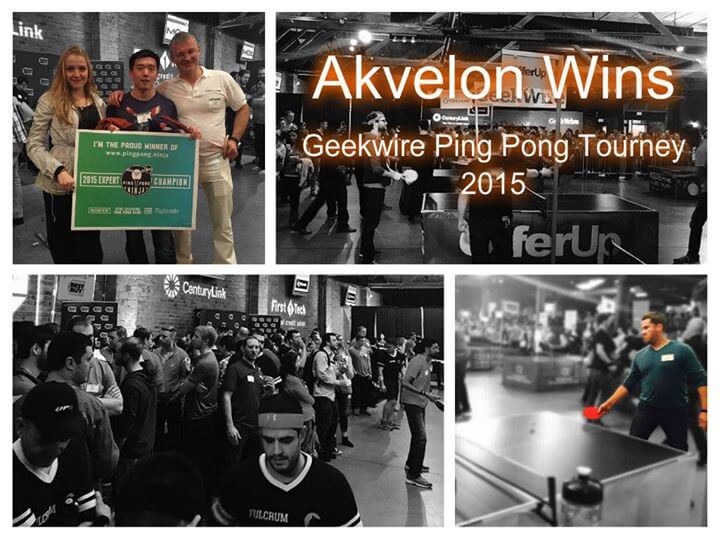
There is a separate sporting record. Dreizin was among Akvelon’s competitors at the 2015 GeekWire table-tennis tournament in Seattle. The company’s Valeri Kim won the championship. The distinction matters: the CEO turned up to play, while the trophy belonged to somebody else. A company photograph is quite capable of accommodating both facts.
An unusually vocal customer base
Then there are the cats. Dreizin is a co-founder and CEO of MeowTalk, the app that attempts to interpret feline vocalizations. Its executive team also includes Korovkin, data scientist Stavros Ntalampiras and technology chief Oleg Rezhko. This branch of the story has rather more meowing than the average enterprise software biography.
The project’s origin belongs to a group. Javier Sanchez, a cat owner and fellow co-founder, encountered Ntalampiras’s research into cat vocalizations. Sanchez teamed up with Dreizin, Korovkin and Rezhko, and the group brought in Ntalampiras. Giving the collaborators their names makes the story more interesting than the customary fiction of a solitary inventor.
MeowTalk launched in November 2020. By October 2024, reported downloads exceeded 20 million. Dreizin estimated that it had analyzed more than a billion meows. He described the collection with cheerful astronomical ambition: “We’re the largest depositors of meows in this galaxy.” The galaxy, so far, has lodged no competing claim.
“We’re the largest depositors of meows in this galaxy.”
Sergei Dreizin, October 2024
The useful qualification is that an app’s interpretation remains an interpretation. Dreizin and fellow MeowTalk executive Mark Boyes have acknowledged that the system is imperfect. Cat communication specialists have questioned its readings too. A large collection of recordings does not make every individual reading correct.
The product lets owners correct a suggested interpretation and provide examples of their own cat’s sounds. That feedback is central to the proposition: the human keeps observing, the software offers a reading, and the owner can disagree. It is a rather more engaging relationship than accepting a pronouncement from a phone while the cat looks on, unimpressed.
The border that changed the business
The invasion brought Dreizin back to questions no app could simplify. Akvelon had Russian offices in Kazan, Yaroslavl and Ivanovo. It also had a substantial Ukrainian team. Closing the Russian operation meant offering relocation to employees willing and able to leave. Dreizin spoke about the decision through the experience of having known the Soviet Union himself.
There is a difference between an organization’s geography on a presentation slide and the geography of its obligations. On the slide, a dot can be removed. In practice, people have to decide where they can live and work. Dreizin’s public account acknowledged the disruption. The ethical choice did not come with an exemption from operational difficulty.
Akvelon closes its Russian operations and offers relocation to employees willing and able to move.
Support for Ukraine also took organizational form. Dreizin and Korovkin helped start United with Ukraine alongside Nina Shapirshteyn. By March 2023, the charity was part of the company leaders’ continuing response to the war. It gave their involvement a structure that could carry on beyond an announcement.
The administrative detail is revealing in its own modest way. The charity’s 2024 filing lists Dreizin as CFO, treasurer and secretary, with no reported compensation. Those are the titles of accounts, records and recurring responsibilities. Public conviction has its visible moments; keeping an organization running also has paperwork.
The engineer still asks for evidence
Dreizin’s public attention has also turned toward AI-assisted engineering. On LinkedIn, he has shared Akvelon’s work on adopting coding assistants and asked about their actual effect on developer productivity. More recently, he raised the question of how far agents could go in working directly with enterprise data.
The framing is practical: what can the tools do inside a working organization? A demonstration can be charming. Software that changes business records must also handle the relationships and rules those records represent. That is a familiar concern for someone whose earlier work included sign-ins, administration consoles and integrations between applications.
His interests extend to people learning the craft. Responding to an Akvelon student project, he praised what interns and mentors had achieved in five weeks, then added a remark about getting their pull requests approved. Even congratulations, in software, may require a review before they can be merged.
A cow wanders into the tax debate
In April 2025, Dreizin spoke against Washington state’s business tax increases. His objection arrived with another animal metaphor: “They think they can milk this cow forever, but cows eventually always move to the greener pastures.” It was a business owner’s warning about incentives, delivered with considerably more pasture than the usual fiscal commentary.
That remark sits comfortably beside the whiskey joke and the galactic meow collection. There is a recognizable public voice here: willing to be funny, quite willing to be blunt. The humor gives a human scale to subjects that can otherwise disappear into executive vocabulary.
His career has room for both the integration nobody notices and the cat app people cannot resist discussing. It also contains a decision to dismantle a large part of a business he had helped build. Taken together, those episodes give a fuller portrait than a list of titles. The work keeps changing; the responsibility for deciding what to build, whom to work with and when to leave remains stubbornly human.