A television broadcast has an unusually severe editor: the clock. A piece of software may be clever, expensive and admired by everyone in the meeting, but the programme still has to appear on time. Manish Sachdeva spent part of his career building for that world. It is a useful place to begin understanding a founder whose later work reaches into warehouses, workforce systems and retail operations. In each setting, the software has a working day to get through.
Today, Sachdeva is founder and CEO of delaPlex Group, with a separate role as a non-executive director of delaPlex Limited in India. He is based in Alpharetta, Georgia. The geography of his career crosses India and the United States; its more revealing journey crosses the distance between writing software and organizing the people needed to make it useful. There are acquisitions, partnerships and a stock market listing along the way. There is also the persistent matter of what happens after a customer switches something on.
A deadline with an audience
His training was in engineering. A computer technology degree from Nagpur University in 1994 was followed by a Master of Engineering at Birla Institute of Technology & Science in 1996. His early employers included Tata Elxsi and Tektronix Engineering Development in India. He also worked at RedPrairie as a senior business analyst. That combination of engineering and business analysis would eventually look quite at home in a company working on enterprise operations.
By 2010, he was chief technology officer at Video Technics. The company’s software handled the machinery of professional broadcasting: recording, playback, file handling and the workflows around them. Its version 5.1 announcement, timed for the NAB show, described improvements including support for video formats and desktop streaming. These are the details that tend to disappear behind the finished television picture. Someone, nevertheless, must make them behave.
Sachdeva’s accompanying explanation put the emphasis on responding to customers. His phrasing was modest enough to survive outside a press release. Broadcast customers were buying a way to do their jobs, and the release addressed the mechanics of that work. A technology career can be understood through titles; it can also be understood through the problems its products are expected to solve.
“we continue to respond to the needs of our customers.”
Manish Sachdeva · Video Technics, 2010
Three businesses, one broadcast
In Amsterdam at IBC 2013, the role had changed. Sachdeva was speaking as chief executive of BroadStream Solutions, announcing a combination involving delaPlex Software, VideoTechnics and OASYS. He explained the deal through the expertise each business contributed: IT, broadcast products and automated playout. The ambition was to put more of the broadcaster’s workflow within a connected offering.
Playout is the business of getting scheduled material onto a channel. It sounds rather courteous until one considers the number of opportunities for an awkward pause. The combination Sachdeva described addressed a practical industry desire: fewer gaps between the systems that prepare content and those that deliver it. It also marked a change in the scale of his work, from directing product engineering to bringing businesses and capabilities together.
Andy Tuggle, previously at VideoTechnics and then working in BroadStream’s sales and business development, spoke alongside that announcement about expanded customer support. The relationship had history. Tuggle’s public recommendation of Sachdeva describes years as colleagues at Video Technics and praises his commitment to fellow employees. It adds a human detail to the transaction: some of the people making the next business work had already learned how to work together.
Complementary expertise, brought into BroadStream Solutions.
The business grows a supporting cast
DelaPlex dates its business story to 2008. The broadcast chapter belongs within that longer history, rather than serving as a tidy before-and-after boundary. Software companies acquire new customers, colleagues and specialisms in overlapping layers. Sachdeva’s career reflects that less orderly, more believable version of company building.
By late 2019, he was talking publicly about strengthening delaPlex’s leadership. Ben Wolk joined as chief revenue officer after working in media and technology, including as president of BroadStream Solutions. Once again, a familiar industry connection appeared in a new business setting. Sachdeva described a company with a technical foundation that was adding leadership to serve more customers and pursue further growth.
There is a straightforward management problem inside that announcement. The skills required to deliver a piece of software do not automatically supply every skill required to sell, support and expand a services business. A founder has to build an organization around the work. Wolk’s appointment put commercial experience beside engineering capability, with broadcast knowledge forming part of their shared professional background.
The pattern is interesting because it gives the company’s expansion a cast of characters. Technology businesses are often described as if a strategy simply materializes and everyone obediently takes their place. Here, the names and previous roles make the process more concrete. Growth involved finding people whose experience could travel into the next version of the business.
An opening bell in Nagpur
On February 2, 2024, delaPlex Limited debuted on the SME platform of India’s National Stock Exchange. The listing ceremony took place in Nagpur. The Indian affiliate had completed an IPO subscription period in January, and the debut brought a public market milestone into the group’s story.
Sachdeva was already a non-executive director of the Indian company, having been appointed in October 2023. His brother Nitin Sachdeva holds distinct responsibilities as managing director of delaPlex Limited and president of delaPlex Inc. Keeping those roles clear helps explain the business: group leadership, the US company and the Indian listed entity each have their own place in the picture.
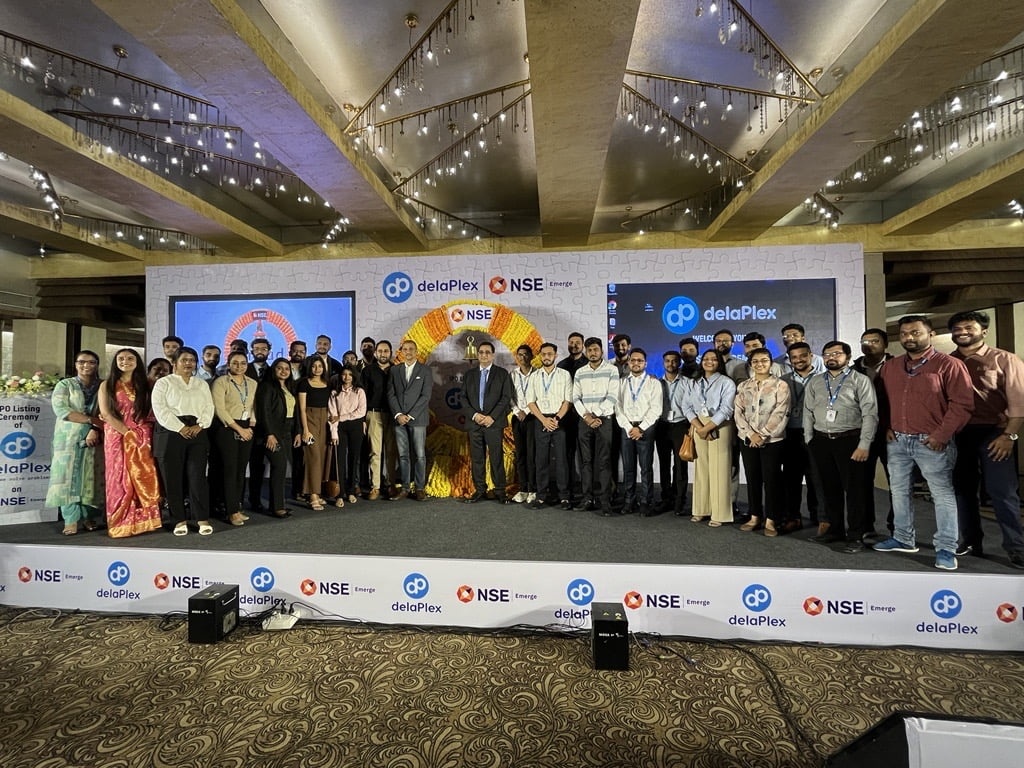
The ceremony introduced a different audience to a familiar set of questions about growth and relationships. Investors joined customers, employees and partners among the people with an interest in what came next. In his comments on the debut, Manish emphasized their confidence in the company. A listing supplies a date that can be printed in large type. Running the business continues on the following morning, with rather fewer cameras.
Different milestones: the group’s operating history and the Indian company’s public listing.
The warehouse enters the picture
By then, the operational setting had broadened well beyond broadcasting. In July 2023, delaPlex expanded its partnership with Open Sky Group to pursue warehouse management work in India and Southeast Asia. Open Sky specialized in implementing supply chain systems, including Blue Yonder solutions. DelaPlex brought local consulting resources and industry relationships to the arrangement.
“India is a key global hub for supply chain operations,” Sachdeva said. The partnership concerned both new deployments and upgrades. Those are concrete ambitions: help organizations put a warehouse system into use, or move an existing one forward. The business opportunity rested on delivery expertise as much as on the software being delivered.
The connection to his earlier career is an editorial observation, but a useful one. A broadcast workflow and a warehouse workflow both depend on handoffs. Work passes from one stage to another; information has to arrive where it is needed. The settings differ considerably. The engineering attraction of making connected parts cooperate is easy to recognize across both.
In May 2024, another expanded relationship addressed testing. DelaPlex and Cycle Labs outlined a collaboration combining Cycle’s enterprise test automation platform with implementation and staffing capabilities. The arrangement included globally available team members with Cycle skills and a role for automated testing within delaPlex’s quality assurance and development processes.
For Sachdeva, the stated goals included improving product quality and shortening the journey to market. Testing is an appropriate companion to expansion: adding capabilities also adds interfaces that must be checked. The Cycle relationship dealt with the people and practices required to perform that work. The brochure may introduce a system in a paragraph; getting it ready for use requires considerably more patience.
Still making the next connection
The 2026 conference materials put retail and supply chains firmly in view. DelaPlex’s Manifest announcement named Sachdeva alongside Marty Reynolds and Sam Williams for the February event in Las Vegas. Its ICON 2026 page also named him among the leadership team, alongside Reynolds, Ravi Rangu and Williams. These announcements place him in the company’s outward-facing work of meeting customers and partners.

ICON’s business agenda connected workforce management, warehouse management and planning, with store operations and automation also in the mix. The vocabulary has travelled some distance from the broadcast recording and playback features of 2010. The practical audience remains recognizable: people trying to coordinate a complicated operation without spending their entire day negotiating with its software.
Sachdeva’s career is interesting at those joins: engineer and executive, product and service, an established colleague and a new role. Its milestones give the story shape, while the collaborations give it texture. After the announcements and the opening bell, the next customer still has something that needs to work. That is a demanding kind of continuity, and a fitting place to leave a career devoted to keeping things moving.