A robot arm is a demanding colleague. Give it a destination and it still needs a route, an awareness of obstacles, and a way to arrive without colliding with anything expensive. In 1989, Joe Selvaraj and S. S. Keerthi put that problem into a research report. Decades later, Selvaraj’s work has a larger cast: software engineers, customers, fellow executives, and the people trying to pass through a website’s captcha.
He is the co-founder and CEO of Sysvine Technologies, based in Mountain View, California. He also holds the co-founder and CEO title at MTCaptcha. Put those roles beside the robotics research and a pleasing pattern appears: systems are useful when they can negotiate the complications around them. The connection is a useful way to read a career that has moved between research, services, and products, with practical engineering questions at each stage.
A robot with somewhere to go
The early research concerned an articulated, two-link planar robot. The Indian Institute of Science’s 1989 technical report catalogue records Selvaraj’s collaboration with Keerthi. His professional publication listing describes a heuristic approach to collision avoidance using distance functions, with an emphasis on geometric intuition and short computing times.
There is something refreshingly concrete about this starting point. The arm has two links. The obstacles occupy space. The path has to work. Anyone hoping to charm the robot with a persuasive slide deck is likely to have a long afternoon.
The problem also offers a useful way into Selvaraj’s later career. Engineering involves choices under constraints. A route can look elegant and still run into an obstacle. An algorithm has to do its job within the available computing time. The published description makes those concerns visible in a small, intelligible setting.
Read alongside his subsequent work, the paper supplies technical depth to a title that might otherwise sound purely managerial. Before the leadership teams and product portfolios, there was an identifiable engineering question with a physical shape.
From writing software to running the shop
Selvaraj’s professional history runs through software development, consulting, and executive responsibility. Earlier roles include software engineer at Tata Consultancy Services, senior consultant at Covansys, and director at Southeast Toyota Distributors. He later served as president and CEO of Exelogic Corporation before his Sysvine role.
It is a progression through several different vantage points on software. The engineer works on what must be built. The consultant works inside a customer’s circumstances. The executive has to keep the organization capable of doing the work again. Each position changes the size of the problem, and the number of people who have a legitimate opinion about it.
At Sysvine, Selvaraj’s responsibilities encompass vision, strategy, technology, and growth. The combination matters. Technology decisions and business decisions occupy the same job description. A promised capability needs an engineering team behind it; an engineering team needs a business that can keep its promises.
His base in Mountain View places him in California’s software world, while Sysvine’s operations extend beyond it. That geography helps explain the scale of the role. The company describes engineering centers and offices across the United States, Germany, and India, serving customers in several countries.
Selected documented work, rather than a complete chronology.
A company is also a system
Sysvine’s engineering work spans architecture, design, development, data engineering, quality engineering, DevOps, and support. Its description of taking a proof of concept through a minimum viable product into a functioning software product gives that range a sequence. The early demonstration is a beginning; the useful product requires more people and more disciplines.
Selvaraj shares leadership with Katie Selvaraj, Sysvine’s co-founder and CFO. The team also includes Paul Ratnakar in business development, Dilip Rajkumar in cognitive transformation, Senthil Kumaran in digital experience, and Gugan Mohan in product engineering. Those distinct responsibilities give the CEO title some organizational context.
The list is a reminder that a founder’s biography can become misleading if everyone else disappears. A company doing architecture, development, testing, and ongoing support has work moving between specialties. The named leaders are part of the story because the business needs those specialties to meet.
Selvaraj’s own language occasionally supplies a lighter touch. In a recommendation for software architect Amit Rangari, he reached for an automotive comparison:
“Amit provides architecture as Tesla provides speed and efficiency!”
Joe Selvaraj, recommending Amit Rangari
It is a compact compliment, delivered with more horsepower than the average professional endorsement. It also puts attention on a colleague’s capability. In a career largely described by technical roles and executive titles, that sentence adds a welcome human note.
Even the ceiling speaks binary
A photograph of Sysvine Park shows workstations beneath ceiling lights arranged as zeros and ones. The company’s accompanying description explicitly celebrates that binary design. Software people have found many ways to bring work home; here, the office has brought the code into the lighting.
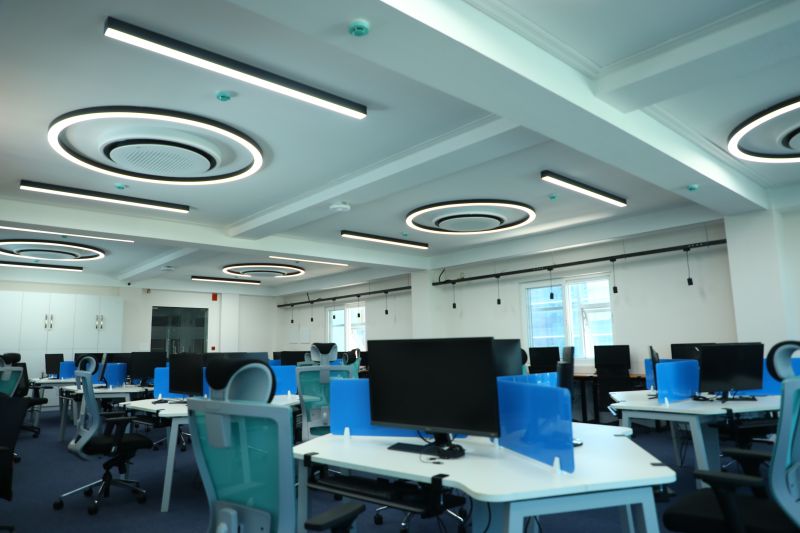
The room offers a useful change of scale from the CEO’s job description. These are desks where the promised engineering has to happen. The company’s employee accounts add further detail. DevOps engineer Shankar Arumugam describes working with Terraform, Kubernetes, and automated delivery pipelines. Ashwin Raj describes more than ten years at Sysvine and an emphasis on accountability among colleagues.
Linda Shiny’s account discusses a Career Growth Plan, leadership initiatives, and opportunities to speak openly. These are employees’ descriptions of their experience. Taken together, they show which parts of working life Sysvine chooses to foreground: technical learning, responsibility, and a route to greater capability.
That matters in a profile of its chief executive. A software services company sells work performed by people whose knowledge must keep changing. The tools in Arumugam’s account make that need concrete. The office lights may provide the joke; the learning behind the desks is the more consequential detail.
The captcha at the other door
MTCaptcha introduces another setting for Selvaraj’s leadership. The business names him as co-founder and CEO, alongside Huan Chen as co-founder and chief product officer, Katie Selvaraj as CFO, Yusuf Nathani as CTO, and Dilip Rajkumar as COO. Several colleagues recur across the two leadership teams.
The product addresses a familiar irritation: a website needs protection against bots, while a person wants to complete an ordinary task. MTCaptcha’s stated mission is to stop bots without penalizing legitimate visitors. Privacy, accessibility, and enterprise trust are explicit priorities in its description of the business.
A captcha is a small encounter with a larger engineering problem. The person using a site should not need to understand the machinery protecting it. The operator still needs that machinery to work. Security and usability meet at a point where impatience is entirely understandable.
Beside Sysvine’s broad engineering remit, this is a concentrated product problem. The two CEO roles therefore illuminate different scales of responsibility. One concerns an organization supporting many software projects. The other concerns a particular category of interaction on the web. The connection is useful precisely because the work takes different forms.
The work that continues after the launch
The current Sysvine product story includes CorpVine, an integrated performance management platform covering people, delivery, and corporate finance. Its documented functions connect employee records, skills, project work, and career planning. These are the administrative details on which a growing organization can spend an astonishing amount of time.
CorpVine’s career planning functions link roles with skills, learning targets, and assessments. Its delivery tools bring together projects, team members, timesheets, and work product commitments. The distinction between developing a person and delivering a project is visible in the product, along with the need to connect the two. It gives a practical counterpart to the career growth language in the employee accounts.
There is a familiar management difficulty here. An organization can have information everywhere and still struggle to assemble a useful picture. Skills sit in one place, project records in another, and financial questions arrive with their own vocabulary. CorpVine’s proposed answer is to connect those functions. For readers trying to understand the company Selvaraj runs, that is a more tangible object than a broad promise of business transformation.
The learning tools have names of their own: KnowVine for an enterprise knowledgebase, and CourseVine for courses. The product description includes scheduling classes, assigning instructors, recording attendance, and connecting learning with employee profiles. It is an unglamorous but recognizable chain of work. A person learns something; the organization needs a way to remember that capability and make it available to the next project. The product makes those connections explicit. For a business whose services depend on its engineers, knowing who can do what is a practical concern with consequences well beyond the training calendar.
Two dated releases bring the picture up to October 2026. On September 28, Sysvine announced asset management in CorpVine, including equipment, accessories, subscriptions, and licenses. On October 19, it announced project-level KPIs. These are company developments during Selvaraj’s leadership, rather than claims that he personally designed each feature.
The subjects are revealing in their ordinariness. Someone must know which assets exist. Someone must decide how a project is progressing. Someone must connect a colleague’s skills with the work ahead. A platform promises to put some order around those questions.
For Selvaraj, the professional record now holds research, engineering services, and product leadership in the same frame. The robot arm remains a useful opening image: a destination, surrounding obstacles, a workable route. The later work adds customers, colleagues, and businesses to the picture. There is considerably more to coordinate. One hopes the ceiling lights help.