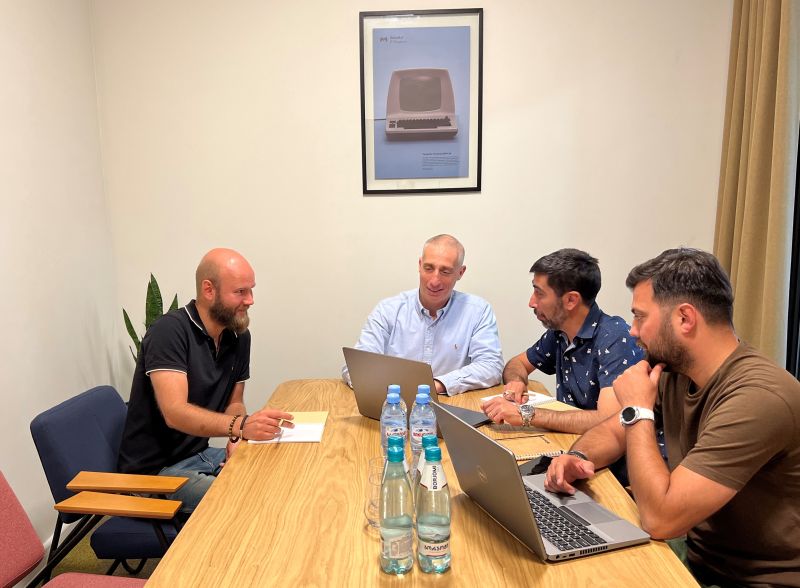
There is a framed computer on the wall and a decidedly unframed collection of laptops on the table. Eugene Goland sits with colleagues in Georgia, in a photograph shared during a business visit in 2022. Water bottles occupy the remaining real estate. It is an ordinary working scene, which makes it a useful place to begin a story about someone whose business depends on getting people to work together across considerable distances.
Goland co-founded DataArt in New York in 1997. He also helped found Mail.ru, the internet business that emerged from technology developed inside DataArt. One venture put an email service in front of the public. The other built software for clients. Goland’s continuing job has been with the latter, where the customer’s name often matters more than the supplier’s.
Follow his public remarks across the years and a particular preoccupation keeps returning: who knows the client, who understands the work, and whether those people trust each other enough to say what needs saying. For a software executive, he spends a conspicuous amount of time discussing the human beings around the software. The machines receive plenty of investment. They do not get all the credit.
A second business inside the first
The early chronology contains a small lesson in how technology businesses actually develop. DataArt came first, in 1997; Port.ru, the business behind Mail.ru, followed in 1998 as a spin-off. Goland’s fellow founders in that venture included Michael Zaitsev and Alexey Krivenkov. The two histories overlap, but their destinations diverged. Building an internet audience and building a dependable engineering organization became different undertakings.
It is tempting to make the email venture the whole story. A recognizable internet name is easier to put in a headline than a long relationship with a corporate technology department. Yet Goland’s sustained commitment has been to the less conspicuous activity: organizing the expertise that other companies need. The interesting question is how he kept that activity useful as both clients and technologies changed.
His education spans those two sides of the job. He earned a computer science bachelor’s degree at New York University and an MBA at the University of Maryland’s Robert H. Smith School of Business. His present responsibilities cover strategy and global management, alongside investor relationships, governance, finance, legal affairs and compliance. A founder’s working life can involve rather more reporting than the origin story suggests.
Learning the customer’s language
By the mid-2000s, Goland was talking about expertise as a business choice. DataArt had moved into financial services, where knowing how to write software was only part of the assignment. The client also had to believe the engineers understood the business the software would serve. Technical competence opened the conversation; industry knowledge helped make the conversation worth continuing.
In November 2005, he took that subject to an outsourcing forum at the Yale Club in New York. The discussion covered choosing vendors, managing relationships and handling risk. Goland addressed the differences between outsourcing for smaller businesses and for large enterprises, as well as financial-sector work. These are practical questions with long consequences. A poor choice of engineering partner can linger well beyond the introductory lunch.
Two years later, he joined the Global Knowledge Leadership Council of the Billion Minds Foundation. His professional interests were extending beyond individual contracts into the wider business of knowledge and learning. The pattern is recognizable: software delivery sits inside a larger web of institutions, relationships and expectations. Knowing the code does not automatically mean knowing how that web works.
“To this day, our biggest bets are on people.”
Eugene Goland, celebrating long-serving colleagues in 2021
The people who stayed
In 2021, Goland publicly thanked colleagues who had spent more than twenty years at DataArt. His list included Michael Zaitsev, Alexei Miller, Dmitry Bagrov and Julia Zavileyskaya, among others. He described enduring relationships inside the company and with clients as a priority over immediate gain. Twenty years is a useful unit here: long enough for several fashionable management vocabularies to arrive, prosper and quietly leave the building.
A colleague’s account of DataArt’s culture offered a more personal observation. Goland, it said, was prepared to extend trust before it had been earned through a long acquaintance, and to accept the disappointment when that trust was broken. That description gives some substance to a word that can become decorative in corporate life. Trust involves exposure. Otherwise it is simply a favorable reference.
There was also a collector’s detail in his account of an office visit in 2021. DataArt’s first development center, in St. Petersburg, housed an IT museum with more than 400 historical hardware exhibits. He noted that the building had once been an Ericsson factory. A business occupied with the next technical problem had made room for the machines that preceded it. The setting supplied a little perspective on the word “new.”
When the familiar map stopped working
Russia’s invasion of Ukraine in 2022 brought decisions that could not be resolved with a statement of corporate values alone. DataArt left Russia that June. For Goland, the departure meant breaking with the country that had housed its first development center and with some colleagues of two decades. He described the emotional difficulty while making clear that the company had decided to leave.
The operational obligations remained: employees, clients, contracts and knowledge that had to move with the work. In his account, the company received no payment for transferring the Russian entities and obligations. The exit required a practical disentangling of a business built over years. The resulting geography would have to support the people and projects that continued elsewhere.
By June 2022, DataArt had helped relocate approximately 1,300 staff to other markets. That same month, it announced a $75 million minority investment from FTV Capital, which had closed earlier in the year. Goland emphasized the investor’s industry experience and connections. FTV’s Richard Liu joined the board. For a founder responsible for investor relationships, the useful partner brought access and judgment along with money.
Goland’s year-end reflection credited the administrative teams that organized support and relocation, and the Ukrainian colleagues who continued delivering work. The distribution of credit matters. A corporate survival story easily collapses into one executive’s decision. His account kept returning to the people who performed the many smaller tasks on which that decision depended.
India begins with an acquaintance
When DataArt expanded into India, Goland described two forces coming together: a strategic reason to enter a major technology labor market and an acquaintance with Sheetal Kale, who could help the company understand it. Some clients also wanted work delivered from India. The expansion was commercial, but its practical opening came through a person who knew the terrain.
By June 2023, he was discussing a company facing weaker demand after rapid growth. He argued that the slower period offered time to improve skills and prepare for different opportunities. Becoming more global would also require changes in account management, compliance, reporting and governance. Geography alone would not do the work. A new office still needed an organization capable of listening to it.
Different measures, different moments. These figures are not a revenue growth series.
A machine still needs an experienced reader
In June 2025, DataArt announced a $100 million commitment to data and AI capabilities. Goland’s accompanying explanation put reliable data near the beginning of the work. It also described training, new qualifications, tools and deeper technology partnerships. The proposed spending covered three years. It was a plan to develop capability, with all the organizational effort that word conceals.
The company then supplied a revealing small experiment. Sixteen participants tried to build a web messenger using AI tools without manually writing code. Two completed the task, both experienced programmers. The result appeared in DataArt’s March 2026 account of its internal AI adoption. It is a compact illustration of why producing code and evaluating code require different kinds of knowledge.
Other internal experiments brought reported improvements: faster reviews of training assignments and shorter searches through a large collection of sales documents. DataArt used the lessons to develop Artisyn, its AI-enabled delivery model. The figures belong to particular company exercises, rather than a promise for every project. Their interest lies in the mundane work being examined: finding information, reviewing submissions, establishing rules that teams can reuse.
2 of 16 participants finished. Both were experienced programmers. Task: build a web messenger with AI tools and no manual coding.
Back around the table
During a visit to Yerevan discussed in June 2026, Goland returned to familiar concerns: meetings with staff, industry expertise, relationships with technology partners and the pace at which organizations adopt AI. He expressed optimism about freeing people for creative work, alongside concern about irresponsible use. His view of technical progress retained a place for human judgment and the institutions that have to accommodate it.
The Georgia photograph offers a fitting image to keep in mind. Four people, several screens, a conversation that requires everyone to show up. Across Goland’s ventures and decisions, the recurring work has involved making those encounters productive: finding colleagues, learning a market, choosing a partner, carrying a team through a rupture. The tools on the table keep changing. Someone still has to understand the people sitting around it.
Continue the conversation
- DataArt biography
- Eugene Goland on LinkedIn
- The India interview
- The Yerevan interview
- The $100m strategy, by Eugene Goland
- Inside the Client Zero experiments
- FTV Capital investment announcement
- Long-serving colleagues
- The Georgia visit photograph
- The 2022 departure interview
- The early financial-services strategy
- The 2005 Yale Club forum
- Billion Minds Foundation appointment
- DataArt’s 2019 DEG investment announcement
- DataArt company profile