Seven days is a small interval on a company timeline. It feels rather longer when it is the distance between payday and the day salaries actually arrive. In the early quarters of Solution Analysts, delayed client payments left founder Kalpesh Patel short of cash. His team’s pay was a week late. Years later, when he described the episode, he remembered the discomfort of spending time in the office.
There is an uncomfortable precision to that memory. A business can promise automation, efficiency and better processes, then discover that its own survival depends on something less programmable: people willing to give it time. Patel recalled that his employees stood by him. He treated their confidence as part of the company’s subsequent growth.
That makes a useful starting point for a founder whose work stretches from enterprise applications to mobile software and industrial technology. The interesting question is how a person who builds systems learns to hold a company together. Patel’s answer keeps returning to the people who stay.
An engineer before the corner office
Patel founded Solution Analysts in Ahmedabad in 2011, after roughly a decade in technology. He came to entrepreneurship with a working knowledge of business applications, rather than a sudden discovery that businesses might need them. His earlier work included developing applications with Morgan Stanley’s globally distributed Investment Management IT team. Before starting his company, he led an Alfresco practice in India.
Alfresco and Liferay, the content-management platforms associated with his early career, offer a clue to his professional formation. This is software concerned with the everyday machinery of an organization: information, access, documents and the work that connects them. The problems are practical. So are the consequences when the machinery behaves badly.
He also trained other professionals in those platforms. Teaching belongs alongside architecture in his public professional biography, an important pairing for someone who would later spend his days directing technical teams. Knowing how a system works and helping another person understand it are related skills, though anyone who has attended a baffling software demonstration knows they do not always travel together.
His stated purpose in starting Solution Analysts was to automate clients’ business processes and make them more convenient. That purpose could accommodate a mobile application, a website or an enterprise system. It gave the company a problem to pursue as the available technologies changed.
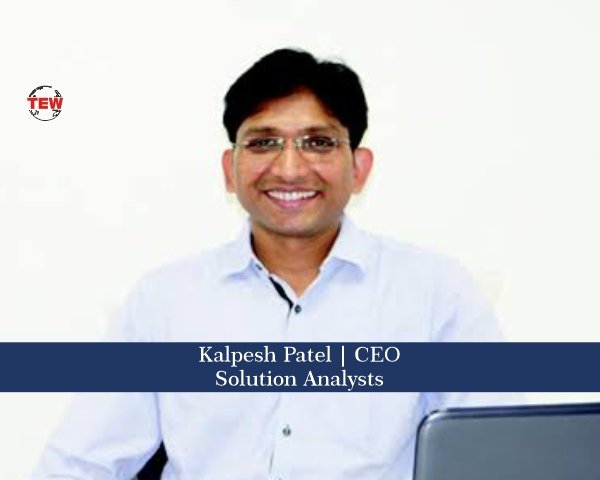
The people who stayed
By 2020, Patel was describing a business offering web development, enterprise mobility and Internet of Things applications, with solutions in areas including video conferencing, digital wallets and learning management. The company’s range had expanded. His account of its early difficulties remained refreshingly specific: clients paid late, and employees could not be paid on time.
He linked a successful business to integrity, honesty, communication and meeting deadlines. These are ordinary words with expensive consequences. A missed deadline can move a client’s launch. A delayed invoice can move somebody else’s salary. His early experience gives those principles a practical setting.
In a later interview published in July 2022, Patel said his first customer and first employee were still associated with the business. That is a historical claim, rather than a promise about every year since. It nevertheless shows what he chose to count. Asked about progress, he could reach for the original relationships as readily as for the expanding project list.
He has used the phrase “SA Family” for the workforce. Such language earns its meaning through daily behavior. In Patel’s telling, the formative example was a moment when the company needed patience from its own staff. The memory places an obligation on the founder as well as expressing gratitude to the team.
“employees are real assets for any company”
Kalpesh Patel
What the contract says about the founder
There is a less sentimental way to examine Patel’s approach: look at how he explained charging for work. His earlier account distinguished fixed-price contracts, time-and-material arrangements and dedicated teams. The choice depended on how clearly a customer understood the requirements and how much control the customer wanted during development.
When the scope was settled, a fixed price could make sense. When requirements were still evolving, time and materials allowed room for discovery. Sometimes a project began with paid exploration before moving to a fixed-cost implementation. That is an engineer’s concession to a familiar business problem: a confident estimate is much easier to produce after someone has established what is being estimated.
He also described checking a repository of reusable components before preparing the final costing. Work already done could shorten the next development cycle. A company accumulates useful knowledge through projects; making that knowledge usable again gives experience an operational value.
A guide to his described contracting approach, not a current price list.
The same practical concern appeared in his discussion of selecting an app platform. His team considered the client’s business model, intended audience and geography. A software decision begins well before the first screen is drawn. Patel’s account leaves room for that less photogenic work, which is useful: a beautiful interface cannot rescue a product built for the wrong circumstances.
Cricket has room for one more player
Ask about the early business and Patel’s wife enters the story. He credited her with handling administration so he could concentrate on project execution. He also said her efforts helped preserve social relationships while the new company occupied much of his time. Entrepreneurship, in this account, involved work that did not all appear under the founder’s job title.
He acknowledged that he spent less time at home during the initial years. Later, he described finding a better balance. The detail matters because it gives the founding story a second set of responsibilities. Running projects was visible company work. Keeping administration moving and relationships intact made that work possible.
His father was the person he named as his biggest motivator. Patel said his father’s life lessons continued to guide him. He also admired qualities in other people, including courage, an inventive approach and leadership. The family connection came first in his answer.
Then there is cricket. Patel listed playing it, watching films and reading self-help books among his interests. When he played cricket with his team, he liked his son to join as a player. It is a small, appealing detail: the child gets a place in the game. Even a founder’s calendar can occasionally accommodate something with no delivery milestone.
Automation acquires several addresses
Over time, Patel’s work extended beyond the original services company. TaskOPad identifies him as its co-founder and chief technology officer. Its focus on task and workflow management sits comfortably beside the operational problems that have followed him through his career. The company’s biography also identifies him as a founder of ContCentric.
In the interview published in 2022, he discussed Rejig Digital as a group focused on industrial Internet of Things solutions, an initiative announced at Solution Analysts’ tenth annual day. It represented a more specific setting for the familiar automation objective: industrial operations and connected equipment.
That interview also gave a detailed account of how work moved through Solution Analysts. Information gathering came first, followed by business analysis and a visualization of the proposed solution. Where requirements needed more exploration, a discovery workshop brought technical, business and design perspectives together. Client approval preceded execution.
The sequence is revealing about his preferred way of managing uncertainty. A client’s initial idea becomes something people can inspect and discuss before the team commits to building it. Training, analysis and delivery occupy different parts of the same professional life. Patel’s role has repeatedly involved translating between them.
The next problem is more specific
His public writing in 2025 and early 2026 shows where his attention has moved. Industrial connectivity and manufacturing transformation appeared among his 2025 topics. By February 2026, he was writing about OneStream architecture and the case for specialization in IT services.
The titles are pointed. One February piece questions real-time integration as a goal for OneStream architects. Another considers why growth in IT services needs a different approach. A third examines design decisions that can create trouble after an apparently successful implementation. These are topics about what happens when software must keep working beyond its first delivery.
Industrial connectivity
OneStream architecture
Specialization in IT services
The progression suggests a continued interest in the consequences of technical choices. Earlier interviews concerned mobile platforms, contract structures and the way teams learned new tools. The newer titles narrow the discussion to enterprise architecture and the shape of the services business itself. The question of usefulness persists as the vocabulary changes.
Patel has described his ambitions through automation, client convenience, mentoring and opportunities for the team. Those aims connect the software architect, the trainer and the founder. They also leave plenty of work to do. A company’s processes can be refined; its people still need time, attention and reasons to stay.
Return to that first delayed payroll. In a career full of applications and platforms, it remains a strikingly human measure of the business. Patel remembered a week when he could not meet an obligation and the people around him gave him room to recover. Years later, he was still talking about the first employee and the first customer. Some of the most consequential things a founder builds are relationships that make another year possible.
Follow the work
Profiles, conversations and company projects.
- Kalpesh Patel on LinkedIn
- Personal profile and links
- Personal Facebook profile
- Solution Analysts
- TaskOPad and its founders
- The 2020 business conversation
- On family, cricket and entrepreneurship
- On development and company culture
- The early company story
- Watch Patel discuss team collaboration
- Solution Analysts on YouTube