Prerak Parikh had been offered an opportunity to sound more ambitious. During a February 2024 investor call, the question was straightforward: why couldn’t Sigma Solve grow faster? For a small technology business, surely there was room to raise the target. Parikh’s answer concerned the machinery behind the number. He wanted a clearer view of how the company would execute before making a larger commitment.
He cautioned against making a commitment that the business could fail to meet. In a business conversation, that is a modest position with an expensive implication. A promise made in a few seconds can occupy engineers, salespeople and customers for months. Someone eventually has to make the calendar agree with the presentation.
Parikh is now the CEO and co-founder of Sigma Solve Inc. His earlier title was chief technology officer. That progression gives the exchange its interest. The person discussing what the business might become had also been responsible for exploring the technologies that could help it get there. The distance between possibility and delivery was familiar professional territory.
“I don't want to over commit and under deliver.”
Prerak Parikh · February 2024
A developer’s paper trail
There is a pleasantly specific detail in Parikh’s professional record: a nopCommerce developer certification dated July 30, 2017. The listing associates him with Sigma Solve in the United States. Among the broad descriptions that collect around an executive, this one has the welcome dimensions of an actual task. A platform, a technical assessment, a date.
Certification is a small window into a career. It cannot tell us how someone handles a difficult customer or an awkward meeting. It does establish a connection to the work beneath an online storefront. Commerce software must accommodate rules, transactions and the inconvenient habits of people using it. An attractive page is only the beginning of the assignment.
The company’s current leadership biography describes a computer science background at Florida Atlantic University and advanced machine learning study at MIT. It also assigns Parikh a continuing responsibility for investigating and implementing emerging technology. The CEO title has therefore arrived with a technical brief still attached.
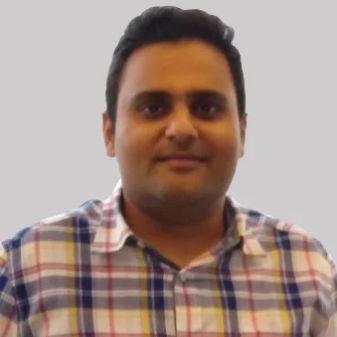
Parikh in a portrait published by The Org. The software work extends beyond the executive title.
In March 2022, he spoke as Sigma Solve’s co-founder and CTO when the company announced a partnership with Liferay. His explanation emphasized the open-source platform as a foundation for a business’s digital presence. The partnership added Liferay’s digital experience platform to the company’s services, connecting an engineering choice with a commercial offering.
That is a useful early view of his role. Selecting technology involves judgment about what a customer will need to build around it. The platform becomes part of a longer relationship: integration, adaptation, maintenance, another request. A technology decision has a social life after the announcement. It travels through the organization that has to use it.
A business across time zones
At the start of a December 2023 management discussion, Parikh noted that he was in the United States and it was early for him. It was a small, unpolished introduction to a business organized across geography. The time difference had entered the conversation before the operating model did.
He described US-based founders working with an Ahmedabad development center, with roughly 250 employees across the US and India at that time. The company also had an Australian presence. His argument for this arrangement emphasized proximity to customers alongside access to engineering delivery. The founders’ presence in the American market was part of the service they were selling.
Geography can look tidy on a company slide. In practice, every location introduces another set of conversations to coordinate. A customer must explain the problem. An engineer must understand enough of the operation to build a useful answer. Leadership has to keep those understandings connected. The map is the easy illustration; the handoffs are the work.
customer relationships
engineering delivery
Parikh’s ambition in that discussion was to reach $30 million in annual revenue over four to five years. That was a goal stated in 2023. Its usefulness in understanding him lies in the connection he drew between expansion, industry knowledge and the ability to deliver. Ambition had a proposed operating structure beneath it.
The customer’s seat at the table
There is another way to examine that structure: follow someone who has sat on both sides of it. Ian Grunes, now identified by Sigma Solve as its chief operating officer, publicly recalled hiring the business eight years before joining its next phase. His account gives the leadership team a connection that predates the job title.
Grunes’s description was affectionate and rather less ceremonial than a standard executive announcement. He said the company had repeatedly helped him out of difficulty. The joke carried a business point. A service relationship had lasted long enough to become a reason to join the organization providing it.
A former customer brings a particular kind of memory into a company. They have experienced the sales conversation as a buyer. They know how delivery feels from the receiving end, where the technical vocabulary matters less than whether the work arrives and makes sense. That perspective can follow them into every internal discussion about what the company should promise.
The current leadership team places Grunes alongside Parikh, co-founder and CFO Biren Zaverchand, and engineering leader Nitin Sant. The combination puts commercial, operational and technical responsibilities within the same group. Parikh’s role sits among those responsibilities, where decisions about new technology meet questions about people, cost and execution.
An investor puts the software to work
By August 2025, another connection supplied a concrete example of Parikh’s interest in AI. Testaify identified him as an investor who had become a customer of its autonomous testing platform. The announcement concerned opening access beyond an initial waitlist. His relationship to the product combined a financial interest with a place in the workflow.
The use case was software quality. Testaify described a platform intended to discover applications, generate tests and report findings. Parikh’s accompanying comments concerned using AI to improve testing while delivering enterprise development services. This was a particular job for the technology, with a particular team expected to use it.
Investment and adoption ask different questions. An investor considers what a business could become. A customer has to decide whether a product belongs in the working day. Bringing those positions together creates a useful point of scrutiny: belief in the company must coexist with the practical experience of using its software.
Testing is an apt setting for that encounter. Software demonstrations usually show what happens when everything goes well. Testing introduces the awkward inputs and unexpected sequences that users eventually supply for free. The exercise has little patience for a persuasive slide. It asks the program to do the work again, under less agreeable circumstances.
A logo with instructions
Parikh’s explanation of Sigma Solve’s refreshed identity offers a more visual account of the same priorities. He described the summation symbol as bringing together engineering, data, design and domain understanding. An arrow represented forward movement. The S represented solving the business problem. It was a compact diagram of how he wanted the organization understood.
He linked the change to increasingly complex enterprise engagements and to a disciplined approach to building and delivery. A logo refresh can be an occasion for adjectives. His account spent its attention on process: how different kinds of expertise combine, how work moves forward and what the result is supposed to accomplish.
The symbolism is almost endearingly instructional. The arrow has somewhere to go. The parts are expected to add up. Even the letter at the end receives an assignment. For an organization selling help with complicated systems, there is something appropriate about making the brand explain its working.
The company behind the promise
On June 30, 2025, Parikh was appointed an additional director of Sigma Solve Limited, the Indian listed company. The appointment placed another formal responsibility alongside his leadership of the US business. The accompanying biography emphasized application development, automation, AI and data analytics. It also recorded his relationship to promoter Prakash Parikh, his father.
The corporate relationship matters. Sigma Solve Inc. is a wholly owned subsidiary of Sigma Solve Limited. An account of Parikh’s career therefore runs through related organizations with different responsibilities. His board appointment brought the US operating perspective into the Indian company’s formal governance.
The business has also acquired a recurring place on the Inc. 5000. Its current profile lists appearances in every year from 2021 through 2026, with a 2026 rank of 4,062 and 58 percent growth over three years. Parikh is named under leadership. Those are company results and recognition, shared with the people doing the work.
Six consecutive Inc. 5000 appearances for Sigma Solve.
2026: No. 4,062 · 58% three-year growth
The varying ranks resist a perfectly ascending storyline. Business careers are easier to package when every number obligingly rises. Here, the record is more useful as evidence of continued participation and growth than as an excuse for a victory march. A list position describes one measure; the organization still has customers to serve the following morning.
Today, Sigma Solve describes its work in terms of modernizing software, data and operations without interrupting the business using them. That last condition gives the assignment its difficulty. Replacing a system is one problem. Replacing it while people keep taking orders, moving goods and making decisions introduces a second, rather insistent customer: the ordinary working day.
That is where Parikh’s story returns to the promise. The developer certification, the platform partnership, the international operating model and the testing investment all involve making a technical choice answerable to use. In his account of AI, the customer’s freight load remains a practical test of value. The system has to help the customer get the job done. Eventually, the software has to work, and the company has to deliver what it said it would.