A company can redraw its reporting lines in an afternoon. Finding out whether the new arrangement can actually do the work is a larger assignment. Somebody has to reconcile the payroll, count the vacancies, identify the skills and calculate what happens when a team moves. Orgvue has built a software business around that awkward interval between the executive sketch and the working organization.
The London company gives HR, finance and transformation teams a place to assemble workforce data and test alternatives. A proposed structure can be examined for headcount, cost and capability before anyone implements it. The appeal is practical: decisions about thousands of people deserve more scrutiny than a handsome slide.
The chart acquires a memory
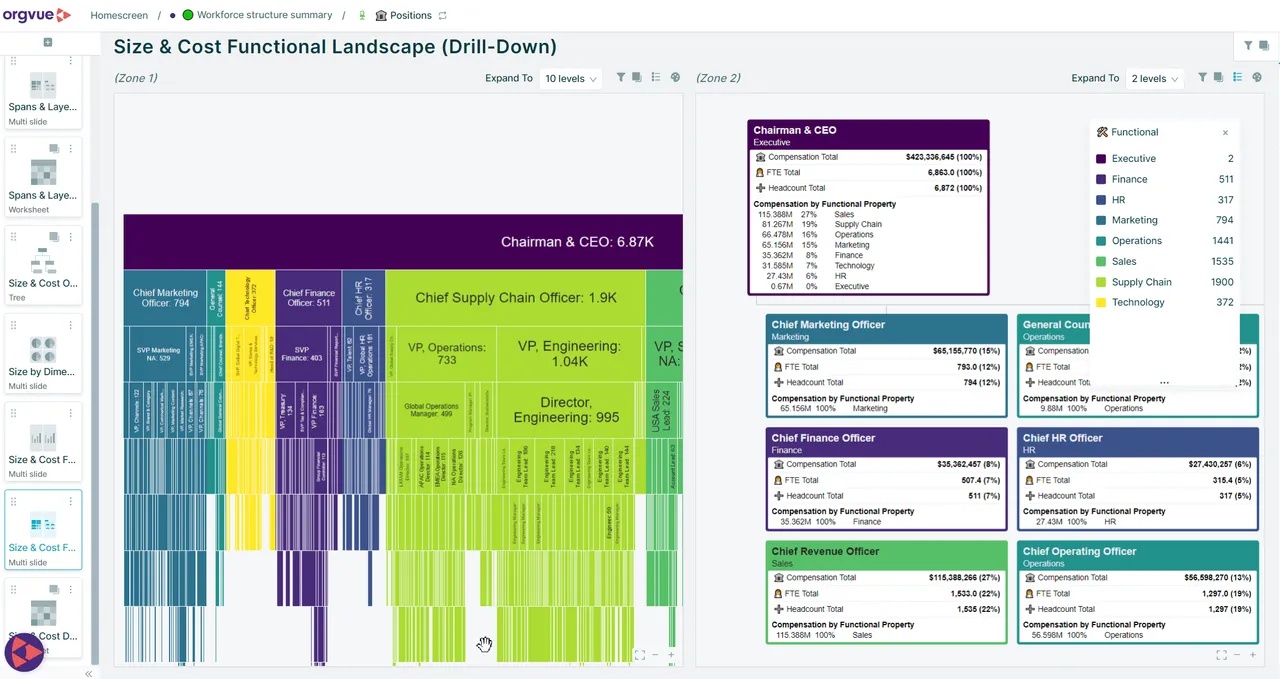
Orgvue combines information about people, roles, positions, activities and costs. Its platform supports organizational analysis, scenario modeling, workforce planning and monitoring. Users can compare the organization they have with the one their strategy requires, then keep checking the approved plan against reality. It occupies the space where personnel records meet decisions about the shape of a business.
One small distinction explains much of the product: a person and a position are separate records. An employee can leave while the role remains. A future position can exist in a plan before recruitment begins. Keeping those things separate allows vacancies, new roles and staff movements to remain visible, instead of disappearing into a headcount total.
That distinction becomes useful when managers ask whether a department can absorb more work, whether a merger creates duplicate roles, or whether growth requires different skills. A reporting line answers who has a boss. A workforce model can connect that line to the resources and work underneath it.
Danone wanted fewer big reorganizations
Danone offers a revealing example. After successive large restructures, the food and beverage company wanted a continuous approach to organizational development. Its ambition was to reduce the need for expensive, reactive transformation projects. That experience changed the question from how to execute the next restructure to how to avoid depending on one.
“Our aspiration is for Danone to end its company-wide transformation approach.”
Vincent Favre, Global Organizational Development Director, Danone
In Orgvue’s published case, Danone shortened its planning cycle from annual to quarterly. It combined 30 data sources across 16 regions, 11 functions and three business units. The work included simplifying data properties and improving the calculations linking employees to positions. Daily refreshes helped maintain the resulting picture. Data housekeeping, it turns out, can be a strategic activity.
Orgvue’s HR materials report that Danone halved modeling time and trained 171 HR directors and business partners to monitor progress. The pair subsequently won Best Use of Technology in Transformation at the 2025 Management Today Transformation Awards. The award announcement describes a three-month organizational redesign. These are reported customer outcomes, with processes and trained users behind them.
The $90 million number needs its context
Another case concerns an unnamed West Monroe client undertaking a $600 million technology transformation. Its workforce had doubled in two years as development needs and uncertainty increased. The company needed to understand what operating a platform across cloud and on-premises environments would mean for its organization.
West Monroe established an employee and contingent-worker baseline and used Orgvue to manage nearly $320 million in annual labor costs over eight months. The published case describes organizational and operational changes producing an estimated $90 million in annual savings, or nearly 30% of people spending. That is a reported savings estimate for the client’s redesign, not the price of Orgvue or proof that software alone produced the result.
The consultancy also assessed competencies across more than 35 roles. That made skills gaps part of the conversation about reskilling, hiring, automation and external labor. The useful sequence was to establish what work the organization needed, examine its resources, then model the changes. Starting with a savings target alone would leave much of that argument unfinished.
The first thing to give way was the spreadsheet process
In a separate technology-company case, Orgvue describes talent planning that had depended on outdated spreadsheets. The customer trained 25 internal experts and enabled 200 direct users with different access levels. It established approval workflows and connected the planning environment to six other systems, with updates pushed every two hours.
The scale explains the problem: 10,000 positions and 151,000 data changes in 60 days. Business-led headcount planning and HR-led talent transitions ran alongside each other. A spreadsheet can hold rows; coordinating permissions, approvals and changes across teams is a different burden. Here, the reported weakness was the planning process around the data.
A government customer illustrates another starting point. Its position-level plans were too short-term for the digital capabilities it needed. Within four months, according to Orgvue, it had a process forecasting workforce supply and demand more than five years ahead. The team organized its analysis around job families, employment types and business units, then modeled attrition and future hiring needs.
- 01Establish todayPeople · positions · costs
- 02Test tomorrowDemand · skills · scenarios
- 03Check the changeActuals · gaps · revisions
An enterprise purchase, with people attached
Orgvue sells subscriptions and professional services. Its published commercial terms say subscription fees are invoiced annually in advance, while professional services are generally invoiced monthly in arrears. The sales route begins with a conversation and a tailored demonstration. This is a scoped enterprise purchase, with implementation and adoption work around the license.
There is a public price clue. Orgvue’s UK G-Cloud 14 software listing gives a range of £65,000 to £9,999,999 “a unit.” Its separate services listing quotes £1,450 to £2,550 a unit per day. Those are procurement-framework ranges, not a universal annual subscription or a typical project bill. Scope, services and the buyer’s agreement determine what a particular deployment costs.
The internal bill also deserves attention: cleaning records, agreeing definitions, training users and assigning ownership. The customer cases make those activities visible. For a small organization with straightforward reporting lines and infrequent change, the coordination overhead may outweigh the benefit. The stronger fit is an organization where complexity already consumes substantial planning effort.
Consulting firms extend the business. Orgvue lists Deloitte, Accenture and Korn Ferry among its partners; West Monroe’s case shows the delivery work involved. Partners can purchase an environment for a defined project duration and workforce population, refer opportunities, or resell access. The software can therefore arrive with the people helping a client redesign its operations.
A consultant’s problem becomes a software company
Founder Rupert Morrison’s background helps explain that arrangement. A 2019 analyst history traces seven A.T. Kearney consultants joining Concentra in 2008 and a management buyout led by Morrison in 2012. Orgvue’s origins sit in the practical business of understanding organizations, rather than merely drawing them.
In May 2018, the company announced £41 million in growth equity led by One Peak Partners, with Morgan Stanley Expansion Capital and other investors participating. The stated purpose was international expansion and product development. Oliver Shaw became CEO in January 2023; Morrison is identified on the company’s podcast page as founder and deputy chair.
Orgvue now describes a team of more than 250 employees. Its stated workplace offer includes hybrid arrangements, flexible scheduling, feedback and internal mobility. Named customer examples include Aviva, TVH and the European Broadcasting Union, alongside Danone. The expertise it sells combines organizational design, data analysis and the less glamorous discipline of helping people use the resulting system.

AI gets a job in the preparation room
In December 2025, Orgvue announced Henshaw Roles and Henshaw Assistant through an early access program. The capabilities use AI to accelerate organizational data analysis. Roles addresses role clustering; Assistant supports insight and analysis. The name nods to George Holt Henshaw, whom Orgvue credits with drafting the first organizational chart. Even enterprise software has its historical fandoms.
The practical attraction is reducing time spent sorting inconsistent organizational information. Orgvue’s current AI page reports 76,000 Salesforce positions mapped into role architecture in hours. That is a company-published example, not a promised completion time for every buyer. Human review still matters: a plausible grouping does not establish that two jobs require the same judgment or experience.
External reality enters through Lightcast. Announced in March 2025, that partnership brings labor-market intelligence and taxonomies into Orgvue, allowing internal roles to be considered alongside skills availability, compensation and hiring demand. A plan to recruit scarce talent becomes more useful when the model acknowledges the market outside the building.
In August 2026, Orgvue announced ISO/IEC 42001:2023 certification for its AI management system. Its explanation emphasizes governance, review and human oversight. Meanwhile, its March research reported that 32% of surveyed organizations making redundancies on AI’s cost-saving promise had subsequently rehired staff. The finding concerns that surveyed group, not all employers; it reinforces the company’s argument for examining work before removing capacity.
The useful habit is checking again
Orgvue operates among overlapping alternatives: people analytics tools, organization-chart products and broader planning systems. Visier, Ingentis, ChartHop, Anaplan and Workday Adaptive Planning can enter different buying conversations. Orgvue’s particular emphasis is joining organizational design to workforce planning and then tracking the resulting decisions. The comparison should follow the buyer’s task, rather than a single feature checklist.
The habit readers can copy is concrete. Establish a shared baseline, separate positions from people, make the demand assumptions explicit, compare alternatives and assign responsibility for checking the chosen plan. Orgvue’s monitoring tools compare actual headcount and cost with planned numbers, so deviations can prompt a revision instead of waiting for the next overhaul.
That discipline depends on usable data, participation from HR and finance, and leaders prepared to reconsider assumptions. Orgvue’s own change-management guidance stresses stakeholder involvement, communication and the danger of losing expertise when project leaders leave. A model cannot supply those commitments. It can make the trade-offs visible enough that the next conversation starts with something better than a fresh set of boxes.