There is a small but consequential difference between a company saying it has paid you and your bank balance agreeing. For an employee, that difference is measured in rent, groceries, and an increasingly tense refresh of a banking app. For a multinational employer, it can disappear between payroll software, a local provider, and a bank. Papaya Global has made that unglamorous interval its business.
- Payroll, employment services, and international payments in one platform.
- An acquisition brought regulated money movement inside the business.
- The useful question: when does the worker actually receive the money?
The company sells software and services to finance, payroll, and HR teams managing people across borders. Its pitch joins two activities employers often buy separately: working out what each person is owed and delivering it. The attraction is fairly plain. A beautifully reconciled spreadsheet has limited entertainment value when somebody’s salary is late.
The spreadsheet was only the beginning
Eynat Guez founded Papaya with Ruben Drong and Ofer Herman in 2016. Her experience came from international workforce operations and relocation, where employing someone abroad meant navigating unfamiliar rules and a procession of specialists. The founders built a shared platform for that fragmented work. Country expertise would still matter; employers would get a more coherent way to manage it.

Consider SentinelOne. In Papaya’s published customer account, the cybersecurity business had grown beyond 2,000 employees across 33 countries, while payroll still depended on Excel files and repeated manual updates. A bonus or address change created another opportunity to copy something incorrectly. Growth was adding administrative uncertainty alongside headcount.
Papaya brought the information into one platform and connected the workflow to local payroll partners. SentinelOne also integrated NetSuite and Expensify, reducing manual handling of journal entries and expense information. These are the small, repetitive transfers of information that rarely make a product launch exciting. They make a payroll specialist’s month considerably easier.
“Now we work with one tool and one set of data.”Roman Becka, payroll specialist at SentinelOne, in Papaya’s customer account
The deadline changed the business
Then came the harder handoff: moving money. In a January 2026 interview, Guez described how Papaya initially worked with payment providers, only to encounter a mismatch over timing. Payroll is judged by its arrival date. A transfer instruction alone does not complete the job. That distinction pushed the company toward operating more of the payments process itself.
In March 2022, Papaya announced its acquisition of Azimo, the international money-transfer business. The purchase brought payments technology, staff, and regulatory permissions into the group. Its reported $150 million to $200 million price was substantial; the parties did not disclose an official figure. Papaya’s September 2021 funding round had raised $250 million at a $3.7 billion valuation. That valuation belongs to that round.
- 01Collect
workforce data - 02Calculate
local payroll - 03Approve
and fund - 04Money
arrives
The last step is the employee’s first concern.
Buying Azimo also meant taking on the obligations of a regulated payments operation. Guez later acknowledged that the regulatory complexity exceeded what she had anticipated. This was a change in what the company had to know how to do, as well as what it could sell.
One platform, several kinds of work
The product range reflects the different ways companies employ people. Managed global payroll serves workers on a customer’s own entities. Employer of Record services arrange local employment through an employing organization. Contractor management handles onboarding, documents, invoices, and payouts. These arrangements carry different responsibilities; a buyer needs the appropriate service for each workforce.
Workforce OS brings payroll operations and workforce information together. Contingent OS, announced in May 2025, addresses external workers such as freelancers and consultants. Payments tools connect the operational records to disbursement. Local payroll knowledge remains part of delivery: standardizing the workflow does not make every country’s employment rules identical.
Papaya’s expertise therefore sits across software, local employment services, and money movement. Its payments arm is Azimo; banking relationships include J.P. Morgan and Citi. Its integration ecosystem includes Workday, Oracle, and NetSuite. In practical terms, the platform must connect to systems employers already use and to the financial infrastructure that gets funds to recipients.
The human side remains visible in the company’s own hiring materials. Papaya describes a culture of autonomy, diversity, teamwork, and experimentation, with learning support and a published leave policy. Those are employer statements. They also reflect the mix of disciplines the product requires: payroll specialists, compliance staff, engineers, and payment operations people have to make the same monthly process work.
The price of fewer handoffs
The business model combines recurring software and managed-service charges with payments services. The published Payroll Plus starting price is $29 per employee per month. At that starting rate, 500 employees imply $14,500 monthly before any additional charges. It is arithmetic, not a customer quote. Countries, employment arrangements, payment needs, and the agreed scope determine the actual purchase.
Payroll Plus. A starting price, not an all-inclusive employment cost.
Alternatives include established payroll providers such as ADP and employment platforms such as Deel and Remote. Papaya’s distinguishing bet is the connection between payroll operations and regulated workforce payments. Buyers should compare that connection against their own problem: consolidating country providers, employing abroad, paying contractors, or improving financial visibility. Those are related purchasing decisions, with different requirements.
A useful evaluation would follow a single worker through a complete cycle. Ask how a salary change enters the system, who approves it, how exceptions reach a specialist, and where a payment can be tracked. Then repeat the exercise for a contractor and a worker hired through an Employer of Record. A polished dashboard is easier to assess when it has to explain a real sequence of decisions. The demonstration should match the countries and arrangements a buyer actually operates.
The next handoff is a question
In June 2026, Papaya launched ONE, a compliance intelligence product designed to work with a company’s policies, employment templates, collective bargaining agreements, and payroll data. The launch described coverage across 95 countries and all 50 US states, with free access and no contract required. In September, a partnership with Infinity Payroll Group added advisory and deployment expertise around it.
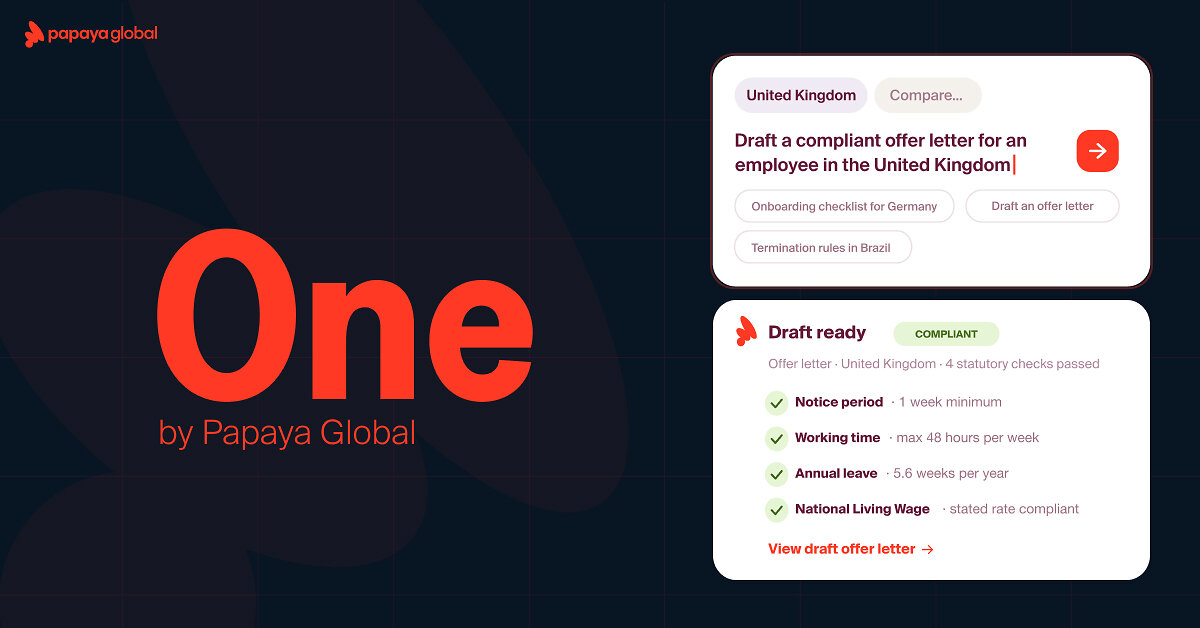
The lesson a reader can borrow is to follow an operation all the way to the recipient. Map each handoff, identify who owns it, and measure completion where the customer experiences it. A multinational with scattered payroll processes has a reason to investigate Papaya. A domestic business with simple payroll may have little need for this much infrastructure. The test is pleasantly concrete: did the right amount arrive on the right day?