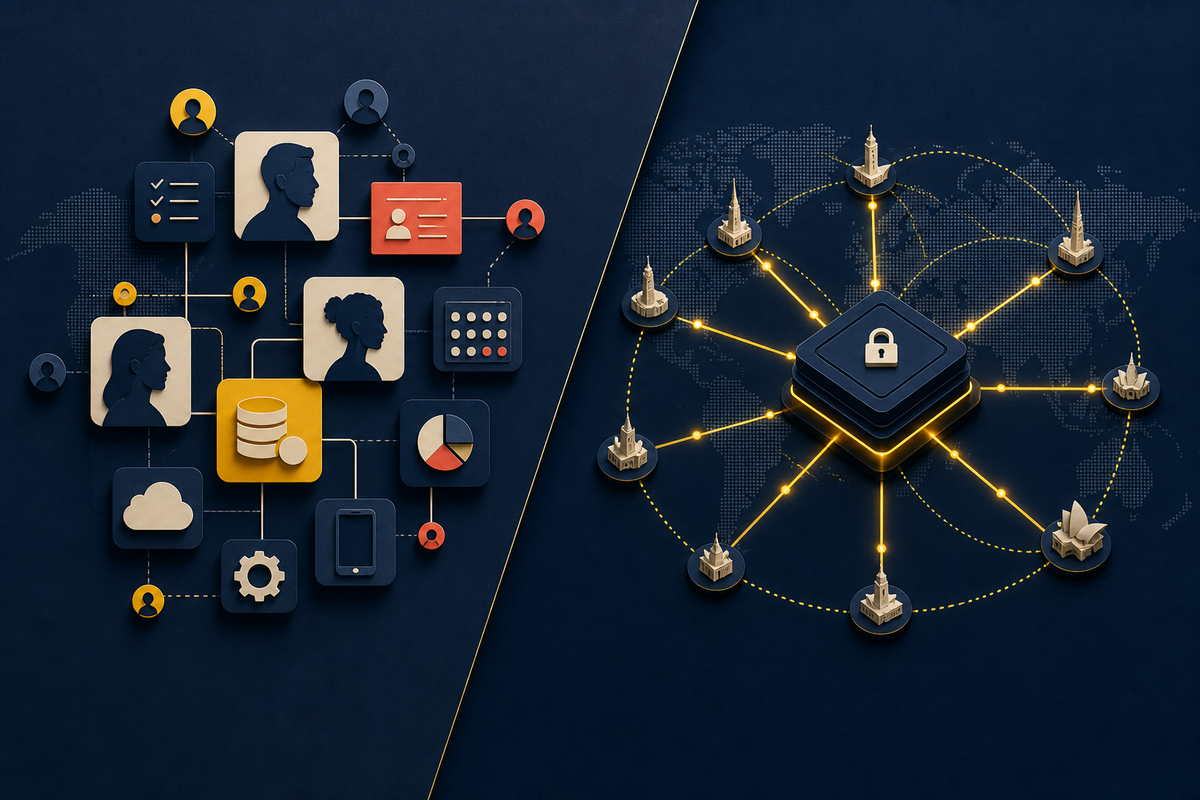
A payroll demo usually ends at the green check mark. The file is approved. The dashboard is tidy. Somewhere beyond the screen, however, the difficult part begins: bank cutoffs, foreign exchange, local tax authorities, beneficiary data and the small matter of getting the correct amount into thousands of accounts on time. Deel and Papaya Global both sell relief from this complexity. Their disagreement is about where relief should start.
Deel has spent the past few years pushing outward. What began around contractors, compliant global hiring and employer-of-record services now reaches into HR records, recruiting, performance, learning, compensation, benefits, immigration, workforce planning, devices and access. Its pitch is increasingly familiar to buyers of large software suites: one worker record, fewer vendors and fewer seams between hiring, managing and paying people.
Papaya Global offers overlapping services, including global payroll, EOR and contractor management. Yet its most distinctive claim points downward, toward infrastructure. The company bought cross-border payments business Azimo in 2022, obtained payments capabilities and built bank relationships designed to carry payroll funds. Papaya describes the result as a regulated payment network that sits close to local rails and connects calculation, funding, delivery and reconciliation.
The useful comparison is therefore not a row of check marks. It is a choice between two operating models. Do you want the payroll provider to absorb more of your HR stack? Or do you want it to specialize around the moment approved payroll becomes actual money?
Deel keeps adding rooms
Deel's widening strategy is visible on its product pages. The company presents HRIS as the shared foundation for direct employees, contractors and EOR workers across more than 150 countries. Around that record sit time off, documents, reporting and workflows. Continue outward and the catalog includes applicant tracking, performance reviews, learning, surveys, compensation, benefits, mobility and IT operations.
This breadth has a practical logic. An employee's new salary should not need to be retyped into payroll. A departure should trigger the return of a laptop and the removal of system access. A move between countries should update documentation, benefits and payroll rules. Each additional product gives Deel another chance to turn a handoff into a workflow inside one system.
Deel expands outward
- Worker record
- ↓Hiring + EOR
- ↓HR + performance
- ↓Payroll + benefits
- ↓IT + mobility
Papaya drills downward
- Payroll data
- ↓Validation + approval
- ↓Funding + FX
- ↓Local payment rails
- ↓Delivery + reconciliation
Acquisitions have helped fill the map. Deel bought PaySpace in 2024, adding a cloud payroll engine with roots in Africa and the Middle East. Other deals brought in people development, IT device management and compensation software. The pattern matters more than any individual purchase. Deel is assembling a system that can meet an HR team at several points in the employee lifecycle and keep that team inside the platform.
The advantage is consolidation. The risk is that a broad suite can be merely adequate in modules where a specialist is stronger. A buyer replacing several contracts may value common data and simpler administration more than the deepest performance or recruiting feature. A buyer with a mature Workday, SAP or HiBob environment may see duplication instead.
The product decision begins with a systems question: which source of truth are you willing to replace?YesPress analysis
Papaya makes payday the center
Papaya's argument starts from a less visible failure. Payroll can be calculated correctly and still arrive late. Traditional cross-border payments may pass through intermediary banks, creating extra checks, fees and uncertainty. When the payroll processor and payment provider are different companies, an operations team can end up managing the gap between them.
Papaya says its Payments OS combines automated workflows with banking infrastructure from J.P. Morgan and Citi across more than 160 countries. The platform is designed to pay workers, tax authorities and vendors, then show the route from funding through delivery. Its global payroll page claims support in more than 180 countries. Those are company-reported figures, and coverage still needs to be verified for each country, currency and payment type.

The Azimo acquisition explains how Papaya chose to compete. Rather than treating payment as an outsourced last mile, it folded cross-border money movement and licenses into the product. The company still integrates with HR and finance systems, and it has broadened its language to Workforce OS, Payments OS and Contingent OS. But the center of gravity remains payroll and payments, not an effort to replace every adjacent HR category.
“Payment is not the last step in a payroll process. It's the reason the process exists.”Papaya Global, June 2026
That focus appeals to enterprises that already have a system of record and do not want another one. Papaya can sit between existing HR data, local payroll requirements and financial settlement. The tradeoff is integration. Keeping a familiar HR stack avoids a large replacement project, but every connector becomes something to monitor. A specialist payment layer reduces one kind of risk while preserving another.
Choose the failure you can operate
The temptation in a head-to-head is to declare a winner. That would hide the procurement work that matters. A 200-person software company hiring its first employees abroad has different constraints from a manufacturer paying 30,000 workers through established entities. The first may value a fast path from contract to HR record, laptop and pay. The second may care more about funding windows, local tax payments, treasury controls and a clean reconciliation file.
Deel is the more natural candidate when the mandate is to consolidate tools. Its public pricing also gives smaller teams a clearer starting point for several products, though enterprise totals depend on modules, countries and services. Papaya is the more natural candidate when payroll transformation must coexist with a settled HCM and the payments chain is the operational bottleneck. Its pricing is generally quote-led, making a detailed scope essential.
Neither marketing site can answer the hardest questions for a particular company. Country coverage is not one number. EOR ownership, local payroll engines, payment routes and support arrangements can differ by market. A platform may operate directly in one jurisdiction and through partners in another. Ask for the legal entity, payment provider, service-level commitment and escalation owner for every country that matters.
Steal this proof-of-concept
- Change one employee's salary, country and bank details in the source system.
- Run calculation, approval and funding through a real country workflow.
- Introduce one bad beneficiary record and one missed approval cutoff.
- Trace who detects each error, who fixes it and how long recovery takes.
- Reconcile the final payment against payroll, tax and general-ledger records.
Also test the unglamorous moments. Offboard someone after payroll approval. Reverse an incorrect payment. Add a bonus after cutoff. Ask how currency conversion is priced and where funds sit while awaiting release. Export the data you would need to leave. A good vendor conversation becomes more useful when the happy path is over.
This is where the two strategies become concrete. Deel reduces the number of systems that need to know an employee changed. Papaya reduces the distance between an approved payroll and a settled payment. One attacks workflow fragmentation across HR. The other attacks financial fragmentation around payday.
The quiet verdict
For a growing company that wants one global front door for hiring, HR, payroll and equipment, Deel's expansion is the more legible proposition. Each new module increases the value of a shared worker record. It can also raise switching costs, so buyers should confirm data portability and judge every important module on its own merits.
For an enterprise that already knows where employee data lives and needs more control over how payroll funds move, Papaya Global's payments-centered design is easier to understand. The value rests less on replacing the HCM than on making calculation, funding, delivery and reconciliation accountable within one chain.
The rivalry is useful because it exposes a larger change in business software. Global payroll is no longer just an administrative application. It is becoming a control layer between people systems and financial infrastructure. Deel wants to own more of what happens before the payment. Papaya wants to own the moment the payment becomes real. Buyers should begin with the layer they cannot afford to get wrong.
Frequently asked questions
What is the main difference between Deel and Papaya Global?
Deel offers a wider suite across global hiring, HR, payroll, performance, mobility and IT. Papaya Global centers more tightly on global payroll, workforce payments and payment infrastructure.
Which is better for replacing several HR tools?
Deel is the clearer candidate because it combines HRIS, recruiting, performance, benefits, workforce planning and device management with payroll and EOR services.
Which is better for complex global payments?
Papaya Global deserves close evaluation when funding, settlement visibility, local payment routes and reconciliation drive the decision. Verify every required market.
Do both companies offer EOR services?
Yes. Both support employer-of-record arrangements, global payroll and contractors, but buyers should confirm delivery models and country-level responsibility.
What should a buyer test?
Follow a real employee change through calculation, approval, funding, delivery, exception handling and reconciliation. Identify the accountable party at every handoff.