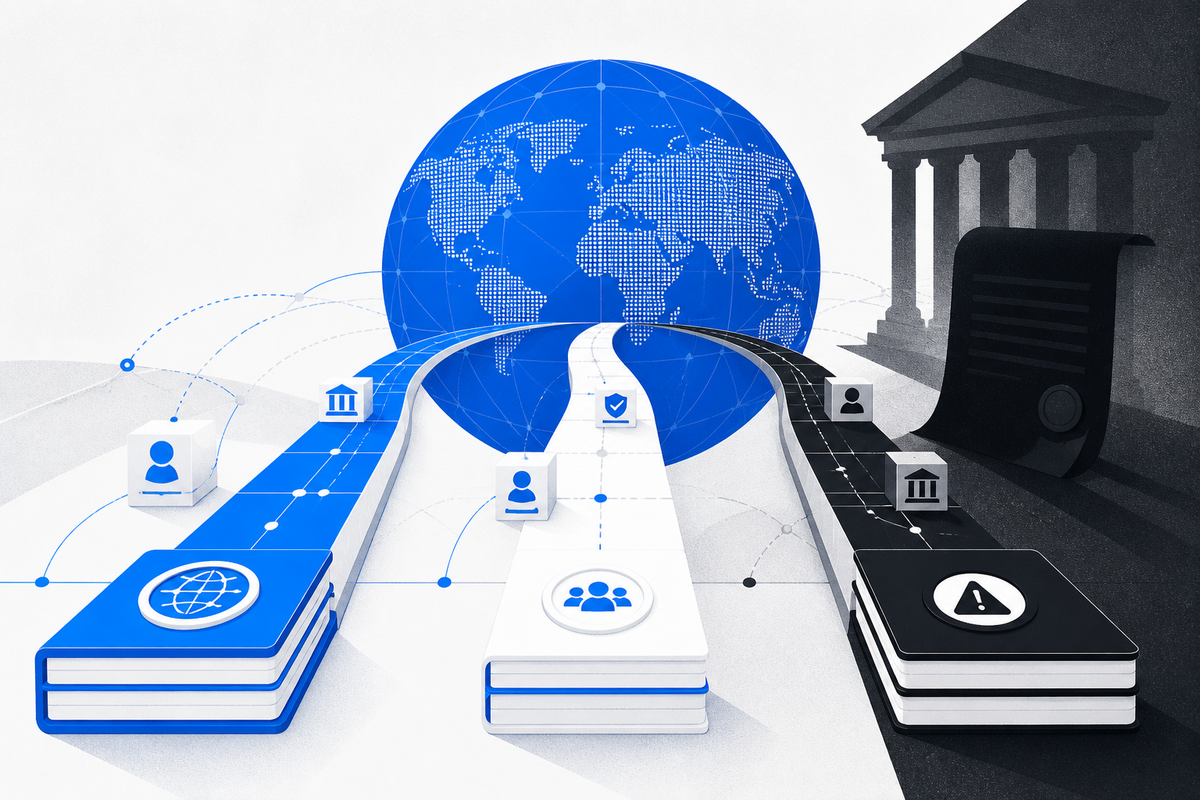
The easiest way to misunderstand global payroll software is to treat it like software. The buyer sees a dashboard, a monthly price and a map washed in optimistic colors. The worker sees something more basic: a contract that is enforceable, a salary that arrives on time and a human being who answers when a tax authority, bank or benefits provider disagrees. Between those views sits an employer-of-record company, sometimes the worker's legal employer, often the payroll operator, always a custodian of unusually sensitive data.
Deel, Remote and Papaya Global all want that position. Each offers a version of the same compression trick: turn dozens of labor codes, currencies, banks and filing calendars into one commercial relationship. Their public product pages now sprawl beyond EOR into payroll, contractors, HR records, benefits and payments. If you compare only check marks, the three begin to blur.
The sharper comparison starts with how each company believes control should work. Deel sells breadth and a large integrated suite. Remote stresses that it owns and operates the entities used for its EOR service. Papaya Global foregrounds payroll and regulated payment rails, including capabilities tied to its Azimo payments arm. Those are marketing claims, but they are useful clues. They tell a buyer where to press.
The promise is similar. The machinery is not.
An EOR becomes the formal employer in a country where its customer has no entity. The customer still chooses the employee, salary and daily work. The provider handles the local employment contract, payroll deductions, statutory filings, benefits and much of the termination process. Global payroll is different: the customer already has local entities and hires the workers directly, while the vendor coordinates calculation and processing. Contractor management adds another layer, with classification risk never quite disappearing because a platform put a friendly form around it.
Papaya Global
$499EOR per employee/month. Emphasis: payroll and payments infrastructure. Tailored quotes may differ.
Deel
$599EOR per employee/month. Emphasis: broad HR, payroll and workforce suite across 130+ EOR countries.
Remote
$699EOR per employee/month. Emphasis: owned local entities and in-house support across 90+ countries.
The prices are real public list prices, but they are not a verdict. Country fees, deposits, implementation, benefits, foreign exchange, payroll delivery and negotiated volume can reorder the table. A lower platform fee may be overwhelmed by cash-funding rules or a poor offboarding process. A higher fee may be rational if the service model reduces handoffs in the countries that matter. The honest comparison is a modeled invoice and operating map for a specific workforce, not a screenshot.
Do not buy a country count. Buy a clear chain of responsibility.
Country counts also need translation. “Available” can mean the provider owns an employment entity. It can mean a partner employs the worker. It can mean payroll calculation is supported for a customer-owned entity, or merely that a payment can reach a local bank account. Those are not interchangeable. Pick five actual countries and ask each vendor to name the employing entity, payroll engine, banking route, benefits administrator and support owner. Suddenly, the large number on the homepage becomes a useful diagram.
The docket belongs in the comparison
Deel carries a piece of context the other two do not. In March 2025, Rippling sued Deel in federal court in California, alleging racketeering and trade-secret theft connected to former Rippling employee Keith O'Brien. Deel has denied that it sought or used Rippling trade secrets. The litigation has changed shape: a court dismissed several claims, while Rippling's federal trade-secret claim survived the motion-to-dismiss stage. Surviving that stage is not a finding that the allegation is true. It means the claim was sufficiently pleaded to continue.
One fact deserves especially careful wording. In a March 2026 joint case-management statement, the Deel defendants acknowledged arranging a $6,000 payment to O'Brien in November 2024. They said it covered living expenses while he considered leaving Rippling and pursuing work with Deel or his consulting business. Rippling alleges the payment was routed through an executive's wife's account and was part of a spying scheme. The payment is not the disputed part. Its purpose is.
That distinction matters beyond courtroom etiquette. Procurement teams routinely receive confident claims from salespeople, rivals and references. Good diligence separates agreed facts, contested explanations and judicial findings. Here, there is an acknowledged payment, sharply conflicting accounts and no final judgment establishing Deel's liability in the trade-secret case.
We found no comparable litigation attached to Remote or Papaya Global in the materials reviewed for this roundup. That is not proof of perfect conduct, and it should not become a lazy halo. Every provider deserves the same questions about employee access, customer-data segregation, audit logging, document preservation and incident response. Deel's live dispute simply makes those questions harder to wave away.
Turn legal context into operating questions
A lawsuit can become empty procurement theater: one side says “risk,” the other says “allegation,” and everyone moves on. The better move is to translate the dispute into controls. Who can search customer data? Are exports logged? How are high-risk employee searches reviewed? What happens when a preservation demand arrives? Does the vendor carry cyber, errors-and-omissions and employment-practices insurance at limits that match your exposure? Can it describe a crisis escalation without asking marketing to join the call?
The chain a buyer should be able to draw
The same discipline helps compare Remote and Papaya Global. Remote's owned-entity claim should be verified for each target country and service. Ownership can reduce partner handoffs, but it does not guarantee quick support or flawless local judgment. Ask for service levels, escalation paths and examples of difficult terminations. Papaya's payments story should prompt questions about licensing, safeguarding, reconciliation and the precise role of Azimo or other local partners. Payment rails are valuable when they shorten the chain; they are less useful if responsibility remains unclear.
Deel's breadth creates another diligence task. A suite can reduce integrations and duplicated records. It can also increase concentration risk. If one provider handles employment, payroll, devices and HR records, a service disruption or contract dispute reaches farther. Ask whether data and funds can be exported product by product, what survives termination and how long a migration takes. Integration is a benefit until exit day, when it becomes architecture.
A practical shortlist beats a universal winner
There is no responsible universal ranking here. A startup making its first two hires abroad has a different problem from an enterprise consolidating payroll across thirty owned entities. The startup may prize quick onboarding, responsive support and predictable deposits. The enterprise may care more about general-ledger mapping, parallel payroll runs, data residency, role-based access and reconciliation across many banks.
- Write three real scenarios. Include one normal hire, one complicated payroll adjustment and one involuntary termination in the countries you need.
- Request the responsibility map. Name every legal entity, partner, processor and licensed money mover involved.
- Model total cash. Add platform fees, deposits, benefits, FX, implementation, payroll delivery and likely severance administration.
- Test the controls. Review permissions, logs, export formats, security reports, insurance and incident escalation.
- Read current documents. Pricing pages change. Contracts govern. Live litigation can change again before your renewal.
References should match those scenarios. The famous logo on a homepage proves very little if that customer uses different countries and products. Ask for a customer that has executed a hard termination, corrected a missed payroll or migrated away from the same stack you plan to replace. A candid account of recovery is more valuable than another frictionless onboarding story.
Then score the human layer. Global payroll fails on Friday afternoons, before holidays and during banking cutoffs. Find out whether support is a pooled inbox or a named team, which time zones it covers and who can authorize an emergency payment. Ask the salesperson to bring an implementation lead and country specialist into the room. If the operating people cannot appear before the contract, they may be harder to find after it.
The best platform is the one whose failure modes you understand before an employee discovers them.
The Deel-Rippling case should neither decide the procurement process by itself nor vanish into a footnote. It is material context for a vendor entrusted with confidential workforce data and critical payments. Remote's entity model and Papaya Global's payment infrastructure deserve equally concrete verification. The useful position is not cynicism. It is documented confidence.
Global employment platforms sell the removal of borders. What they actually do is coordinate the borders on your behalf. That can be enormously useful. It also means the buyer is selecting an operator, counterparty and crisis partner, not merely a dashboard. Watch the demo. Read the agreement. Call the references. And, when the provider is in court over how it treated a competitor's information, read the docket too.
Questions buyers keep asking
Which platform has the lowest advertised EOR fee?
In the public pricing reviewed in August 2026, Papaya Global started at $499 per employee per month, Deel at $599 and Remote at $699. Country costs, negotiated terms and add-ons can change the total.
Does the lawsuit prove Deel stole trade secrets?
No. Rippling alleges trade-secret theft and Deel denies it. The surviving federal claim remains unresolved; allowing a claim to proceed is not a finding of liability.
Did Deel confirm the $6,000 payment?
Yes. Deel's defendants said the payment was job-transition support. Rippling alleges it was tied to espionage. The purpose is contested.
What is the most important EOR diligence question?
Ask who carries legal and operational responsibility at every step in each country, from employment and payroll calculation through funding, payment and termination.
Should litigation automatically disqualify a vendor?
No. Consider the claims, procedural status, governance response, controls, insurance and business-continuity implications alongside product and service evidence.