The most revealing thing about a fundraising agency is the question it asks before the campaign begins. Some ask about the deadline. Others ask how large the mailing list is. O'Brien Garrett asks why a person gives. This sounds almost embarrassingly obvious, like a restaurant wondering whether its customers are hungry. Yet nonprofit appeals are often built from the inside out: the institution decides what it wants to announce, then goes looking for an audience. O'Brien Garrett reverses the current. It listens to donors, studies their behavior, finds the tension between what they believe and what they can do, and only then makes the ask.
That habit has been there from the start. Frank O'Brien founded the Washington firm in 1987 after political organizing and fundraising work, including a stint with pollster John Marttila and an expansion of grassroots fundraising at the Democratic National Committee. The lesson he carried into nonprofit work was not that politics had all the answers. It was that mass communication works best when research and execution sit at the same table.
Yvonne Garrett brought a complementary apprenticeship. She began in fundraising on Bill Clinton's 1992 campaign, later helped Greenpeace expand face-to-face fundraising in the United States, worked on the Human Rights Campaign's early email advocacy, and learned what telemarketing could produce when message, list, and moment aligned. Today, as CEO, she also leads the firm's donor research. Her company biography says she conducts thousands of grassroots donor interviews each year. The agency changed its name from OMP to O'Brien Garrett in 2016, making a decade-long partnership visible on the door.

A donor file is a room full of motives
On paper, O'Brien Garrett is a comprehensive fundraising and communications agency. It designs direct mail, digital fundraising, advocacy, phone outreach, and face-to-face programs. It segments audiences, analyzes results, manages production, and advises nonprofit leaders. Its publicly named clients include Planned Parenthood, the Natural Resources Defense Council, Doctors Without Borders/MSF, the NAACP, Oxfam America, Everytown for Gun Safety, the Union of Concerned Scientists, and the National Audubon Society.
But the useful distinction is not the channel list. Many agencies can send an email or design an envelope. O'Brien Garrett's difference is the loop connecting research to creative work and creative work back to performance data. Interviews supply language and motivation. Analytics identifies which groups behave differently. Creative turns the insight into an appeal. Testing decides whether the insight survives contact with a mailbox.
“Fear can be a powerful motivator, but only up to a point.”O'Brien Garrett, 2020 donor research
The year willingness split from capacity
The firm's clearest public demonstration of its method arrived in 2020, when precedent became nearly useless. In April, O'Brien Garrett surveyed 600 people who had recently given to national organizations. Nearly 70 percent said the economy would not reduce their giving or that they expected to give more. Yet three in ten expected to give less. The firm named the contradiction: people could remain fiercely motivated while losing the financial capacity to act.
The first instinct to fail was the idea of a clean return to normal. So the research kept moving. By September, a third survey had expanded beyond health and finances to examine racial justice, election anxiety, issue priorities, and emotional exhaustion. It included 650 responses. More than 80 percent of donors were still supporting familiar causes or adding new ones, even as nearly four in ten reported stress and anxiety. The facts changed the frame: the job was no longer to manufacture urgency. Donors already had too much of it.
O'Brien Garrett's public infographic captured a moving target: COVID-19, an election, racial justice, and household pressure. The practical advice was to plan several message scenarios early, then tune the relevant one when events became clear.
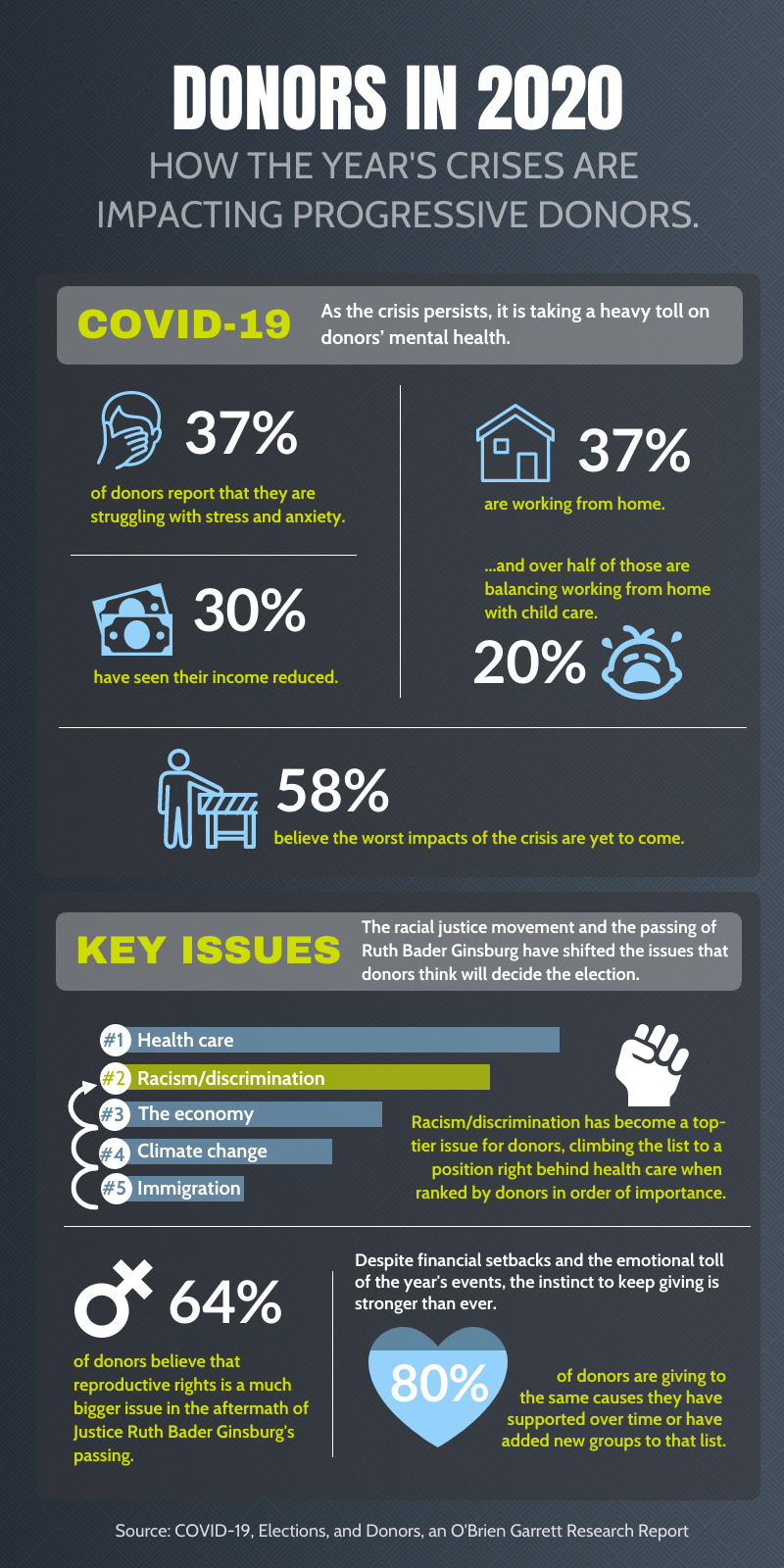
What changed their advice was the accumulation of evidence. Fear might prompt action, the firm wrote, but relentless fear could freeze people. Organizations should prepare multiple post-election scenarios instead of waiting for certainty. They should connect issues rather than assume donors already saw the links. They should communicate confidence without pretending the moment was easy. This is the copyable part of O'Brien Garrett's playbook: replace the annual audience assumption with a live reading of the room.
Then the missing bird landed in the mailbox
Research-first can sound soft until the envelope numbers arrive. In November 2023, an annualized renewal package created for the National Audubon Society went to 402,985 recipients. It generated $1,566,063 in gross income, an average gift of $49.66, and a 7.83 percent response rate. More than 31,000 members renewed. The reported cost was $0.51 per solicitation and $0.13 to raise a dollar. The package combined Audubon's photography, a matching gift, a back-end premium, and a direct case for the donor's role in protecting birds and habitat. It won the 2024 DMFA award for direct-mail renewal.
One envelope, 31,000 renewals
DMFA winnerNational Audubon Society annualized renewal, launched November 2023. Published campaign figures.
A later Audubon appeal made the idea even more literal. The carrier showed a bird photograph with the bird cut out, beside a teaser calling attention to what was missing. The complete picture appeared on a sticker inside. Extinction became an absence the recipient could see before reading a paragraph. The April 2024 package reached 258,615 donors, earned $153,714, and cost $0.51 per solicitation. Compared with the prior year's campaign, its response rate rose 26 percent, its average gift rose 9 percent, and its net per donor rose 194 percent.
There is no mystical creative formula hiding here. The package balanced threat with collective agency, used a match, showed a concrete consequence, and asked the audience to complete the picture. The mechanism was legible. The result was measurable. That is the agency's market position in miniature: not a pure research consultancy, not merely a creative studio, and not just a production vendor, but an operator across all three.
The advantage belongs to organizations with enough signal
O'Brien Garrett is built for established national nonprofits with recurring donor programs, meaningful audience files, multiple channels, and enough campaign volume to test. Its fee-for-service model includes strategy and counsel as well as execution. An aggregation of public Form 990 Schedule G filings identifies 76 engagements with 27 nonprofits between 2019 and 2024. In the 54 engagements reporting both gross funds raised and fees, campaigns produced $1.1 billion against $29.9 million in professional fundraising fees. Those fees can include campaign expenses such as printing, postage, and staffing, so they are not a profit figure.
The same playbook is a poorer fit when there is too little signal to learn from. A small local charity with a short list, no testing budget, and one emergency appeal may not have the volume required for meaningful segmentation. Research can still sharpen language, but the elaborate feedback loop becomes harder to justify. It also weakens when an organization refuses to let evidence challenge its preferred message. Listening is only an advantage if the institution is willing to hear something inconvenient.
For everyone else, the transferable moves are modest. Interview supporters before writing. Use their language, not the organization's internal vocabulary. Separate willingness from capacity. Prepare scenarios when the world is unsettled. Test small choices - signer, ask string, voice, call to action - because tiny words can move large files. And run the name-swap test: if another nonprofit could put its name on the appeal without changing a sentence, the copy has not yet earned the envelope.
Frank O'Brien founds the firm in Washington.
OMP becomes O'Brien Garrett, recognizing Yvonne Garrett's leadership.
Three surveys follow donors through pandemic and election turbulence.
Audubon campaigns earn industry recognition and publish strong response gains.
The agency's enduring idea is smaller than a trend and larger than a tactic. People do not become “donors” when their names enter a database. They remain people - anxious, hopeful, inconsistent, generous, constrained. The fundraiser's first responsibility is to notice. The ask comes afterward.