Brady Josephson's career began with a reluctant walk into a cold Chicago chapel. He was tired, recently back from a trip and did not want to attend the January service. The gathering was a response to the Indian Ocean earthquake and tsunami. Images moved across the screen: people carrying neighbours, clearing debris, assembling clinics, searching for relatives and bringing children back to their families. Josephson cried. In the back of the chapel, he decided that helping would become the organizing idea of his working life.
The decision did not arrive with a tidy job description. It became a change in studies, toward business and nonprofit management, then graduate work in nonprofit administration. It also gave him a durable question: if a person wants to help, what makes the route from intention to action clearer?
Two decades later, that question sits inside a large new remit. Josephson joined World Vision Canada as Chief Marketing Officer in April 2026. Children, job creation, clean water and fundraising had appeared separately across his career. World Vision brought them under one roof. In announcing the move, he caught himself changing a pronoun from "they" to "we," called the opportunity a dream come true, then ended with a compact phrase that fits his public voice: "Back to work!"
Before the dashboard, the diamond
Josephson arrived at nonprofit work with another education already in progress. At North Park University, the Alberta native was a four-year baseball starter and a three-year captain. In his senior season, he earned all-conference and all-region recognition. He was the team MVP, an Academic All-CCIW selection in each of his four years and the university's Sportsperson of the Year. When North Park inducted him into its athletics hall of fame in 2014, he held school records in ten categories.
Baseball offers a useful frame for the marketer he became. It makes failure visible and repetition unavoidable. It teaches a player that averages conceal the distribution beneath them: a handful of pitches, swings or fielding decisions can change a game. Josephson would later make a similar argument about marketing. Performance often follows a power curve, with a small number of creative ideas producing a large portion of the result. The practical task is not polishing every input equally. It is creating the conditions in which an outlier can appear, then recognizing it fast enough to act.
Nine months to make digital work
His first full-time role after graduate school was at Spark Ventures, a startup nonprofit doing development work in Zambia. The organization had little budget and could pay him for nine months. It still needed to raise money. Josephson chose digital because it fit the budget and gave the team room to learn.
That constraint became the first version of his professional operating system: observe a problem, find a testable route through it, learn from what people actually do, and share the result. He moved back to Canada and worked in digital fundraising, then national marketing, for Opportunity International Canada. Microfinance connected fundraising communications to job creation. Technology roles at Chimp and Peer Giving put the mechanics of online giving closer to the center of his work. Teaching as an adjunct professor at North Park forced the practitioner to turn experience into lessons someone else could use.
Eventually he founded The Josephson Group, an umbrella for a digital agency called Shift, a Google Ad Grant service called Nonprofit Supply Co., and the writing that fed both. Re: charity became a home for his public thinking. Entrepreneurship gave him room to experiment, but it also pulled him away from strategy and made writing feel like production. As his family was beginning an adoption journey, the emotional and financial volatility of running multiple small businesses stopped fitting the life he wanted.
NextAfter offered a different combination. Josephson could lead marketing, research and training while helping nonprofits learn at scale. As managing director of the NextAfter Institute, he worked on studies that treated online fundraising as an experience to be inspected rather than a collection of received practices. One project reviewed 204 donation pages. Another examined 2,589 nonprofit emails. The Canadian Online Fundraising Scorecard followed real sign-ups, appeals, donation flows and acknowledgements across 152 charities.
The numbers mattered, but so did the posture. A donation page was not simply a form owned by an organization. It was a moment lived by a supporter. An email program was not a calendar of messages. It was a relationship experienced one subject line, click and thank-you at a time. Josephson's self-description, "charity nerd," was playful shorthand for taking those details seriously.
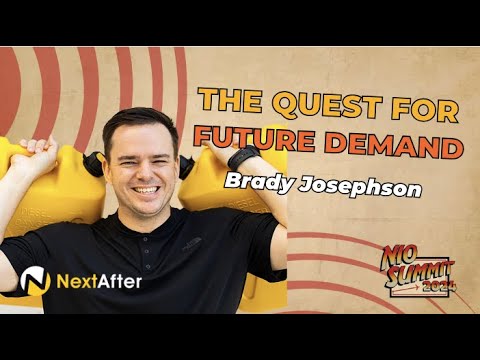
The reach experiment
In 2021, charity: water approached Josephson about helping to lead marketing and growth. He initially thought the outreach was spam. The organization combined threads he had been accumulating for years: international development, a technology-minded culture, disciplined creative work and direct relationships with individual donors. He joined, then spent almost five years across marketing, growth and innovation.
His remit changed over time. He led storytellers, creatives and marketers responsible for growing and celebrating the charity: water community. Later he focused on experimentation, paid acquisition and future-looking projects. He spoke openly about the confidence that fast pre-testing could give a creative team. A quick preference test could shrink six plausible options to three without a day of briefs and meetings. As he put it, the team wanted real-world information so a creative decision would not become an "opinion fight."
One strategic shift moved spending away from optimizing for immediate conversion and toward reach and market penetration. Spending rose 23 percent, while top-of-funnel investment increased 308 percent. Early indicators looked uncomfortable: acquisition cost rose and average gift size fell. The wider result Josephson later shared was more promising.
The apparent paradox was that going broader improved loyalty. Josephson's interpretation was direct: loyalty followed growth rather than causing it. The organization reached more people, brought more of them in, and saw retention rise. The lesson was not that every nonprofit should copy the same budget shift. It was that teams should be willing to hold an uneasy result long enough to understand the system around it.
His charity: water years also stretched marketing beyond the screen. In 2025, the organization opened a 7,000-square-foot Experience Lab in Franklin, Tennessee. The immersive space translated the water crisis into something visitors could encounter rather than merely read about. Josephson described the work with characteristic candour: innovative and risky, built through late nights, mistakes, food, laughter and karaoke. He even noted that some of his own cameo takes were cut from a campaign film.
Coming home, reading the room
Josephson left charity: water in April 2026. His farewell included gratitude, a confession that he had bombed his first big presentation, a running joke about colleagues skipping his Fika gatherings, and a photograph of his oldest son fundraising for clean water on his fifth birthday. It was an exit note built less around personal triumph than around the people who trusted him, the team that tolerated the missteps and the mission they served together.
Three months into World Vision Canada, he published a small field report from the new job. First impressions mattered more than he expected because many colleagues would encounter him only once, or as a face on a screen in a large meeting. Reading mattered, too. Summaries could help, but a new executive without enough context needed time with full documents, away from the distractions of a computer. He began moving material to Goodnotes, sitting in another room and timeboxing an hour for focused reading.
The third lesson was about the shape of executive work. A CMO is expected to have ideas, but the distinctive value of the position is its vantage point. The role can see across teams, functions and divisions. Strategy becomes an act of synthesis and alignment, connecting ideas that already exist instead of sending every idea down from the top. "Synthesize across, not just ideate down," he wrote.
It is a revealing aspiration for someone whose career has rewarded public output: articles, keynotes, podcasts, studies, campaigns and experiments. At World Vision Canada, the next phase may depend on quieter skills. Read enough to understand. Meet people carefully. Find the useful pattern in hundreds of conversations. Help a large organization make one coherent invitation to Canadian supporters.
Josephson still writes with the reflexes of the college infielder and the early fundraiser with nine months of runway. Look for the pitch worth taking. Admit the miss. Study the result. Try again. Generosity, in his hands, remains human and voluntary, but it is not beyond craft. It can be invited with more clarity, supported by a better experience and expanded through brave, evidence-minded work.