A donor database is a peculiar place to go looking for humanity. It is all rows, fields, dates, and totals: the tidy afterlife of gestures that were anything but tidy. Someone ran a race for a friend. Someone staffed a food-bank shift every Tuesday. Someone wrote a check because a letter arrived on the right difficult afternoon. Ann Fellman has spent the latest chapter of a long technology career asking software to remember that untidiness. The record is valuable because a person made it.
Fellman is the chief marketing officer of Bloomerang, the Indianapolis-based maker of fundraising, donor-management, and volunteer software. She works from Minneapolis. Her remit covers product marketing, brand development, corporate marketing, demand generation, thought leadership, and community outreach. It is the familiar acreage of a modern CMO job. Her preferred description of the customer, however, strips the jargon down to three letters: B2H, business to human.
“I’ve always believed that this is not B2B. This is B2H. We are selling to human beings. We are selling to people who have emotions.”Ann Fellman, on Bloomerang's campaign work
That line could sound like a slogan in less experienced hands. Fellman has earned the right to make it practical. Her career has crossed enterprise content management, secure publishing, endpoint data protection, SaaS consulting, and nonprofit technology. Long before she was talking about donor journeys, she was translating products whose vocabulary included portals, endpoint backup, data leakage, and enterprise security. She learned the marketer's old and useful trick: understand the machinery, then explain what changes for the person using it.
The long apprenticeship in translation
Her education did not advertise a software career. Fellman studied international relations at the University of Wisconsin-Madison and spent time at the University of Bonn. The professional route that followed ran through Comdisco, RCT Analytics, Divine, Stellent, and the Minnesota High Tech Association. At Oracle, she worked as a principal product director. At Rimage, she managed a secure content-publishing product. Then came Code42, the Minneapolis data-protection company where her roles rose from enterprise product marketing to vice president and, eventually, senior vice president of marketing.
Director of product marketing at Code42, speaking publicly about the collision of mobility, file sharing, and endpoint security.
Senior vice president of marketing at Code42 and one of The SaaS Report's Top Women Leaders in SaaS.
Two years advising high-growth B2B software companies through Retriever Marketing, including work with JMI Equity portfolio businesses.
Joins Bloomerang as chief marketing officer.
Helps unveil a refreshed Bloomerang brand, discusses predictive fundraising after GiveCon, and begins hosting the Fuel Impact podcast.
The moves look varied on paper, yet the job beneath them barely changed. Complex products have to become useful stories. At Code42, the story concerned the files traveling through laptops and clouds. At Bloomerang, it concerns the relationships hiding across donation forms, volunteer schedules, inboxes, and event lists. Both require a clear view of scattered activity. Only the emotional temperature is different.
In 2018, Fellman was named among the Top Women Leaders in SaaS. She then spent two years as an independent consultant to high-growth B2B software companies. Bloomerang hired her in September 2021, at a moment when nonprofits had rapidly adopted more digital tools and often lacked the staff to make those tools cooperate. Her appointment quote focused on that gap: the sector needed a technology partner for its digital transformation. Five years later, her language has become warmer and more specific. The point is to connect authentically, build sustainability, and make the work less cumbersome.
A relationship, seen whole
Fellman's favorite unit of analysis is not the campaign. It is the supporter. A person might volunteer twice a month, give a small amount after a shift, attend an event, and later become a recurring donor. When those acts live in separate systems, an organization sees four records. When they are connected, it sees one evolving relationship.
She tells a story about a retired schoolteacher who volunteered weekly at a food bank for two decades. The volunteer was not known as wealthy. After her death, she left the organization more than $1 million. The moral is not to treat every volunteer like an undisclosed estate plan. It is to stop treating time and money as unrelated forms of care. A volunteer is already giving. The database ought to notice.
The gap between 65 and 36 is the kind of gap a marketer cannot leave alone. Donors said they wanted regular updates on impact. Far fewer nonprofits said they supplied them. In Fellman's world, this is both a communications failure and an operational clue. Fundraisers often worry that they contact supporters too much. Recent Bloomerang research suggests many donors are open to hearing more, provided the message is relevant and specific. Silence can feel safer to the sender while leaving the recipient unrecognized.
The attention gap
A 29-point distance between what supporters requested and what organizations reported delivering. Figures are from Bloomerang's Mission: Retainable research as discussed by Fellman in 2025.
Her remedy begins with the basics: thank quickly, segment thoughtfully, make the donation experience easy, and say what a gift accomplished. She urges nonprofits to pay attention to the “meaty middle,” the supporters between a first gift and a major gift. A person giving $100 once a year might happily give $10 a month. The extra $20 is less interesting than the habit. Recurring giving turns a moment into a rhythm and gives an organization revenue it can plan around.
“The biggest myth we need to bust is the idea that generosity is declining. It’s not. It’s changing - but it’s not disappearing.”Ann Fellman, The Charity Charge Show
This is Fellman's most persistent public argument. Gloomy accounts of donor fatigue flatten a shifting landscape into a funeral notice. She points instead to individual giving, the long transfer of wealth between generations, the growth of digital payment habits, and the underdeveloped promise of monthly gifts. Optimism here is closer to diagnosis than temperament. If generosity has moved, a fundraiser's job is to find the new address.
The machine gets an assistant's chair
Artificial intelligence has supplied Fellman with another translation problem. Small nonprofit teams are short of time and rich in responsibilities. A fundraiser may write appeals, clean data, prepare board reports, plan events, and answer donor questions in the same day. Fellman encourages them to choose a few contained uses for generative AI: draft an appeal, personalize a campaign, build an email sequence, or identify a promising donor. A four-hour task becoming a one-hour task is not theoretical transformation. It is an afternoon returned.
She adds a condition every time: have a human check the work. The technology can surface patterns, relieve administrative weight, and help an organization retain knowledge when staff change. A person must review, verify, and decide. For a sector built on trust, an efficient mistake is still a mistake, merely delivered sooner.
The same principle appears in Bloomerang's approach to predictive donor intelligence and conversational reporting. A staff member should be able to ask a useful question without becoming a report builder. A model can flag a supporter who may be ready for a conversation. The fundraiser brings context, tact, and responsibility. The machine earns its place by making judgment better informed, never by pretending judgment has become obsolete.
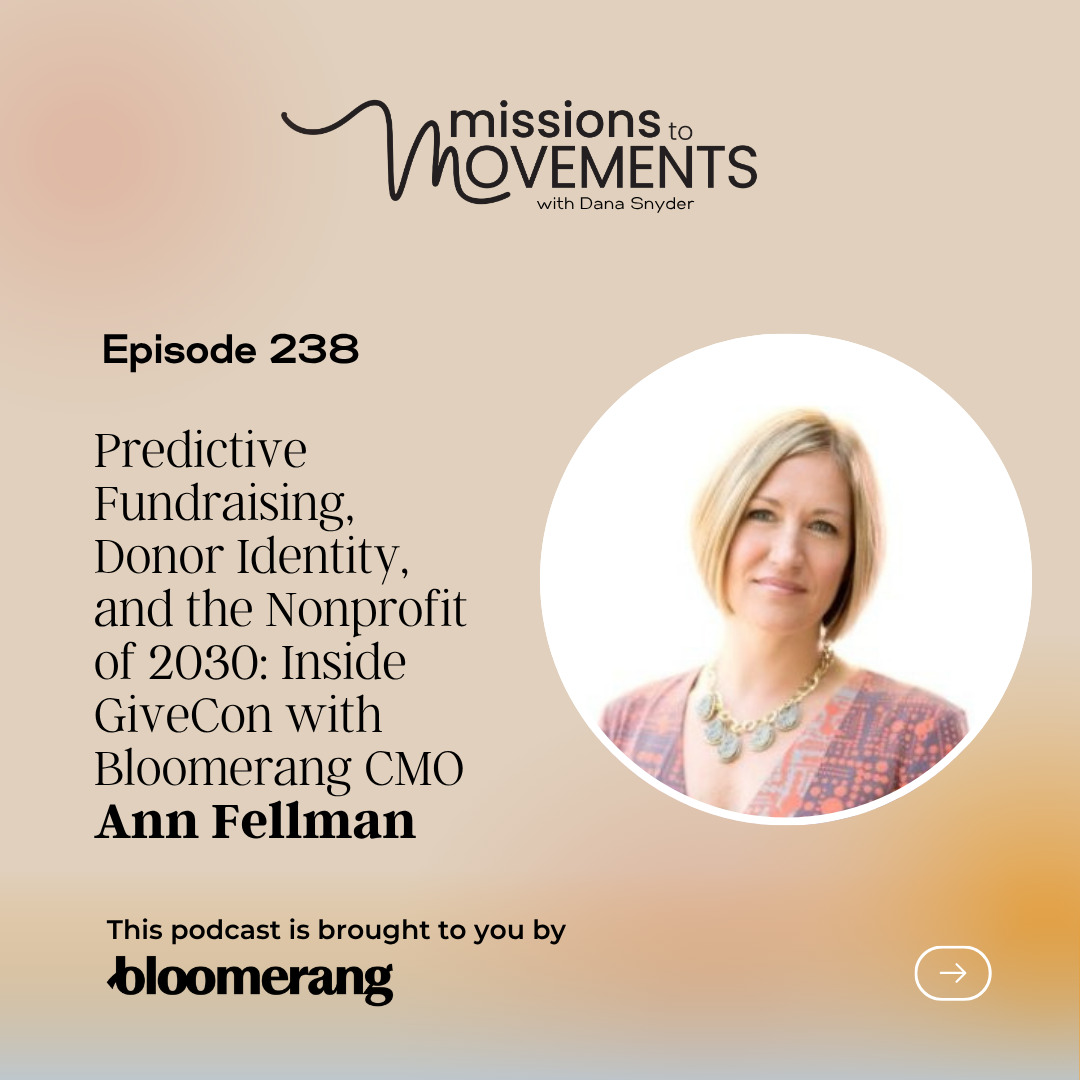
That GiveCon conversation arrived with the pleasant impatience of somebody still carrying the conference in her head. Fellman had just returned home, put down her suitcase, and recorded before unpacking. She talked about rooms full of fundraisers finding “their people,” an organization filling more than 450 volunteer shifts every week, and the practical use of a human-reviewed prediction. The anecdotes connect scale to individuals. Four hundred and fifty shifts is an operational feat. It is also 450-plus decisions to show up.
A brand that refuses the hair shirt
In 2026, Fellman helped present a brighter Bloomerang identity. The refresh grew from a complaint about how nonprofit work is pictured. “Scrappy” and “resourceful” are compliments with small rooms hidden inside them. Fellman's essay described nonprofit leaders as ambitious and visionary, people whose work deserved a visual language with more energy and fewer apologies.
The company tested the new expression through customer interviews and a focus group, considered accessibility across typography and color, and brought its products under one giving-platform story. This was marketing as an act of editorial emphasis. Scarcity is real in the sector, but it does not deserve sole custody of the picture. An organization can face limited staff and still possess an extravagant sense of purpose.
Fellman's own management comments follow the same logic. She says leadership means enabling a team to do its best work and then getting out of the way. She looks for people who are humble, hungry, smart, and curious. In interviews, she asks candidates to name something they became the best at. The subject matters less than the pursuit. The answer reveals whether a person knows how to learn past the point of competence.
There is a pleasing symmetry in that question. Fellman has spent a career becoming fluent in new technical categories, then removing the category language until the benefit can breathe. In nonprofit software, the final reduction is almost comic in its simplicity: remember the human being on the other side of the message. The hard part is building systems, teams, and habits that behave as if this were true.
The next conversation
Her latest role puts her on the other side of the microphone. In 2026, Bloomerang launched Fuel Impact, with Fellman as host. The opening conversation examined sustainable fundraising, succession planning, donor stewardship, and the discipline of asking rather than deciding on a donor's behalf what they can give. Hosting suits a thesis built around attention. The person with the microphone gets to set the question, then has to listen.
Fellman's public work now spans brand essays, conference sessions, product announcements, LinkedIn dispatches, and podcasts. The formats change, but her subjects keep meeting at the same table: generosity, data, trust, curiosity, and time. She is selling software, plainly. She is also arguing about what software is for.
The answer is modest enough to miss amid the grand claims made for technology. A useful system helps a fundraiser see that the gala guest also volunteers. It remembers a preference. It suggests a timely call. It drafts the first version and leaves the final voice to its owner. It clears an hour in which a person can thank another person properly. The database remains rows and fields. With enough care, it can point back to the gloriously untidy life that put them there.