Jay Love has spent money to discover whether anyone would notice. Five dollars here. Ten dollars there. Gifts to hundreds of charities, spread across local, regional, and national organizations. He was testing a small but consequential question: once a charity had his money, how would it treat him?
In 2013, he described the frustration of this exercise, and the relief supplied by the roughly one in five organizations whose prompt response made him feel valued. That was his experience, rather than a census of American philanthropy. Still, it was quite a review. A person who had spent decades selling software to nonprofits was now grading their manners.
There is something pleasingly inconvenient about Love's experiment. A small donation gives an organization little reason to roll out the ceremonial carpet. It reveals the ordinary machinery: the acknowledgment, the delay, the message written for everybody and felt by nobody. Love wanted to know what that machinery felt like from the receiving end.
His career has involved companies, acquisitions, boards, and databases. The recurring subject is simpler to picture: someone gives, waits, and decides whether to give again. Love kept returning to that interval. Eventually, he helped build a company around it.
The receipt is the beginning
By December 2014, Love had turned his mystery shopping into instructions other fundraisers could use. Donate $5 to $15 to about 20 charities. Include your own organization, quietly. Then spend 120 days recording what comes back, how quickly it arrives, and what it says. The experiment could cost $100 to $300. An uncomfortable meeting afterward would be included free.
The silence mattered, but so did the quality of the response. A technically correct acknowledgment could still leave a donor feeling anonymous. Love asked fundraisers to examine letters, emails, calls, and other follow-up together. A charity's internal division of labor offered little consolation to the person opening the mail.
He also encouraged participants to borrow effective ideas. This was an exercise in observation, with room for the possibility that somebody else had worked out a better welcome. Its sting came from including one's own charity without warning the staff. Special treatment would spoil the test.
For Love, the second gift was a crucial milestone. The first donation showed that someone had responded. Another donation suggested the relationship had survived its introduction. That distinction helps explain why a founder who knew his way around a database cared so much about what happened outside it.
“The key to donor retention is obtaining the second gift from any brand new donor.”
Jay Love, 2014
A database career before the cloud
Love graduated from Butler University in 1976 with a business administration degree. His route into nonprofit technology took him through Master Software Corporation, where he spent 14 years as president and CEO. Its Fund-Master products helped charities manage the information behind their fundraising.
He later co-founded eTapestry and led it for 11 years. Love and his colleagues grew the business to more than 10,000 nonprofit clients. That scale gave him extensive exposure to the practical work of fundraising: records to maintain, gifts to process, and organizations trying to make their technology useful.
In August 2007, Blackbaud acquired eTapestry for $24.8 million. The announcement described an 85-person business that would remain in Indianapolis, with Love continuing to lead it. Co-founders John Moore and Steve Rusche were also to continue in their roles. This was a team with a future inside the buyer, as well as a past together.
Love already knew Blackbaud through an earlier transaction: Master Software had been acquired by it in 1997. His career crossed the boundary between independent software businesses and the larger company buying them more than once. He also served as senior vice president of Blackbaud's arts and cultural division.
Another company, the same difficult interval
In 2010, Love moved into the CEO role at Baltimore-based Social Solutions, which made outcome and case management software for social service agencies. Frontier Capital had recruited him. By then, eTapestry's Indianapolis operation had grown to about 125 employees, by the time of his move.
He subsequently joined Avectra as a senior vice president. The company was developing technology that brought social interactions into constituent relationship management. Love's work kept him close to an evolving problem: how organizations could understand people through the information those people left behind.
Bloomerang followed in October 2012. Love was a co-founder and its first chief executive. The new business made donor retention a central concern. After years helping nonprofits keep records, he was concentrating on helping them keep relationships.
That concern also produced a book, Stay Together: How to Encourage a Lifetime of Donor Loyalty. The title is unusually direct for software-adjacent advice. It sounds like something said at a kitchen table. A fundraiser can count donations, build a campaign, and process a payment; staying together asks what happens across the years between those transactions.
Friends are harder to replace than records
Love's teaching gave the database a social life. In a webinar with Fundly's Dave Boyce, he discussed people who first give because a friend is participating in a fundraising event. Their immediate connection may be to that friend. The charity needs to understand how the introduction happened.
He used a hypothetical example of getting 19 people to sponsor him in a 5K. He could then contact those supporters, thank them, explain why the mission mattered to him, and invite further involvement. The familiar person had a continuing role after the race. Finishing the event did not finish the introduction.
His advice makes the fundraiser's job more personal and more specific. Know who connects a supporter to the cause. Show what the contribution accomplishes. Give the relationship something to continue discussing. A name in a system becomes useful when it helps somebody remember a person.
Love worked alongside fundraising thinkers including Adrian Sargeant and Tom Ahern. In 2013, his presentation materials identified Sargeant as Bloomerang's chief scientist and Ahern as its donor communications head coach. Research and writing belonged beside the technology. The software would have to accommodate what they knew about giving.
A simplified illustration of his fundraising advice. The next gift has a history.
The trouble with another checkbox
Love could be critical of the very industry in which he had built his career. Writing in 2013, he remembered demonstrating Fund-Master in the early 1980s, when it needed little training. Over time, requests multiplied, feature comparisons lengthened, and a once approachable product grew more difficult to learn.
He included his own team in that account. They had tried to please buyers who wanted more boxes checked on a spreadsheet. The resulting complexity could become especially painful when an experienced user left and a successor had to learn the system. A purchasing decision made years earlier could occupy somebody's working week.
This criticism sits comfortably beside the mystery shopping experiment. In both cases, Love asked what a process did to the person using it. A system could satisfy the organization's formal requirements while making the actual experience worse. A long feature list and a correct receipt each offered opportunities for misplaced confidence.
His practical preference was for software that made frequently used functions easier. Fundraisers had strategic work to do. Time spent mastering elaborate procedures came out of the same day as the call, the visit, or the thank-you. The database needed to earn its place in that day.
Leaving the chair without leaving the conversation
Love stepped down as Bloomerang CEO on July 1, 2017. Ross Hendrickson, a co-founder who had served as chief operating officer and chief financial officer, took over. Love remained board chairman and moved into a part-time chief relationship officer role.
The succession had been planned since the company's founding. Love explained that he had seen what could happen at businesses and nonprofits that lacked a plan. The choice of a co-founder meant the incoming chief already understood daily operations. Continuity was a decision made ahead of the announcement.
Love said the change would give him more time with family and charitable interests, and more individual time with customers and partners. The new title was a tidy fit for his longstanding preoccupation. Someone still had to attend to the relationships, even as someone else attended to the executive calendar.
His later work included angel investing. Givebutter named him among the participants in its 2022 seed round, alongside founders and operators from other software businesses. He was putting capital into another company's tools for generosity. His involvement in the sector could continue through people building their own businesses.
Four million dollars for future conversations
In August 2022, Butler announced a $4 million gift from Jay and Christie Love to fund a University House and presidential residence. Their gift covered construction, furnishings, and maintenance. The building would also provide a venue for fundraising and community events.
Both were Butler graduates: Jay from the class of 1976, Christie from 1979. Christie had worked in teaching and nonprofit management, including as executive director of the Lawrence Township School Foundation. Together, they had also co-chaired the Indianapolis Fort Harrison YMCA's 2011 capital campaign.
The house gave their philanthropy a physical setting. A president would live there, and visitors would gather there. For a couple with years of fundraising experience, a place that could welcome people had an obvious purpose beyond its walls. Conversations need somewhere to happen.
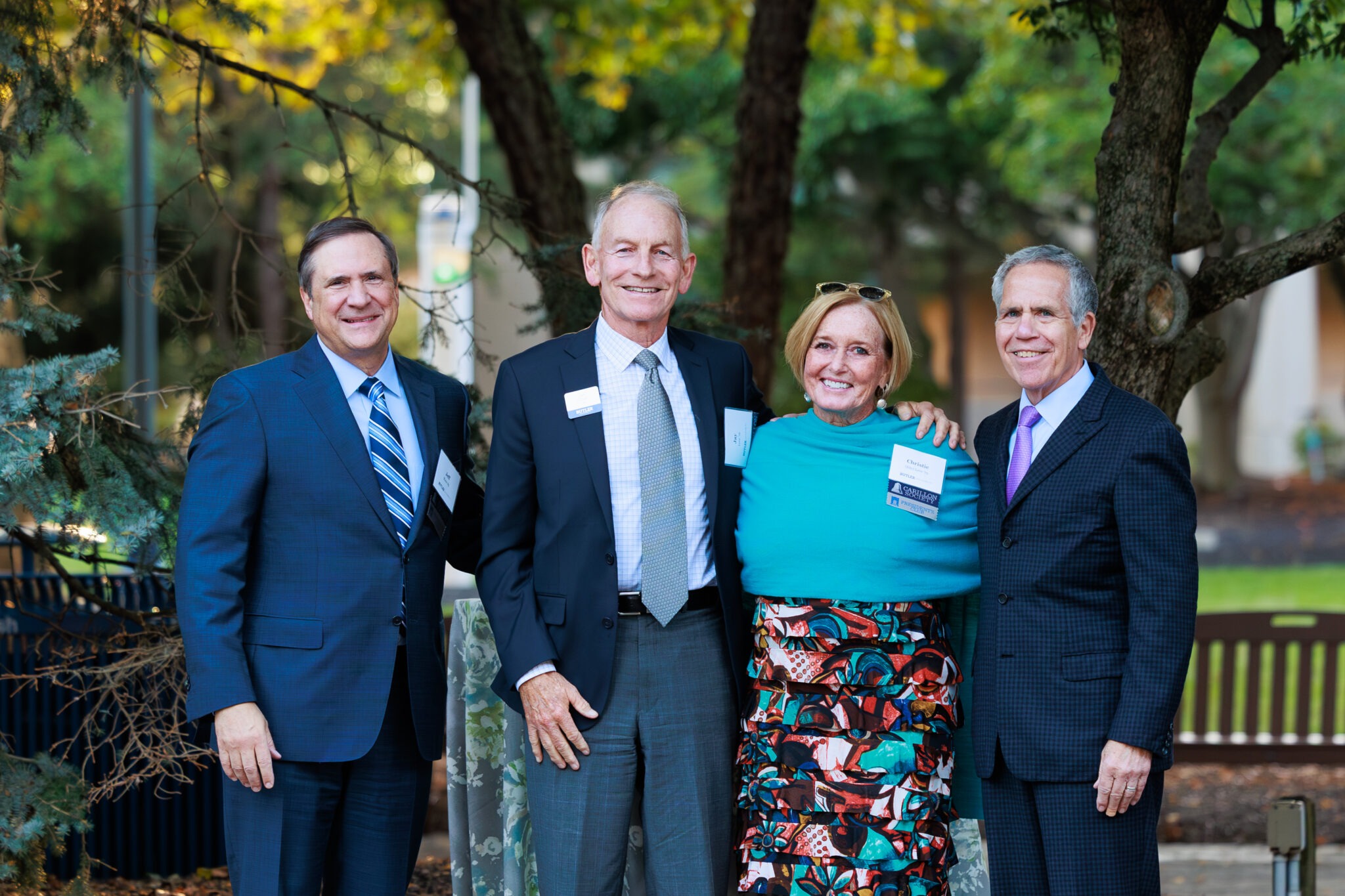
On October 9, 2025, Butler honored the Loves as new Cornerstone Plaza honorees, a recognition for donors whose lifetime giving had reached at least $1 million. At that event, the university described their house as expected to open in 2026. Their contribution was being recognized while the place it would create was still taking shape.
Love's career has moved from database products to web software, from executive leadership to investment and philanthropy. Through those changes, he has kept asking a question that a five-dollar donor can answer as readily as a university trustee: what happens after I give? The answer arrives in the next letter, the next conversation, the next invitation. He has spent years encouraging organizations to make that answer worth waiting for.