Kevin Allan left home and came back carrying better questions. In his case, home was not a city but a consultancy. He joined Changing Our World in 2005, spent seven years advising mission-driven organizations, then crossed to the other side of the table. For the next decade, he lived with the consequences of the sort of counsel he once gave. He ran fundraising at Americares and Children's Aid. He led advancement at the Culinary Institute of America. In 2022 he returned to Changing Our World, and in 2023 became its chief executive.
This is a neat circle on a résumé and a useful complication in practice. Consultants are paid to see the system. Operators are paid to make it work on Monday morning, when the database is untidy, a board member is unconvinced and a campaign goal remains stubbornly attached to arithmetic. Allan has occupied both positions. His career is best understood not as a ladder but as a commute across the desk.
The subject is fundraising, a word that encourages people to stare at the total. Allan's work keeps returning to everything around it: the story that makes a gift intelligible, the data that shows where to look, the board willing to open a door and the organization capable of keeping a promise after the check clears. A campaign can finish with a handsome number and a tired institution. He is interested in the version that finishes with both the number and stronger muscles.
The education before the degree
Allan is a San Francisco native, but the early map of his career refuses to stay put. At Manhattanville College, where he earned his bachelor's degree, he led service-learning experiences through the school's center for religion and social justice. He later worked with Project Concern International in India. He has described that experience as the spark for a lasting interest in helping organizations do more for vulnerable people.
The route then ran through the charitable work of a family office and the development directorship at Stonewall Community Foundation. These were different rooms with different customs: students meeting service in practice, private wealth considering public purpose, and a community foundation turning identity and solidarity into durable support. They supplied the sort of education that does not fit tidily under a single course code.
There was a course code, too. Allan earned an M.S. in Nonprofit Management from The New School. Later, he returned to teach fundraising and development in the same program. Learning the subject, practicing it and then explaining it to a room of graduate students became an early version of the loop his career would repeat.
“View fundraising as a culture, not a department.”Kevin Allan
Crossing the desk
At Changing Our World, Allan began in Los Angeles, working largely with health and human-services organizations and public-private partnerships. He helped establish the firm's West Coast presence, then moved to New York to lead work with international organizations and agencies. His client list eventually included UNICEF and several of its national committees, The Global Fund, California State Parks, the U.S. Green Building Council, Texas Children's Hospital, National 4-H Council and the Michael J. Fox Foundation.
Then came the crossing. In 2012, Americares hired him as senior vice president of development. The assignment covered corporate, institutional and individual giving, as well as special events. During his tenure, private operating and program revenue grew by more than 45 percent. The organization also raised $25 million for regional and localized disaster responses. His wider private-support portfolio included more than $575 million a year in donated products.
The numbers are large enough to become abstract. The job was not. Product donations require partnerships, logistics, stewardship and judgment about what is useful where. Cash for an urgent response asks donors to move quickly without turning trust into panic. The development office has to translate between institutional need and human attention, then make the translation hold under pressure.
In 2016, Allan became chief development officer at Children's Aid, responsible for private and public fundraising across an organization operating at 50 New York City sites. The same year, he moved to the Culinary Institute of America as vice president for advancement. There he oversaw alumni relations and fundraising, and helped steward the college's relationships across the food-service industry. One day the portfolio speaks in emergency response; another day it speaks in scholarships, alumni loyalty and chefs. The grammar of trust remains surprisingly consistent.
Coming home with receipts
When Allan announced his return to Changing Our World in 2022, he called it going back to where it all began. He arrived as executive vice president with responsibility for client success. There was affection in his announcement, along with a promise of fun. There was also a decade of operating experience between the person who left and the person who returned.
That distinction matters. Advice sounds different when the adviser remembers owning the forecast. Board engagement is not a box on a work plan when one has sat through the meeting. Data is not a decorative dashboard when it determines which donor receives a call. Communications cannot be a neighboring department when a muddled story makes an honest ask harder to understand.
The productive round trip
The work now crosses the desk in both directions: strategy informed by consequence, operations widened by perspective.
Brian Crimmins, the longtime CEO Allan succeeded, publicly singled out his intelligence, humor and commitment to colleagues and clients. Those are warm words from a predecessor. They also describe the balance the role demands. A social-impact consultancy sells expertise, but expertise arrives through people. The chief executive must mind the craft and the conditions in which other people practice it.
The campaign before the campaign
Allan's recent advice on capital campaigns is striking for how much of it happens before the public excitement. Major donors may need to be brought into the conversation 18 to 24 months before launch. The goal must be tested against evidence rather than appetite. Readiness belongs to the whole organization, not merely the development team.
In a talk to nonprofit leaders, he offered ten practical prompts. Understand lifetime donor value. Put out the welcome mat. Remove fundraising silos. Close the gap between fundraising and communications. Listen to donors. Ask better questions. Build staff skills and use data more intelligently. Strengthen the relationship between the chief executive and the development leader. Remember that technical expertise is not the same thing as solitary ownership. Finally, treat fundraising as culture.
“Put the welcome mat out” may be the finest phrase in the list. Fundraising language often arrives wearing a dark suit and holding a spreadsheet. The welcome mat puts the emphasis elsewhere: an institution should be legible, hospitable and ready for participation. It is difficult to cultivate belonging with the manner of a tollbooth.
The counsel also reveals Allan's operator's suspicion of tidy boundaries. A donor does not experience an organizational chart. The donor encounters a story, a person, an invitation, a thank-you and, eventually, evidence of what happened. If those pieces disagree, the silo has become visible. If they align, the machinery disappears and the mission gets the room.
A cardboard chair and a long memory
Allan once staffed architect Frank Gehry on a fundraising project early in his career. He remembers Gehry as gracious, good, forthright and tough. The architect bought breakfast. When Allan visited his office, Gehry let him sit in one of two cardboard chairs with matching ottomans, furniture both playful and structurally serious, rather like the buildings.
Years later, Allan was at Walt Disney Concert Hall on an early date. Gehry spotted him and pulled him aside to say hello. The date was impressed. Allan and that date are now married.
It is a charming story because nothing in it is optimized. There is no campaign result, no conversion rate, no lesson announced with a chime. There is simply breakfast, a peculiar chair and the pleasure of being remembered. Yet it contains a quiet theory of relationship-building. People remember precision. They also remember generosity. Professional regard can survive the project and turn up years later in the lobby.
A wider boardroom
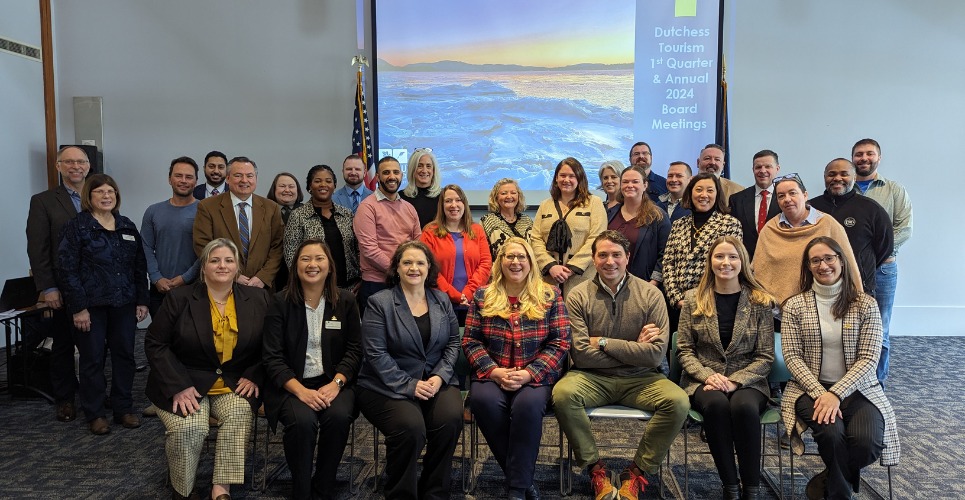
Outside the consultancy, Allan served as an officer and then chair of Dutchess Tourism, the destination organization for New York's Dutchess County. The post connected his institutional interests with two personal ones. He is an avid, if self-described amateur, cook and gardener. A county of restaurants, farms, cultural institutions and river towns is not a bad boardroom for someone inclined toward both.
Tourism may seem removed from philanthropy, but the connective tissue is familiar: many stakeholders, a shared story and benefits that must reach beyond the people seated at the table. Allan spoke of board expertise shaping the county's narrative as a destination. In early 2026, he completed his board service after years as an officer. The work widened his portfolio without breaking its theme.
Today, as chief executive of Changing Our World, Allan leads a firm working across fundraising, corporate social engagement, research and analytics, and communications. Those disciplines can be sold separately. His career argues for seeing them together. Research without narrative stays in a file. Narrative without evidence drifts. A campaign without board ownership becomes the development department's private weather system.
The gift is the visible event. The durable achievement is an organization better able to invite, listen and deliver.
The loop back to Changing Our World is therefore less a return than a useful accumulation. The consultant learned to operate. The operator returned ready to advise. The teacher kept asking what could be made clear. And the amateur cook, one imagines, already understood that timing matters, preparation hides beneath ease and nobody is persuaded by a beautiful menu if dinner never arrives.
Fundraising has plenty of ceremony: the launch, the naming, the oversized total on the screen. Allan's career draws attention to the quieter architecture underneath. The conversations held early. The silos removed before they harden. The donor welcomed before being solicited. The team that ends a campaign more capable than when it began. Money is the countable outcome. Trust is the structure that lets an institution count again.